Automating Knowledge Graph Population: Extracting Entities and Triples from Unstructured Text with an LLM

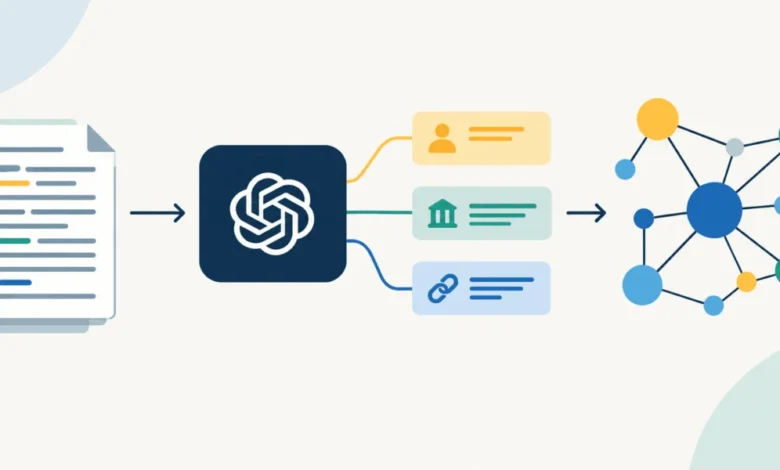
The modern challenge of information retrieval in Large Language Model (LLM) architectures is increasingly defined by the struggle between massive, unstructured datasets and the requirement for deterministic, factual accuracy. As organizations move beyond standard vector search—which often falls victim to hallucinations and retrieval noise—the industry is pivoting toward Graph-Retrieval-Augmented Generation (Graph-RAG) systems. A fundamental hurdle in this transition is the labor-intensive nature of building knowledge graphs. This article outlines a scalable, automated pipeline that utilizes local LLMs, specifically Llama 3.2 via Ollama, to transform raw, unstructured text into structured SPOC (Subject-Predicate-Object-Context) quads, effectively bridging the gap between raw data and high-integrity graph databases.
The Evolution of Knowledge Representation
Historically, knowledge representation relied on manual curation or complex Natural Language Processing (NLP) pipelines, such as dependency parsing and Named Entity Recognition (NER). While effective, these methods were rigid and struggled with the nuance of human language. The shift toward using LLMs for information extraction represents a paradigm shift. By leveraging the semantic reasoning capabilities of models like Llama 3.2, developers can now parse narrative text and map it directly into graph structures without needing a dictionary of predefined schemas.
The SPOC quad model—which adds a "Context" dimension to the traditional RDF (Resource Description Framework) triple—is a significant advancement. By appending context, such as the source document title or a timestamp, systems can perform conflict resolution. If an LLM encounters two contradictory facts, the system can prioritize the source with higher authority or more recent provenance, a feature essential for building robust enterprise-grade RAG applications.
Establishing the Local Infrastructure
The implementation of this workflow requires a robust environment capable of handling local model inference. The reliance on Ollama is strategic; by running models locally, developers ensure data privacy, eliminate API latency costs, and maintain a consistent environment for deterministic output.
To initiate this process, the system requires a standard Python environment. The configuration begins with the deployment of the Ollama server, which acts as the intermediary between the raw text source and the Knowledge Graph database. In a production-like setting—or when using cloud-based development environments such as Google Colab—the initial step involves establishing the server as a background process using subprocess management. This ensures that the model can be queried via standard HTTP requests, effectively turning a local machine into an automated data-extraction hub.
The Mechanism of Fact Extraction
The core of this automated pipeline lies in the prompt engineering and JSON-enforced output strategy. To ensure the reliability of the extracted data, the system forces the model into a rigid JSON schema. This is a departure from conversational LLM usage; the goal here is not creative generation but precise data serialization.
The extraction engine operates by iterating through text segments—such as Wikipedia summaries—and applying a structured prompt that mandates the extraction of atomic facts. By setting the LLM temperature to 0.0, developers minimize stochastic output, ensuring that the model remains focused on the explicit relationships presented in the text. This "cold" inference is critical for knowledge graph integrity.
For instance, processing a biographical summary of a historical figure such as Alan Turing involves the LLM identifying the subject, the action or state (predicate), and the target entity (object). The system then appends a context label to each record, linking the fact back to its specific source. This creates a traceable data lineage that is missing in traditional vector-based RAG systems.
Technical Implementation and Data Flow
The technical workflow involves a Python-based module, typically defined as QuadStore, which mimics the behavior of a lightweight graph database. This implementation serves as the foundational storage for the extracted quads.
- Text Acquisition: Utilizing libraries like
wikipedia, raw data is fetched and cleaned. To maintain speed and accuracy, the system often processes text in granular blocks rather than entire documents at once. - Extraction Engine: The
extract_spoc_quads_finalfunction constructs the prompt, manages the HTTP request to the local LLM, and parses the returned JSON. It includes validation logic to catch variations in key naming (e.g., "Subject" vs "subject") and ensures that only valid, complete quads are added to the store. - Storage and Indexing: Once extracted, the quads are injected into the
QuadStoreobject. This process allows for programmatic querying, enabling users to perform lookups like "List all entities related to Turing" or "Find the context for the fact regarding Bletchley Park."
The Strategic Value of Deterministic Retrieval
The implications of this technology are profound for sectors requiring high-assurance data, such as legal, medical, and financial services. In these domains, a hallucination is not merely an annoyance—it is a liability.
By pre-populating a graph with verified, context-aware facts, organizations can create a "ground-truth layer." When an end-user queries the system, the RAG architecture first consults the knowledge graph. If a definitive answer exists within the SPOC quads, the system retrieves it with 100% confidence. If the query falls outside the graph’s coverage, the system can then transition to secondary retrieval methods, such as vector search, while clearly flagging the information as non-deterministic.
Addressing Scalability and Model Constraints
While the demonstration utilizes Llama 3.2, the architectural design is model-agnostic. The primary constraint in scaling this approach is not the model’s intelligence but its throughput. Extracting facts from millions of documents requires parallel processing. This can be achieved by deploying multiple Ollama instances across a cluster or utilizing high-memory GPU resources to process multiple text chunks concurrently.
Furthermore, as the knowledge graph grows, the QuadStore must evolve from a simple list-based implementation to a specialized database management system (DBMS). Technologies like Neo4j or ArangoDB, which natively support graph structures, are the logical next steps for enterprise scaling. However, the logic remains the same: translate raw language into structured relationships that computers can navigate with precision.
Future Perspectives in Graph-RAG
The convergence of LLMs and graph databases marks a maturation of the AI industry. We are moving away from "black box" models that rely on statistical probability toward hybrid systems that combine the linguistic flexibility of neural networks with the rigorous logic of graph theory.
The ability to extract entities and triples from raw text in an automated fashion is the "missing link" that has prevented widespread adoption of Graph-RAG. By closing this loop, developers can now build systems that not only speak like humans but possess a verifiable, structured understanding of the world. As these tools become more accessible, the barrier to entry for building intelligent, reliable, and fact-based AI applications will continue to drop, fostering a new generation of software that values truth as much as fluency.
Summary of Findings
The integration of local LLMs into the data pipeline offers three primary advantages:
- Data Sovereignty: By keeping the extraction process local, sensitive information never leaves the local infrastructure.
- Cost Efficiency: Eliminating per-token API fees for data extraction significantly reduces the operational cost of building and maintaining a large-scale knowledge base.
- Auditability: Every fact in the knowledge graph is explicitly tied to a context, providing a clear audit trail for every piece of information retrieved by the AI.
As practitioners continue to refine these workflows, the emphasis will likely shift toward improving the "Context" dimension of the SPOC quad. Integrating temporal metadata, source reliability scores, and confidence intervals into the quad structure will further enhance the deterministic nature of these systems, ensuring that AI-driven information retrieval remains both powerful and perpetually accurate.