MIT Engineers Unveil FLEX: A New AI-Driven Framework Empowering Robots to Interpret Unspoken Human Intent Through Conversational Language

The landscape of human-robot interaction is undergoing a fundamental transformation, shifting away from rigid programmatic inputs toward fluid, intuitive communication. Researchers at the Massachusetts Institute of Technology (MIT) and New York University (NYU) have developed a novel artificial intelligence-assisted learning platform known as FLEX, designed to bridge the gap between literal robotic execution and human intuition. Set to be presented this month at the annual Conference on Robot Learning, FLEX—which stands for a flexible feature-editing pipeline for robot motion-planning—allows robotic systems to read between the lines of conversational commands, deriving broader generalizations and unspoken preferences from simple, everyday instructions.
For decades, the integration of robots into domestic and collaborative workspaces has been hindered by a steep communicative barrier. While human beings naturally infer underlying meaning, context, and common sense from casual dialogue, traditional robotic systems rely entirely on explicit, mathematically defined trajectory planning. The development of FLEX addresses this long-standing friction point by harnessing the expansive knowledge base of large language models (LLMs) to grant robots a form of situational common sense, fundamentally altering how machines interpret and adapt to dynamic human environments.
The Mechanics of FLEX: A Three-Step Intelligent Pipeline
Traditional natural language processing in robotics typically operates on a linear, additive model. When a human issues a corrective command—such as instructing a robotic arm carrying a bowling ball not to drop it onto a nearby mug—the robot registers the command, adds the mug to a static exclusion list, and recalculates its physical trajectory to avoid that specific coordinate. While effective for isolated incidents, this conventional methodology creates a cumbersome administrative burden. Environments change continuously, objects are moved, and feature lists quickly become bloated with hyper-specific rules that demand constant manual updating.
To overcome these operational bottlenecks, the MIT and NYU research team engineered FLEX around a streamlined, three-step architecture comprising Add, Generalize, and Mask.
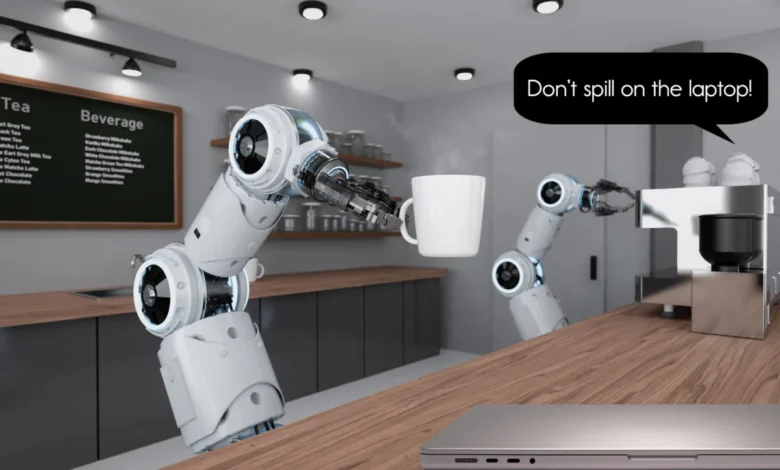
The first phase, "Add," mirrors legacy systems by capturing the immediate natural language command. When a user interjects with a warning like "Don’t spill on my laptop!" while a robotic arm maneuvers a cup of coffee across a cluttered table, the system registers the laptop as an obstacle.
The second phase, "Generalize," introduces the platform’s core innovation. Rather than treating the laptop as a singular, isolated hazard, FLEX incorporates an advanced LLM—specifically OpenAI’s GPT-4o—to analyze the newly introduced object within the context of previous user directives. Trained on vast troves of internet data, including web content, social media posts, and video transcripts, the LLM recognizes patterns linking liquids and electronics. As MIT Computer Science and Artificial Intelligence Laboratory (CSAIL) postdoc and study author Nathan Dennler explains, the model has processed countless anecdotes of ruined hardware resulting from liquid exposure. Consequently, the robot deduces a higher-level preference: it must avoid all electronics, automatically updating its path to steer clear of both the laptop and a nearby smartphone, entirely unprompted by the user.
The third and final phase, "Mask," ensures operational efficiency. Utilizing standard computer vision systems, the robot continuously evaluates its surroundings. If an object that was previously flagged is removed from the environment, the system automatically purges it from the active feature list. Remarkably, this entire computational cycle—from verbal command to environmental reassessment and trajectory adjustment—takes approximately five seconds.
Background Context and the Evolution of Human-Robot Interaction
The introduction of FLEX arrives at a critical juncture in the robotics industry. Spearheaded by Andreea Bobu, assistant professor of aeronautics and astronautics at MIT and head of the Collaborative Learning and Autonomy Research (CLEAR) Lab, current research increasingly prioritizes assistive technologies that can operate safely alongside untrained consumers.
For years, roboticists have experimented with various strategies to incorporate natural language into learning pipelines. Early milestones included utilizing speech recognition to clarify task goals, dynamically redirecting robotic trajectories, and updating spatial safety boundaries in real-time. However, these antecedent methodologies remained bounded by literal interpretations. If a user commanded a robot to avoid a specific ceramic plate, the machine learned exclusively to avoid that plate, remaining oblivious to the fact that other fragile glassware nearby warranted the exact same precautionary measure.
Dr. Bobu’s team recognized that consumer adoption of domestic robots hinges entirely on ease of use. Modern households are structurally unique, highly cluttered, and deeply idiosyncratic; no commercial robot can possibly ship pre-programmed with every localized preference of its owner. Expecting everyday consumers to master the complex mathematics of trajectory planning or meticulously script exhaustive safety parameters is commercially unviable. By shifting the burden of interpretation from the human operator to the machine’s underlying AI architecture, FLEX represents a paradigm shift toward frictionless coexistence.
Empirical Testing and Simulation Outcomes
To validate the efficacy of FLEX, the research team conducted rigorous evaluations across multiple simulated virtual environments. The testing scenarios focused on domestic and light industrial tasks, specifically evaluating a robotic arm tasked with serving a cup of coffee, relocating a delicate candle, and transporting a bowling ball across a dynamic workspace.
During these trials, human volunteers interacted with the robotic agents strictly via natural conversational language, issuing commands such as "Don’t spill on my laptop," "Stay away from the stack of paper," and "Don’t drop it on the mug."
The experimental outcomes demonstrated the platform’s robust generalization capabilities. In the coffee-serving scenario, upon receiving the warning regarding the laptop, the robot successfully reasoned that its operational envelope must encompass all electronic devices. Similarly, when warned away from a stack of paper during the candle-relocation task, the system generalized the hazard to encompass flammable materials broadly. In the bowling ball trial, the instruction regarding a specific mug enabled the robot to infer a blanket policy protecting fragile items.
In every tested instance, the robotic agents executed their primary mechanical objectives while seamlessly adapting to unstated, higher-level human intentions, drastically reducing the volume of explicit instructions required to maintain a safe operational path.
Expert Perspectives and Institutional Support
The implications of this research extend far beyond academic robotics laboratories, touching upon commercial viability, human psychology, and ethical AI deployment. The study—co-authored by MIT researcher Audrey Lee and NYU’s Ilia Sucholutsky—highlights the growing intersection between large language models and physical robotics, a subfield gaining significant momentum within the broader artificial intelligence community.
"Everyone’s homes are different, and everyone cares about different things, so no robot comes out of the box knowing what matters to you," Professor Bobu noted, emphasizing the human-centric design philosophy driving the CLEAR Lab. "What excites me about FLEX is that it can pick that up from a sentence or two instead of asking you to spell out every rule—and that’s the difference between a robot people put up with and one they actually want in their home."
Industry analysts observe that as autonomous household assistants transition from theoretical concepts to tangible consumer products, natural language comprehension will serve as the primary differentiator in market acceptance. Systems like FLEX mitigate the frustration of extensive configuration, lowering the technical barrier to entry for elderly demographics, individuals with disabilities, and technology-averse consumers.
The research was supported by key institutional entities, including the MIT Generative AI Impact Consortium and the Social and Ethical Responsibilities of Computing (SERC) program within the MIT Schwarzman College of Computing. This institutional backing underscores a broader commitment within the academic community to ensure that advanced autonomous systems remain aligned with human values, safety protocols, and societal expectations.
Broader Implications and Future Horizons
As the research team prepares to formally present FLEX at the Conference on Robot Learning, attention is already turning toward future scalability. While current demonstrations have successfully validated the pipeline in simulated environments, transitioning the framework from virtual scenarios to complex, unpredictable physical households presents ongoing engineering challenges.
Key areas for future development include reducing the latency of LLM query responses in real-time hardware applications, enhancing the nuance of multi-modal sensory inputs, and refining safety guardrails to prevent algorithmic over-generalization. For instance, while avoiding all electronics when a laptop is threatened is generally sound logic, an over-zealous generalization could inadvertently halt essential collaborative tasks if a robot misinterprets the operational boundaries of necessary tools.
Nevertheless, FLEX marks a definitive milestone in the quest for truly intuitive machines. By effectively endowing robots with conversational common sense, the MIT and NYU collaboration brings the robotics industry one step closer to realizing the long-held vision of autonomous agents that understand not just what humans say, but precisely what they mean.