Modernizing Cloud Infrastructure with STRG as a Cost-Effective S3-Compatible Alternative to Legacy Storage Solutions

As modern web applications scale, the management of digital assets has evolved from a secondary operational concern into a primary driver of infrastructure expenditure and architectural complexity. Developers are increasingly tasked with balancing the need for high-availability storage with the constraints of restrictive vendor lock-in and the escalating costs associated with hyperscale cloud providers such as Amazon Web Services (AWS), Google Cloud Platform (GCP), and Microsoft Azure. In response to these pressures, the market for S3-compatible, vendor-neutral storage platforms has expanded significantly. STRG has emerged as a noteworthy participant in this landscape, offering a cloud-native object storage solution designed to integrate seamlessly with existing toolchains while mitigating the financial overhead typically associated with major cloud providers.
The Evolution of Cloud Object Storage and Market Dynamics
The trajectory of cloud storage over the last two decades has been defined by the dominance of the S3 (Simple Storage Service) API. Introduced by Amazon in 2006, the S3 standard effectively established the protocol for object storage on the internet. As businesses transitioned from on-premise data centers to the cloud, the sheer volume of unstructured data—ranging from media assets and application logs to machine learning datasets—grew exponentially.
Industry analysts estimate that the global cloud storage market, valued at approximately $100 billion in 2023, is projected to grow at a compound annual growth rate (CAGR) of over 20% through 2030. However, this growth has brought with it "egress tax" concerns and unpredictable pricing models. Organizations often find themselves trapped in ecosystems where the cost of moving data out of a provider’s environment outweighs the benefits of the service itself. This has created a vacuum for agile, transparent, and cost-efficient alternatives that maintain compatibility with the de facto S3 standard, allowing developers to migrate workloads without rewriting entire application architectures.
Technical Architecture and Compatibility
The core value proposition of platforms like STRG lies in their commitment to S3 compatibility. By adopting the S3 API, STRG allows developers to leverage existing SDKs, command-line interfaces (CLIs), and middleware without modification. This interoperability is a critical factor for enterprise adoption, as it reduces the "switching cost" often associated with infrastructure migration.
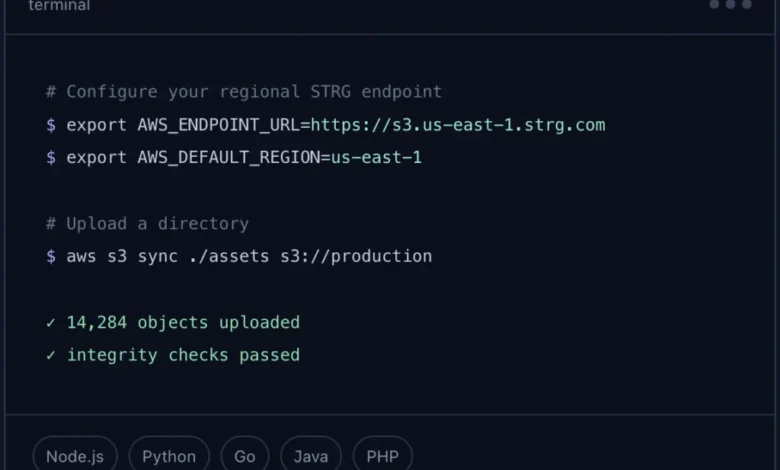
For developers, the transition involves a standard configuration process. By establishing an API key and defining buckets, users can interact with the storage environment using standard AWS CLI commands. For instance, executing an aws s3 cp command against a STRG-hosted endpoint functions identically to native AWS operations. This design choice removes the steep learning curve typically associated with adopting new infrastructure, enabling teams to maintain their established deployment pipelines.
Beyond simple command-line utility, the platform supports programmatic integration via the AWS SDK for JavaScript. This allows for complex workflows, such as automated asset uploading, list retrieval, and object transformation, to be integrated directly into Node.js or browser-based applications. The ability to perform operations like PutObjectCommand or ListObjectsV2Command through a standard client instance ensures that the storage layer remains abstracted from the application logic.
Governance and Feature Parity
While cost-efficiency is the primary driver for interest in alternative storage, functionality cannot be sacrificed. STRG provides a robust suite of management features, including customizable lifecycle policies—which automate the transition of objects to cheaper storage tiers or their deletion—as well as granular access control and Cross-Origin Resource Sharing (CORS) rules. These features are essential for modern web applications that require secure, compliant, and efficient handling of public or private assets.
Furthermore, the implementation of object locks provides a necessary layer of data immutability, which is increasingly critical for security-conscious organizations. By preventing the alteration or deletion of data for a specified duration, these controls assist in protecting against ransomware attacks and meeting regulatory data retention requirements.
Integration with AI and Agentic Workflows
A significant recent development in the infrastructure space is the integration of cloud storage with AI-driven autonomous agents. As developers integrate Large Language Models (LLMs) into their application stacks, the need for these agents to interact with file systems and object storage has grown.
STRG has addressed this shift by providing a Model Context Protocol (MCP) server. This allows AI agents to interface with the storage platform using standardized communication protocols. By utilizing commands such as claude mcp add, developers can grant their AI agents the ability to list, read, or manage assets within their buckets. Crucially, this integration adheres to the principle of least privilege. The agent’s capabilities are constrained by the permissions assigned to the specific access key provided to it, ensuring that the AI can only execute operations explicitly authorized by the administrator. This capability represents a significant advancement in how developers build "agentic" applications, allowing for automated data processing and asset management without compromising security.
Economic and Operational Implications
The adoption of an S3-compatible provider presents several strategic advantages for engineering teams:
- Reduction in Egress Fees: Many alternative providers structure their pricing to be more predictable than traditional hyperscalers, often offering lower or zero-cost egress, which is a major factor in controlling total cost of ownership (TCO).
- Vendor Neutrality: By relying on a common API, organizations avoid being locked into a single provider’s proprietary ecosystem, maintaining the flexibility to migrate assets as business needs evolve.
- Simplified Architecture: Modern cloud platforms prioritize developer experience. Through simplified dashboards and intuitive API management, teams can reduce the time spent on administrative overhead, allowing them to focus on core product development.
However, moving to any cloud storage provider requires a thorough assessment of data residency requirements and compliance certifications. For global organizations, the ability to store data in specific geographic regions—such as the eu-central-1 endpoint utilized by STRG—is essential for meeting GDPR and other regional data protection regulations.
Future Outlook
The landscape of cloud object storage is entering a period of decentralization. As startups and enterprise developers alike seek to optimize their infrastructure, the demand for platforms that provide high performance alongside cost transparency will continue to rise. STRG’s focus on bridging the gap between legacy S3 workflows and the needs of modern AI-integrated applications positions it within a broader trend of infrastructure modularization.
As organizations continue to evaluate their storage strategies, the criteria for selection will likely shift from brand recognition to technical agility and interoperability. The ability to deploy storage that supports both traditional command-line operations and future-facing AI agent interactions suggests that the next generation of cloud services will be defined by their ability to act as foundational layers for both human and machine-driven workloads.
In summary, the transition toward versatile, S3-compatible platforms is a reflection of a maturing market. Developers now expect a high degree of integration, security, and economic efficiency as the baseline for infrastructure services. By leveraging standardized protocols and embracing new paradigms like MCP, service providers can facilitate a more flexible, competitive, and innovative ecosystem for digital asset management. For engineering managers, the task ahead is to assess the potential for cost savings and operational efficiency through the adoption of these modern storage solutions, ensuring that their application infrastructure is prepared to scale in a cost-effective and secure manner.
Related posts: