TikTok Releases New Playbooks Targeting the Lucrative Q5 Holiday Season for Gaming and Mobile App Marketers

The digital marketing landscape is perpetually evolving, yet certain seasonal phenomena continue to present unique, high-yield opportunities for brands willing to look beyond traditional campaign cycles. TikTok has officially published two comprehensive marketing guides focused squarely on the end-of-the-year period spanning from Christmas Day to New Year’s Eve—a temporal window frequently designated by industry insiders as "Q5." These new playbooks have been specifically engineered to provide gaming developers, mobile app publishers, and digital advertisers with actionable strategies designed to maximize user acquisition, engagement, and monetization during a time when consumer behavior shifts dramatically.
As the traditional fourth-quarter holiday rush concludes, many marketers conventionally wind down their ad spend, assuming that consumer purchasing intent plummets immediately following December 25. However, internal data and external market research tell a vastly different story. TikTok’s newly released playbooks challenge this long-held assumption, arguing that Q5 is not a period of dormancy, but rather a high-engagement zone characterized by relaxed consumers, newly minted gift cards, and heightened screen time. By releasing these dedicated resources, TikTok aims to steer brands away from seasonal fatigue and toward an overlooked goldmine of consumer attention.
Unpacking the Q5 Phenomenon: Consumer Behavior and Market Dynamics
To understand the strategic significance of TikTok’s latest publications, one must first examine the unique economic and psychological profile of the Q5 consumer. According to metrics highlighted in the platform’s newly released documentation, approximately 70 percent of consumers actively plan to shop during the week immediately following December 25. This post-Christmas shopping surge is primarily driven by two major factors: sweeping post-holiday retail sales designed to clear inventory, and the redemption of holiday gift cards and monetary gifts.
Furthermore, platform-specific data reveals that TikTok users lean heavily into this shopping mindset. The data indicates that 75 percent of TikTok users maintain the same level of shopping activity—or actually increase it—during the Q5 period compared to the weeks leading up to Christmas. Even more compelling for direct-to-consumer and app-based brands is the finding that 63 percent of these shoppers are purchasing items specifically for themselves. This self-gifting behavior creates an ideal environment for app downloads, digital subscriptions, in-game purchases, and micro-transactions, as consumers utilize newfound funds or leisure time to invest in personal entertainment.
During this post-holiday window, consumers are frequently on holiday from work or school, resulting in an abundance of free time. This surplus of leisure translates directly into elevated social media consumption. As users turn to platforms like TikTok for entertainment, connection, and relaxation, brands that maintain an active presence are uniquely positioned to capture their undivided attention.
Strategic Advantages for Gaming Brands
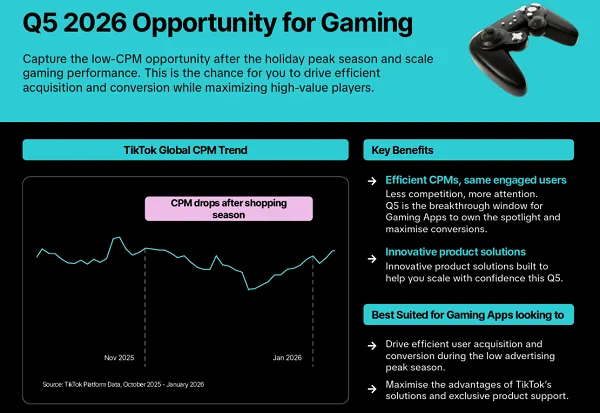
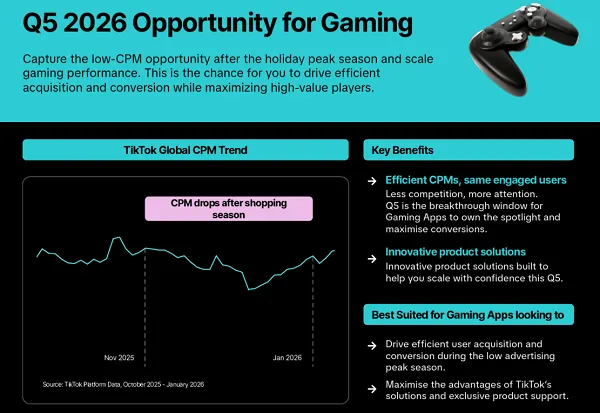
The first of the two published guides, tailored specifically for gaming brands, is a concise four-page document that zeroes in on one of the most compelling economic arguments for Q5 advertising: reduced competition leading to lower costs.
In the weeks leading up to Christmas, the digital advertising ecosystem experiences intense congestion. Major retailers, e-commerce giants, and luxury brands flood auction-based ad networks with massive budgets to capture final holiday orders, driving the cost per impression (CPM) and cost per click (CPC) to annual highs. Once December 25 passes, however, a significant percentage of these traditional retail advertisers abruptly pull their campaigns, resulting in a sudden drop in marketplace competition.
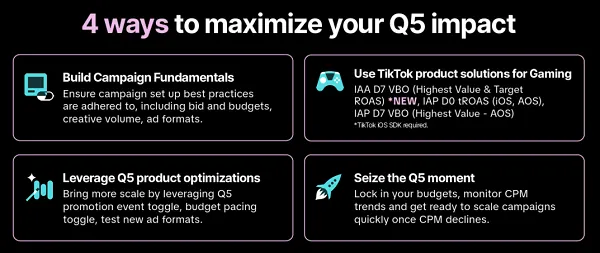
TikTok’s gaming guide highlights that this contraction in advertiser demand directly causes a lower cost per ad during the Q5 period. For gaming companies—which rely heavily on continuous, cost-effective user acquisition to sustain their ecosystems—this dynamic represents a rare arbitrage opportunity. Advertisers can secure premium ad inventory at a fraction of the cost experienced earlier in the fourth quarter.
Beyond financial efficiencies, the gaming playbook provides granular, technical advice on how gaming publishers can structure their campaigns to capitalize on this environment. The guide outlines best practices for setting up specific campaign types, such as App Install campaigns and In-App Event optimization, ensuring that developers are not merely driving downloads, but are actively engaging users who are likely to retain and monetize over the long term. It also includes strategic notes on leveraging user-generated content, influencer partnerships, and immersive ad formats native to the TikTok ecosystem.
Mobile App Promotions and Technical Implementation
While the gaming guide addresses the unique monetization loops of the gaming sector, TikTok’s second publication broadens the scope to encompass the broader mobile app economy. This companion guide offers parallel strategic insights while diving deeper into the technical infrastructure required for successful execution.
Mobile app marketing success during Q5 often hinges on precision tracking and attribution. With privacy changes and evolving platform protocols continuing to complicate measurement, the guide places a heavy emphasis on proper tracking setup. It provides step-by-step guidance on implementing the TikTok Pixel, the Events API, and advanced matching techniques to ensure that app developers can accurately measure conversions, track return on ad spend (AdSpend), and optimize their campaigns in real time.
In addition to technical setup, the app marketing playbook details best practices for various promotional verticals, including subscription-based services, fintech applications, e-commerce companion apps, and utility software. By breaking down the unique psychological triggers of the post-holiday season—such as the desire for self-improvement, fitness tracking, financial planning, or simply digital escapism—the guide helps non-gaming app publishers craft messaging that resonates with users who are actively setting intentions for the upcoming year.
Chronology of Q5 Strategy Development within the Digital Marketing Sector
The formalization of Q5 as a distinct marketing season is a relatively recent evolution in digital advertising strategy, though the underlying consumer behavior has existed for decades.
Historically, digital marketing retrospectives treated December 31 as the definitive hard stop for fourth-quarter holiday campaigns, followed by a quiet "Jan-Feb" lull. However, the proliferation of mobile commerce, digital gift cards, and app-based economies gradually exposed a blind spot in this conventional wisdom. Over the past five years, major social media platforms and digital agencies began noticing anomalous spikes in user activity and conversion rates during the final week of the year.
By the early 2020s, industry analysts began formalizing the term "Q5" to describe this lucrative interstitial period between Christmas and New Year. Recognizing the commercial value of capturing this traffic, platforms began compiling proprietary data to prove the viability of the season. TikTok’s release of these specific playbooks represents the latest maturation of this trend, moving Q5 from an informal industry observation into a formalized, strategically targeted marketing season supported by institutional data and official platform documentation.
Industry Implications and Reactions from Marketing Professionals
The release of these playbooks has garnered significant attention from media buyers, performance marketers, and agency executives who view the documents as a welcome roadmap for an otherwise chaotic time of year.
Digital marketing experts have long wrestled with the operational challenges of maintaining campaigns over the winter holidays. Skeleton crews, holiday office closures, and the fear of wasted ad spend often lead brands to institute a complete "media blackout" from December 24 through January 2. Industry analysts note that TikTok’s intervention provides the empirical backing needed for marketing managers to convince cautious corporate stakeholders to keep their ad dollars flowing.
"For years, brands have left money on the table simply out of habit," noted one senior programmatic media buyer who reviewed the newly published guides. "The data showing that 63 percent of users are shopping for themselves during Q5 completely flips the script. Consumers aren’t finished spending money; they are just changing who they are spending it on. Platforms like TikTok providing technical setup instructions and cost-efficiency metrics makes it much easier for brands to justify extending their Q4 budgets into the final week of the year."
Furthermore, the focus on gaming and mobile apps is seen as particularly astute. Both sectors operate on high-volume, performance-driven metrics where customer acquisition cost (CAC) and lifetime value (LTV) dictate long-term viability. By highlighting the combination of reduced ad auction competition and high user availability, TikTok has effectively positioned its platform as an indispensable partner for app publishers looking to jumpstart their performance metrics ahead of the new year.
Broader Economic Context and Future Outlook
As the digital advertising industry continues to navigate economic uncertainties and shifting privacy landscapes, the ability to identify and exploit niche windows of high ROI is increasingly critical for brand survival. Campaigns that rely solely on broad, year-round awareness messaging are facing heightened scrutiny from chief financial officers demanding clear attribution and immediate returns.
TikTok’s release of the Q5 gaming and app marketing guides underscores a broader shift toward data-backed, highly localized seasonal strategies. By providing both the macro-level justification (consumer intent data) and the micro-level execution (technical setup, campaign types, and tracking best practices), the platform has bridged the gap between high-level theory and tactical implementation.
Looking ahead, industry observers expect other major digital advertising ecosystems to follow suit, expanding their own year-end educational resources to capture the Q5 budget allocation. However, with its unique demographic makeup, immersive short-form video format, and deeply engaged user base, TikTok has established a strong early foothold in defining how brands navigate the final, crucial days of the calendar year. For gaming studios and mobile app developers willing to defy traditional holiday hibernation, the message from these new playbooks is clear: the end of the year is not the time to close up shop, but rather the optimal moment to seize a wide-open digital highway.
Related posts: