EU consumers spend a disproportionately large share of their online fashion budgets abroad

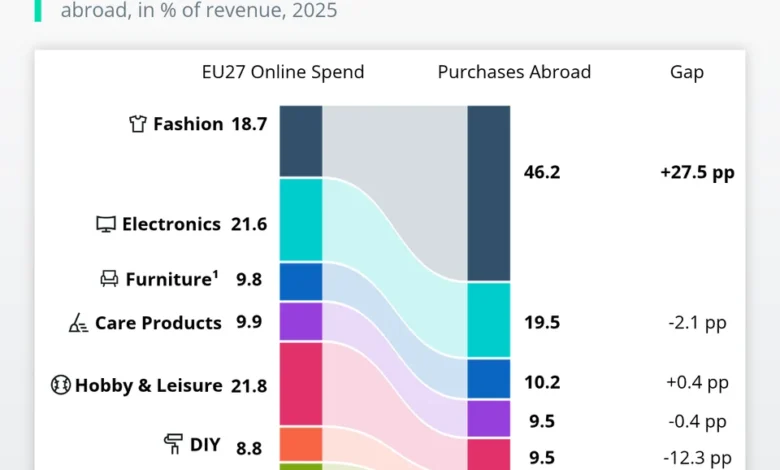
The landscape of European e-commerce is undergoing a fundamental transformation, defined by a growing divergence between domestic purchasing habits and the burgeoning appetite for international imports. Recent data provided by the E-commerce Database (ECDB) reveals that while European consumers remain loyal to local retailers for everyday goods and hobby-related items, their behavior shifts dramatically when browsing websites based outside the European Union. Fashion has emerged as the clear leader in this cross-border segment, capturing a significant 46.2 percent of all spending directed toward non-EU retailers.
This shift in consumer behavior is not merely a preference for specific brands; it is a structural change in the supply chain of global retail. As digital marketplaces based in China continue to refine their logistics and pricing strategies, the traditional barriers to entry for non-EU merchants—such as shipping times and international customs friction—have been systematically eroded.
The Disparity Between Domestic and Cross-Border Shopping
To understand the scale of this shift, one must compare it against the broader context of European online retail. In the overall European e-commerce market, fashion occupies a respectable but secondary position. According to ECDB figures, hobby and leisure goods dominated the total online spend last year, accounting for 21.8 percent of all purchases. Electronics followed closely at 21.6 percent, while fashion trailed behind at 18.7 percent.
The data highlights a compelling psychological and logistical divide: when Europeans shop at home, they prioritize reliability, warranties, and the acquisition of high-value durable goods like electronics or specialized hobby equipment. However, when they venture into the global digital marketplace, their priorities pivot toward affordability and trend-driven fashion.
The ECDB report notes that the category mix for cross-border spending looks "very different" from domestic baskets. While hobby and leisure spending remains localized, fashion, textiles, and apparel see a massive surge in international demand. Other categories, such as furniture, also see a higher proportional share in cross-border trade compared to domestic retail, though the volume remains smaller than that of the fashion sector.
The Rise of the Chinese E-commerce Titans
The driving force behind this surge in fashion-led cross-border spending is the dominance of a few key players. Last year, European consumers directed 55.1 billion euros toward retailers based outside the EU for physical goods. Of that figure, a staggering 49.7 billion euros was funneled through Temu, AliExpress, and Shein.
These platforms have effectively captured the "fashion-first" demographic. Because these corporations prioritize low-cost, high-volume apparel sales, their business models are inherently linked to the fashion sector’s dominance in cross-border statistics. The logistics of this model are equally deliberate; apparel is ideal for global shipping. It is lightweight, compact, and resilient to the rigors of international transit, unlike fragile electronics or bulky home appliances. As ECDB concludes, "light, cheap, and durable goods cross borders best."
A Chronology of Cross-Border Growth
The rapid ascent of these platforms within the European market did not happen overnight. The following timeline illustrates the evolution of this trend:

- 2020–2021: The COVID-19 pandemic accelerates the adoption of online shopping across Europe. Simultaneously, logistics providers optimize air-freight routes from East Asia to Europe, lowering the cost of small-parcel delivery.
- 2022: Shein and AliExpress solidify their presence in Western Europe, moving beyond price-conscious demographics to gain mass-market appeal.
- 2023: Temu launches its aggressive European expansion. By implementing high-frequency marketing campaigns and deep discounts, the platform sees unprecedented growth, eventually becoming the leading e-commerce entity in four distinct European national markets.
- 2024: The European Commission begins formal investigations into the compliance of these platforms, focusing on product safety, the sale of illegal goods, and the impact of the "de minimis" customs thresholds that previously allowed small, low-value parcels to enter the EU duty-free.
The Regulatory Landscape and Official Responses
The influx of millions of small parcels has not gone unnoticed by European regulators. The European Commission has expressed mounting concern over the "tsunami" of goods that bypass standard customs duties and safety inspections due to their low declared value.
In response, the EU is exploring legislative measures, including the introduction of "parcel taxes" or the removal of customs exemptions for low-value goods. The goal is to ensure a level playing field for European merchants who must adhere to stringent VAT, environmental, and labor regulations that many non-EU competitors currently circumvent.
In a move to preempt these regulatory hurdles, some of the major platforms have begun shifting their strategy. By establishing logistics hubs and warehouses within the European Union, these companies are moving from a pure cross-border model to an "in-region" fulfillment model. This shift allows for faster delivery times and may help these platforms integrate more smoothly into the European regulatory framework, though it also signals a transition from "importing" to "competing" directly within the local market.
Economic and Market Implications
The concentration of 90 percent of non-EU spending on just three platforms—Temu, AliExpress, and Shein—poses significant risks to the diversity of the European retail ecosystem. Analysts suggest that the reliance on these platforms for fashion goods could lead to a "hollowing out" of mid-market European retailers who cannot compete with the aggressive pricing models afforded by these platforms’ supply chains.
However, there is also a counter-argument regarding consumer welfare. In a period of high inflation across the Eurozone, the accessibility of low-cost goods provides a necessary buffer for low-income households. The challenge for policymakers, therefore, is to balance the protection of domestic industry and consumer safety standards with the economic benefits that global competition brings to the retail sector.
The Sustainability Factor
Beyond economics, the environmental footprint of this cross-border model remains a contentious issue. The "fast fashion" cycle, fueled by the convenience of cheap, international shipping, stands in direct contrast to the European Green Deal and the EU’s broader goals for circular economy legislation. The high volume of returns and the carbon footprint associated with long-haul air freight for low-value items are increasingly under the microscope.
As the European Commission considers new fees and stricter oversight, the industry is bracing for a period of adjustment. Whether these regulations will effectively curb the dominance of non-EU fashion giants or simply incentivize them to further localize their operations remains to be seen.
Conclusion
The data provided by ECDB confirms that the European digital marketplace is no longer a closed loop. It is a highly permeable environment where the convenience and price point of international platforms have fundamentally reshaped the fashion retail sector. While the European Union grapples with the regulatory implications of this shift, one fact remains clear: the consumer’s desire for affordable, accessible, and trend-focused fashion has made international e-commerce a permanent and influential feature of the European economic landscape.
As the legislative climate in Brussels tightens, the next phase of this cross-border dynamic will likely be defined by a shift from speculative expansion to operational maturity, as these global players attempt to navigate the complex regulatory waters of the European Union while maintaining their grip on the fashion-conscious consumer base.
Related posts: