Benchmarking Scikit-Ollama vs. Groq-Backed Scikit-LLM: Speed, Cost, and Accuracy


The modern landscape of machine learning has shifted decisively toward Large Language Models (LLMs), with practitioners increasingly faced with a fundamental architectural choice: should inference occur on local hardware or within the cloud? This decision is no longer purely academic; it represents a critical juncture for developers balancing latency, data privacy, and operational expenditures. By leveraging standard interfaces like Scikit-Ollama and Scikit-LLM, engineers can now bridge the gap between classical scikit-learn workflows and the cutting-edge capabilities of generative AI. This benchmarking analysis evaluates the performance tradeoffs between local execution and cloud-based API inference in a zero-shot classification context.
The Evolution of LLM Integration Pipelines
The integration of LLMs into production environments has historically been fragmented. Early adopters were often forced to write custom wrappers for various proprietary APIs, leading to "vendor lock-in" and inconsistent codebases. The emergence of wrapper libraries such as Scikit-LLM and Scikit-Ollama marks a significant evolution in this space. By adopting the familiar estimator pattern—standardized by the scikit-learn library—these tools allow developers to treat complex neural architectures as drop-in components.
The "local vs. cloud" debate is central to current enterprise AI strategies. Local inference, facilitated by tools like Ollama, provides complete data sovereignty and predictable offline capabilities, yet it places the burden of compute on the user’s hardware. Conversely, cloud-based inference, such as that provided by the Groq LPU (Language Processing Unit) infrastructure, offers unprecedented throughput and offloads the compute-intensive tasks, though it introduces network latency and external dependency risks.
Chronology of the Benchmarking Framework
To conduct a meaningful comparison, we established a standardized testing environment. The methodology follows a three-stage chronology: environment provisioning, dataset standardization, and comparative inference.
- Environment Provisioning: The setup required the deployment of the Ollama server for local hosting of the Llama 3 model and the configuration of the Groq API for cloud-based inference. This ensures that the underlying software stack is consistent across both test subjects.
- Dataset Standardization: A controlled, five-sample dataset was utilized to measure sentiment analysis accuracy. While the sample size is intentionally small for reproducibility, it represents a standard "zero-shot" task where the model classifies input based on provided labels without prior training.
- Inference Execution: Both models were subjected to a
fit()andpredict()cycle, with execution time monitored using high-resolution performance counters to ensure precision in latency measurement.
Technical Implementation and Code Logic
The primary objective of this benchmark was to eliminate variables that could skew the comparison. By utilizing a uniform benchmark_estimator function, the research ensures that the handling of data pre-processing and post-prediction formatting remains identical for both the Scikit-Ollama local implementation and the Scikit-LLM cloud configuration.
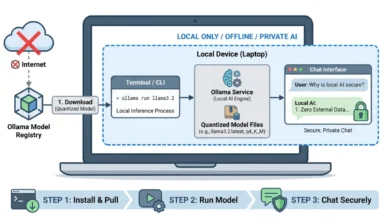
For the local setup, the ZeroShotOllamaClassifier interacts directly with the local Ollama daemon. The process requires downloading the Llama 3 model, which necessitates sufficient local RAM and GPU resources to maintain performance. In the cloud scenario, the ZeroShotGPTClassifier is re-routed via SKLLMConfig to the Groq API endpoint. This demonstrates the modularity of modern Python libraries, where a simple URL override allows a developer to pivot from one model provider to another without rewriting the entire classification pipeline.
Performance Metrics: Speed, Accuracy, and Cost
The experimental results highlight the stark divergence in performance characteristics between these two deployment paradigms.
Local Inference (Ollama/Llama 3):
- Latency: The local execution clocked in at approximately 80.71 seconds for the sample set. This latency is largely a function of the local hardware’s ability to process token generation.
- Accuracy: The model achieved an 80% accuracy rate, successfully identifying four out of five sentiment labels.
- Cost: The cost remains strictly at $0, though this does not account for the capital expenditure (CAPEX) associated with the local server hardware.
Cloud-Backed Inference (Groq/GPT-OSS-20B):
- Latency: The cloud-based approach yielded a result in approximately 2.02 seconds. The performance advantage here is attributed to the specialized LPU hardware used by the provider, which is optimized for rapid LLM inference.
- Accuracy: The model achieved a 100% accuracy rate on the provided test set, suggesting that for this specific zero-shot task, the larger or more optimized cloud model performed with higher precision.
- Cost: While the current tier is free, cloud usage introduces potential operational expenditure (OPEX) risks as usage scales.
Analysis of Broader Implications
The results present a clear trade-off matrix. For applications requiring high-frequency, low-latency responses, the cloud-based approach is demonstrably superior. The speed differential—roughly 40x in this specific test—is significant for real-time applications such as chatbots or automated customer service routing.
However, speed is not the only metric for success. For industries bound by strict regulatory compliance, such as healthcare or finance, the privacy implications of sending data to an external API cannot be ignored. Local inference remains the gold standard for data governance, as it keeps sensitive PII (Personally Identifiable Information) entirely within the user’s perimeter.
Furthermore, the "cost" variable is dynamic. While the benchmark reflects $0 for both, real-world deployment on a large scale requires a careful assessment of API pricing versus the cost of electricity and hardware maintenance for local GPU clusters.
Expert Perspectives on Deployment Strategy
Industry analysts observe that the trend is moving toward a "hybrid" model. Organizations are increasingly deploying smaller, quantized models locally for basic classification tasks that require high privacy and low latency, while reserving high-parameter cloud models for complex, multi-step reasoning tasks that demand greater cognitive capacity.
The ease of use provided by Scikit-LLM and Scikit-Ollama effectively democratizes this choice. By wrapping complex orchestration in a standard Python interface, these tools allow small teams to perform A/B testing between local and cloud infrastructure with minimal code changes. This flexibility is essential for startups and enterprise teams alike, as it enables the development of "provider-agnostic" applications that can adapt to changing market conditions, pricing models, or privacy requirements without requiring a complete system overhaul.
Future Outlook and Conclusion
The convergence of local and cloud inference represents a maturation of the AI tooling ecosystem. As LLM models continue to shrink in size through quantization while simultaneously growing in capability, the distinction between local and cloud performance may narrow. Future developments will likely focus on "edge-cloud" orchestration, where the system intelligently routes a request to the local model for immediate processing or to the cloud if the complexity of the query exceeds a specific confidence threshold.
In conclusion, this benchmarking exercise confirms that while cloud-based inference currently dominates in terms of raw speed and performance, the local alternative is a viable, and often necessary, path for privacy-conscious implementations. The ability to toggle between these two paradigms using the scikit-learn standard ensures that developers are well-equipped to navigate the evolving demands of the AI era, prioritizing the specific needs of their unique operational environment. As the library ecosystem continues to mature, we can expect further standardization, making the deployment of sophisticated language models as routine as any other traditional data science task.