The rapid proliferation of Large Language Models (LLMs) has forced software engineers and data scientists to confront a critical reality: standard industry benchmarks are insufficient for production-grade applications. While public benchmarks like MMLU (Massive Multitask Language Understanding) or GSM8K (Grade School Math 8K) provide a baseline for general reasoning capabilities, they fail to account for the nuance of domain-specific business requirements. Whether it is ensuring a customer support agent adheres to a strict refusal policy or verifying that a Retrieval-Augmented Generation (RAG) pipeline retrieves accurate proprietary documentation, developers require bespoke evaluation systems to ensure reliability.
To bridge this gap, engineers are increasingly moving away from "black-box" testing toward custom evaluation harnesses. A test harness acts as the essential scaffolding for an AI system, systematically feeding inputs, capturing model outputs, and scoring them against a predefined baseline. By building a modular harness in Python, organizations can track pass rates, latency, and cost over time, effectively transforming model evaluation from a subjective intuition into a data-driven, repeatable engineering process.
The Evolution of LLM Evaluation Frameworks
The timeline of AI testing has shifted dramatically over the past 24 months. Early adopters relied on manual inspection—human testers reading logs to determine if a model hallucinated or stayed on topic. However, as organizations scaled, the "human-in-the-loop" approach became a bottleneck. By mid-2023, the industry saw the emergence of automated evaluation frameworks. The transition from manual checking to programmatic scoring was driven by the necessity of CI/CD integration.
In a modern software development lifecycle, an evaluation harness serves as a regression test suite. Just as a unit test checks if a function returns the expected integer, an evaluation harness checks if an LLM’s response meets specific safety or accuracy thresholds. This shift is essential because LLMs are non-deterministic; the same input can yield different outputs, making traditional unit testing frameworks difficult to apply without significant modifications.
Architecture: A Four-Component Modular Design
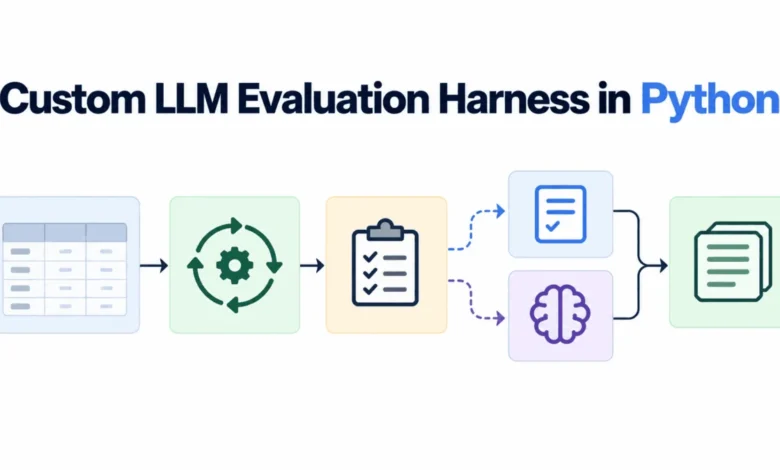
A robust, custom evaluation harness requires a separation of concerns, divided into four distinct modules: the Golden Dataset, the Inference Runner, the Judge Layer, and the Logger. This modularity ensures that the system is extensible and maintainable.
1. The Golden Dataset: Defining the "Ground Truth"
The foundation of any evaluation is the dataset. Unlike training data, a "Golden Dataset" consists of high-quality, curated input-output pairs that represent the "happy path" as well as known edge cases. Industry best practices suggest that a minimum of 50 to 100 cases is necessary for statistically significant results. These cases should ideally be pulled from real-world logs to capture the ambiguity of actual user interactions. Each case should include a unique identifier, the prompt, and the "expected concept"—a concise, verifiable objective that the model must achieve.
2. The Inference Runner: Asynchronous Execution
The runner is the engine of the harness. By utilizing the LiteLLM library, developers can create a unified interface that supports various backends, such as OpenAI’s GPT-4, Anthropic’s Claude, or open-source models hosted on local infrastructure. Python’s native asyncio library is critical here; by executing inference calls concurrently, developers can reduce the total evaluation time from hours to minutes. Setting parameters such as num_retries and timeout is non-negotiable for production-grade testing, as API instability is a common cause of failed evaluation cycles.
3. The Judge Layer: Verification Logic
The judge determines the "pass" or "fail" status of an interaction. This layer can be categorized into two primary methodologies:
- Deterministic Judges: These use exact string matching or regex to verify outputs. They are cost-effective and provide immediate, 100% consistent results, making them ideal for format-checking (e.g., verifying that a model returned a valid JSON object).
- LLM-as-a-Judge: This approach utilizes a high-capability model to evaluate the output of a smaller, faster model. By leveraging Pydantic for structured data output, developers can force the judge to return a strictly typed Boolean score and a justification. This method is essential for semantic evaluations where the intent, rather than the literal wording, determines success.
4. The Logger: Persistence and Decoupling
The logging module acts as the historical record. By writing results to a line-delimited JSON (.jsonl) file, developers ensure that their evaluation records are crash-safe and easily queryable. Crucially, by logging the raw_output alongside the passed status, engineers can re-run the judge layer if they refine their scoring rubric in the future, without needing to repeat the costly inference process.
Supporting Data and Implementation Requirements
The dependency stack for this architecture is intentionally lean. By requiring only litellm for API abstraction and pydantic for schema enforcement, the footprint remains small.
| Component | Purpose | Technical Requirement |
|---|---|---|
| Golden Dataset | Test Case Management | Python List of Dictionaries |
| Inference Runner | Model Communication | asyncio & litellm |
| Judge Layer | Scoring Logic | Pydantic Models |
| Logger | Data Persistence | json / .jsonl files |
Implications for Enterprise AI Integration
The implementation of a custom evaluation harness has profound implications for enterprise AI deployment. Primarily, it addresses the "evaluation gap"—the disconnect between the impressive performance of models in generic benchmarks and their often erratic behavior in specialized business contexts.
According to recent analysis in AI engineering, companies that implement rigorous evaluation harnesses see a 40% improvement in "Time-to-Production" for new LLM features. By automating the feedback loop, developers can identify regressions in model performance caused by prompt updates or temperature changes before they reach the end user. Furthermore, the ability to store and review raw logs provides an audit trail, which is increasingly becoming a compliance requirement in regulated industries like finance and healthcare.
Broader Impact: Towards Reliable AI Systems
The broader shift toward custom evaluation signifies the maturation of the LLM ecosystem. We are moving away from the era of "vibes-based" AI development—where teams relied on anecdotal evidence that a model "seemed" to work well—toward a rigorous, empirical approach.
The flexibility of a modular harness also allows for the inclusion of non-functional requirements. For example, a development team can easily expand the logger to record token usage, latency in milliseconds, and estimated cost per request. By analyzing these metrics alongside accuracy scores, organizations can make informed trade-offs between model quality and operational expenses.
Future-Proofing the Evaluation Pipeline
While the provided architecture offers a robust starting point, the modular design invites future complexity. As an organization’s needs grow, the harness can be scaled by integrating:
- CI/CD Integration: Automatically triggering the evaluation suite on every pull request to the codebase.
- Dashboarding: Visualizing trends in pass rates and latency using tools like Grafana or custom Streamlit applications.
- Advanced Rubrics: Implementing multi-dimensional grading that scores models on tone, conciseness, and accuracy simultaneously.
Ultimately, building a custom evaluation harness is an investment in stability. By taking control of the testing process, developers ensure that their AI systems are not only capable of performing complex tasks but are also consistently reliable, safe, and transparent. The ability to define exactly what constitutes a "good" response is the most powerful tool in the developer’s arsenal, moving the industry closer to the goal of dependable, production-ready artificial intelligence.