Meta Expands Tests Limiting Free Facebook Link Posts Following Meta One for Business Launch

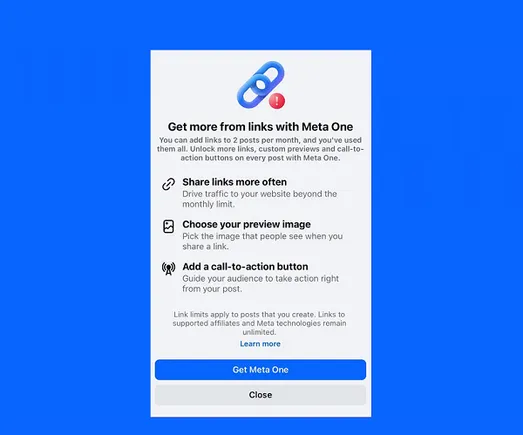
The digital marketing and social media management landscape is undergoing a significant shift as Meta accelerates its monetization efforts for professional accounts. Following the recent rollout of the Meta One for Business subscription packages, numerous business managers and page administrators have reported seeing stringent restrictions on their accounts. Specifically, non-paying professional accounts are increasingly encountering pop-up alerts limiting them to a maximum of two link posts per Facebook Page per month. This move signals an expansion of a controversial testing phase first initiated by the tech giant in late 2025, effectively tying fundamental publishing capabilities to paid subscription tiers.
While Meta has positioned its new subscription bundles as a comprehensive value-add for growing brands and businesses—incorporating features like enhanced monthly allocations for links in Instagram posts and Reels—the inclusion of Facebook link restrictions has caught many administrators off guard. As social media managers grapple with the evolving platform rules, industry analysts are closely examining the broader implications of paywalled functionality on organic social media strategy, audience reach, and the long-standing relationship between platform operators and business users.
Origins and Evolution of the Link Restriction Test
To understand the current deployment of link-posting limitations, it is essential to examine the chronology of Meta’s recent platform tests. The foundation for these restrictions was laid in December 2025, when Meta quietly launched an initial, highly targeted test restricting a select group of business pages to just two link posts per month. At the time, the company described the initiative as an exploratory measure designed to gauge user behavior and evaluate whether increasing the volume of external links provided tangible, measurable value to pages and their audiences.
Throughout most of 2025 and early 2026, these restrictions remained localized to a fraction of the global business ecosystem, leaving the vast majority of pages unaffected. However, the commercial landscape shifted dramatically with the official introduction of Meta One for Business subscription packages. Designed to streamline and monetize professional tools across Meta’s ecosystem, the subscription tiers introduced variable quotas for adding links to Instagram posts and Reels.
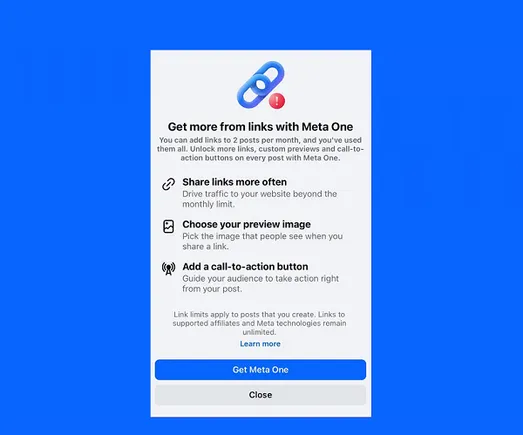
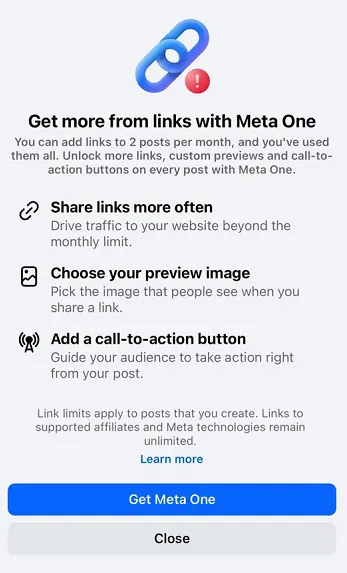
With the deployment of Meta One for Business, page managers began sharing screenshots of automated notifications warning them that their ability to share external links on Facebook would soon be capped at two per month unless they subscribed to a paid tier. This synchronization between the rollout of paid subscriptions and the wider enforcement of link caps indicates that the initial testing phase has yielded the operational metrics Meta required to move forward with a broader rollout.
Exemptions and Operational Scope
Despite the expanding scope of the test, Meta has implemented specific safeguards to ensure core platform functionality remains intact. Notably, publisher pages—such as major news organizations, journalistic outlets, and verified media entities—have been officially exempted from the link-posting limitations. Industry observers note that this carve-out is a strategic necessity; continuous streams of news content and external links are vital for maintaining user engagement, keeping feeds active, and ensuring that Facebook remains a primary destination for breaking information and web traffic.
For standard commercial brands, small businesses, and creator profiles, however, the landscape is shifting. Without a Meta One for Business subscription, these accounts face a steep operational bottleneck if their primary social media objective involves driving traffic from Facebook to external e-commerce sites, blogs, portfolios, or landing pages. While the restriction currently impacts a growing subset of professional accounts, the trajectory of Meta’s testing suggests that these limitations could eventually become the default standard for non-paying business pages across the platform.
The Reality of Organic Link Performance on Facebook
While the prospect of paying for the privilege of sharing links may alarm business owners accustomed to free organic distribution, quantitative data suggests that the practical impact on day-to-day engagement may be less catastrophic than feared. For years, Meta’s proprietary algorithm has systematically deprioritized posts containing external links, favoring native content designed to keep users within the Facebook application ecosystem.

This trend is starkly illustrated in Meta’s Widely Viewed Content Report for the first quarter of 2026. According to the platform’s transparency data, an overwhelming 98.7% of all post views in the United States during that period did not include a link directing users to an external website outside of Facebook. This marks a profound continuation of a multi-year decline in organic link visibility.
When Meta first began publishing transparency insights in 2022, approximately 9.8% of viewed content included an external link. By early 2026, that figure had plummeted to a historic low of just 1.3%. The algorithm’s preference for native text, images, photos, and video content means that standard link posts already struggle to achieve meaningful algorithmic distribution. Consequently, restricting accounts to two link posts per month may force businesses to reevaluate strategies that were already yielding diminishing returns, prompting a pivot toward native content generation and paid advertising campaigns.
Broader Industry Context and Historical Monetization Strategy
The decision to gate functional capabilities behind a subscription model aligns seamlessly with Meta’s established corporate philosophy and long-term monetization framework. The strategy mirrors a playbook articulated a decade ago by CEO Mark Zuckerberg during the company’s annual stockholder meeting in 2016, where he outlined a three-stage roadmap for platform development and commercialization.
According to this foundational framework, Meta’s approach to any new ecosystem or feature follows a predictable trajectory:
- Build and scale consumer adoption by offering a robust suite of free tools to attract a massive user base and drive widespread engagement.
- Foster business and professional utilization, encouraging brands to establish a permanent presence, build communities, and integrate the platform into their operational workflows.
- Introduce targeted monetization mechanisms, transitioning free utility into paid services, advanced add-ons, or mandatory advertising models once businesses have become structurally dependent on the platform.
By encouraging businesses to build their digital storefronts and audience acquisition pipelines on Facebook for over a decade, and subsequently introducing financial barriers for basic outbound linking utility, Meta is executing the mature phases of this monetization cycle. While critics frequently characterize this approach as a classic bait-and-switch tactic, financial markets and institutional investors generally view it as a logical evolution toward maximizing average revenue per user (ARPU) across professional ecosystems.
Implications and Strategic Adjustments for Businesses
The expansion of link-posting limitations forces a mandatory strategic reckoning for digital marketers, content creators, and small business owners. Organizations that have historically relied on organic link drops to drive web traffic must now navigate several tactical adjustments to maintain their digital presence without necessarily committing to a paid subscription package.
First, businesses must embrace native content optimization. Because Meta’s algorithms heavily favor content that keeps users engaged within the app, brands are increasingly utilizing native video, carousels, and high-engagement imagery to build brand awareness. To capture downstream traffic, marketers are leveraging alternative methods, such as placing links within the primary profile bio, utilizing pinned comments, or directing audiences to utilize direct messaging (DM) automation tools where links can be shared organically without triggering page-level posting restrictions.
Second, brands must carefully calculate the return on investment (ROI) offered by Meta One for Business subscription tiers. For enterprises whose primary revenue driver is directly tied to social media referral traffic, the cost of a subscription package may represent a negligible operational expense compared to the lost conversion opportunities resulting from a two-link monthly cap. Conversely, businesses that use Facebook primarily for community building and brand affinity may find that the restrictions have virtually zero impact on their overarching digital marketing efficacy.
Conclusion
As Meta continues to refine and expand its subscription architecture, the days of entirely free, frictionless business utility on social media are drawing to a definitive close. The broader enforcement of link-posting limitations on Facebook, running parallel to the rollout of Meta One for Business, underscores the platform’s aggressive push toward comprehensive monetization. While the policy change presents immediate operational hurdles for unprepared brands, a sober analysis of platform algorithms and transparency data suggests that the true value of organic link posts has been dwindling for years. Moving forward, digital strategists will need to adapt to a reality where outbound traffic generation on social networks requires either a diversified channel mix, sophisticated native engagement tactics, or a direct financial investment in platform-sanctioned subscription tiers.
Related posts: