The modern digital advertising landscape relies heavily on statistical modeling to justify billions of dollars in corporate expenditure. Platforms such as Google and YouTube provide advertisers with complex measurement frameworks—including Brand Lift, Search Lift, and Conversion Lift studies—designed to evaluate the financial and psychological impact of ad campaigns. However, a critical examination of Google’s official guidance reveals a stark divergence between platform-defined statistical certainty and the practical requirements of enterprise-level financial decision-making.
At the center of this debate is the terminology used by ad tech platforms to describe the reliability of campaign results. Phrases such as "directional results," "moderate chance," and "good chance" are frequently utilized in platform reports to characterize outcomes that fall well short of traditional scientific thresholds for certainty. While these terms offer a nuanced view for algorithm designers, they present profound financial risks for chief financial officers (CFOs) and chief marketing officers (CMOs) who must decide whether to allocate millions of additional dollars based on inconclusive data.
The Anatomy of Platform Guidance and Statistical Certainty
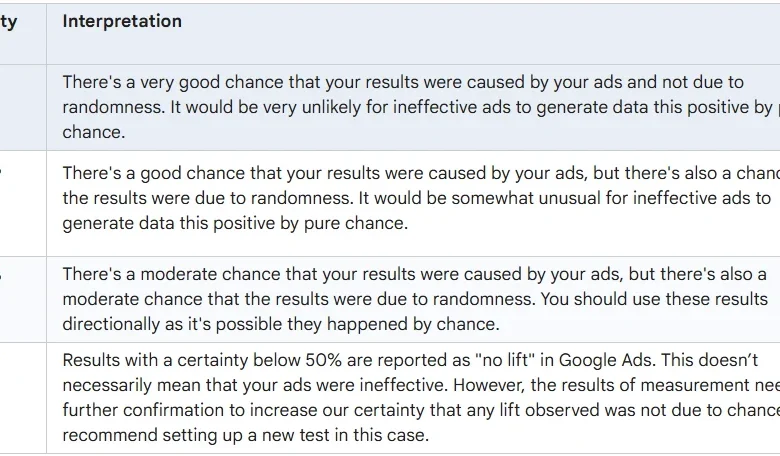
Google’s documentation regarding lift studies outlines specific tiers of confidence to help advertisers interpret the success of their campaigns. According to official guidelines, a certainty rating of 90% or higher is categorized as a "very good chance" that an ad drove the observed lift. Tiers falling between 70% and 90% are classified as a "good chance," while those between 50% and 70% indicate a "moderate chance." Any study resulting in a certainty metric at or below 50% is generally interpreted as showing "no lift."
Within these definitions lies a systemic bias toward optimism. Studies hovering above the 50% threshold are routinely cited by the platform as providing "valuable, directional insights." In practical terms, this means that even when a campaign’s success is statistically indistinguishable from a coin flip, the platform encourages advertisers to interpret the data favorably and consider reinvesting their budgets.
This approach creates an asymmetric risk profile. For Google, which acts as the vendor selling the inventory, weak or suggestive evidence provides an ongoing justification for clients to maintain or increase their ad spend. Conversely, the advertiser absorbs 100% of the financial downside. If a campaign fails to deliver actual returns in the subsequent funding round, the platform retains the revenue from the initial spend, while the client’s business suffers the capital loss.
Divergent Incentives: The Vendor Versus the Buyer
To understand the friction in modern digital marketing attribution, analysts must examine the fundamentally opposing incentives of the two primary parties involved in ad placement:
- The Ad Platform (Google): Operating as a marketplace for media inventory, the platform benefits from high liquidity and continuous spending. A statistical framework that labels ambiguous data as "directionally useful" keeps capital flowing through the ecosystem. The platform bears no fiduciary responsibility for the downstream financial performance of the client’s business.
- The Brand (The Advertiser): Responsible for stewarding shareholder capital, the enterprise buyer must answer to executive leadership. For a CMO or CFO, data is not merely an intellectual exercise; it is the justification for committing substantial corporate resources. A "good chance" or "moderate chance" rarely satisfies the rigorous evidentiary standards required to greenlight multimillion-dollar budget reallocations.
This structural divide highlights a recurring issue across the digital advertising ecosystem. Platforms and agencies frequently utilize comforting, ambiguous language that obscures underlying statistical uncertainty, thereby shifting the burden of risk entirely onto the client.
Translating Certainty into Replication Risk
To bridge the gap between platform statistics and corporate finance, advanced analysts apply principles from biostatistics—specifically Bayesian replication models—to evaluate what happens when a campaign is run a second time under identical conditions.
Consider a standard YouTube Brand Lift study reporting a +3-point lift in consumer consideration with a 70% certainty rating. While the platform frames this outcome as a "good chance" of success, business leaders must calculate the "Replication Risk"—the mathematical probability that a subsequent investment of equal size will fail to produce results strong enough to justify future spending.
Applying a Bayesian replication framework reveals sobering metrics for decision-makers:
- Positive Lift Probability: An equivalent repeat campaign has roughly a 65% chance of producing any positive lift at all—even an infinitesimally small gain.
- High-Certainty Threshold: The probability that a repeat study will achieve a robust certainty rating of 90% or higher drops to approximately 30%.
- Replication Risk: The remaining probability represents the risk that the follow-up campaign will fall short of acceptable corporate standards, leaving leadership with inconclusive proof of success.
When viewed through this lens, a platform-labeled "good chance" translates into highly unfavorable odds for an enterprise investor. Consequently, many seasoned media directors establish a strict floor of 90% to 95% certainty before advising executive leadership to scale up a campaign.
Broader Implications for the Digital Advertising Ecosystem
The challenges associated with interpreting lift studies extend far beyond Google’s ecosystem. Similar statistical ambiguities appear in measurement products offered by Meta, TikTok, and various independent media agencies. Because advertising agency compensation is frequently tied to the total volume of managed media spend, external partners may share an implicit incentive with platform vendors to interpret ambiguous data optimistically.
This dynamic underscores the necessity for internal marketing analytics teams to adopt independent validation standards. Rather than outsourcing risk tolerance to the entities profiting from ad placement, enterprises are increasingly establishing rigorous, standardized frameworks for statistical significance.
Ultimately, data-driven organizations must recognize that an ad platform’s definition of "useful information" is not synonymous with a business’s requirement for "sufficient evidence." By demanding higher standards of certainty and rigorously calculating replication risks, modern brands can protect their balance sheets and ensure that future marketing expenditures are justified by verifiable financial performance rather than hopeful interpretation.