Google Ads Integrates ‘Missed Growth Opportunity’ Insights into Main Recommendations Tab, Enhancing Advertiser Budget and Bid Optimization

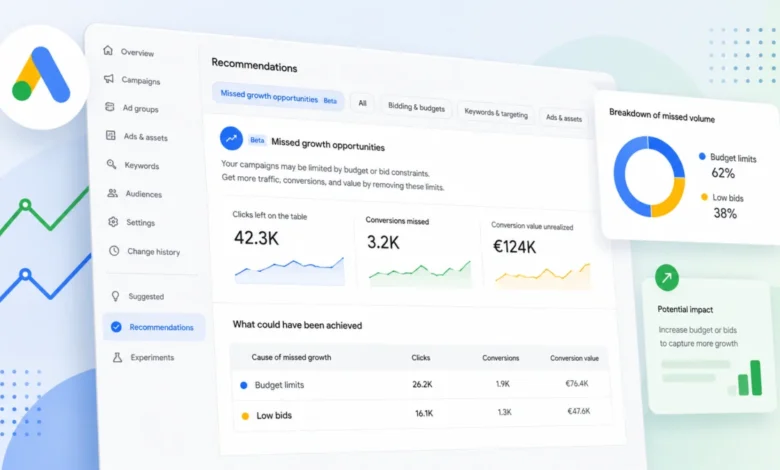
Google Ads has initiated a new beta program that integrates its "Missed Growth Opportunity" (MGO) insights directly into the main Recommendations tab. This strategic move aims to provide advertisers with a more immediate and transparent view of the potential traffic, conversions, and revenue they might be foregoing due to limitations in budget allocation or suboptimal bidding strategies. The integration marks a significant shift, moving these critical performance estimates from a specialized experimental environment to a central, highly visible location within the Google Ads interface, thereby embedding them alongside the platform’s existing array of optimization recommendations.
The Evolution of Optimization Tools and Advertiser Challenges
The digital advertising landscape is characterized by its dynamic nature, where advertisers constantly navigate complex algorithms, fluctuating market demands, and intense competition. A persistent challenge for businesses of all sizes, from nascent startups to multinational corporations, has been the efficient allocation of advertising budgets and the formulation of effective bidding strategies. Studies consistently show that a substantial portion of ad spend can be underutilized or misdirected if not meticulously optimized. For instance, a 2023 report by eMarketer indicated that global digital ad spending was projected to exceed $660 billion, underscoring the immense financial stakes involved. Within this vast expenditure, even marginal improvements in efficiency can translate into significant gains or losses in market share and profitability.
Historically, advertisers have relied on a combination of their own data analysis, third-party tools, and Google’s built-in reporting to make these crucial decisions. Google Ads itself has long offered a suite of recommendations, ranging from keyword suggestions to ad copy improvements, all designed to enhance campaign performance. However, pinpointing the precise impact of budget constraints or bid ceilings on missed opportunities has often required more in-depth analysis, often involving manual calculations or the use of more advanced, less accessible features. This new integration addresses that gap by surfacing these insights proactively and quantitatively.
From Labs to Mainstream: A Chronology of the MGO Feature
The "Missed Growth Opportunity" insights are not entirely novel. They previously existed as an experimental tool within Google Ads Labs, a dedicated sandbox where Google tests new features and functionalities with a select group of advertisers before wider rollout. The Labs environment serves as a crucial incubator, allowing Google to gather feedback, refine algorithms, and assess the practical utility of new tools in real-world scenarios without impacting the broader advertiser base.
The journey of the MGO tool from Labs to the main Recommendations tab signifies Google’s increased confidence in its accuracy and perceived value. This transition typically follows a rigorous process of data validation and user experience refinement. While the exact timeline of its development within Labs is not publicly detailed, its emergence into beta for eligible advertisers indicates that it has matured sufficiently to be considered a valuable addition to the core Google Ads experience. The screenshot accompanying the initial announcement, dated July 21, 2026, suggests a forward-looking development cycle or a phased rollout extending into the near future, emphasizing Google’s continuous commitment to evolving its platform.
This move aligns with a broader industry trend towards more automated and AI-driven optimization. As machine learning models become more sophisticated, platforms like Google Ads are increasingly capable of analyzing vast datasets to identify patterns and predict outcomes with greater precision. By bringing MGO out of Labs, Google is essentially democratizing access to a more advanced layer of predictive analytics, making it available to a wider audience of advertisers who may not have the resources or expertise to conduct such analyses independently.
Dissecting the New Beta Recommendation: What Advertisers Will See

The new beta recommendation provides a quantified estimate of the potential impact of increasing budgets or raising bids. Specifically, the feature highlights:
- Estimated Missed Traffic: Quantifying the number of additional clicks or impressions that could have been gained had budget or bid constraints been alleviated.
- Estimated Missed Conversions: Projecting the number of additional conversions (e.g., sales, leads, sign-ups) that were not realized due to current limitations.
- Estimated Missed Revenue: Providing a monetary estimate of the revenue potential left on the table because of insufficient spend or competitive bidding.
Crucially, these unrealized results are broken down by their attributed cause: whether they stemmed from insufficient campaign budgets or from bids that were too low to compete effectively for valuable ad placements. This granular breakdown empowers advertisers to understand the specific bottlenecks affecting their campaigns and to prioritize their optimization efforts more effectively. The insights are displayed directly within the Recommendations tab, ensuring high visibility and ease of access, seamlessly integrating into the existing workflow where advertisers regularly review performance suggestions.
For instance, an advertiser might see a recommendation stating, "Increase your daily budget by $100 to gain an estimated 500 more clicks and 15 additional conversions, potentially adding $1,500 in revenue this month." Or, "Raise bids on your top-performing keywords by 10% to capture an additional 200 impressions and 5 conversions, contributing an estimated $500 in revenue." These actionable insights provide a clear rationale for adjustment, moving beyond generic advice to specific, data-backed projections.
Industry Reactions and Expert Commentary
The introduction of this enhanced feature has garnered attention from industry experts and the broader advertising community. PPC expert Thomas Eccel was among the first to spot and highlight the update, noting that the feature is essentially a rebranded and integrated version of the former "Missed Growth Opportunity" tool from Google Ads Labs. Eccel’s observation underscores the evolutionary nature of Google’s product development, where successful experimental features are often refined and brought into the mainstream.
Reactions from advertisers are anticipated to be a mix of cautious optimism and a desire for rigorous validation. On one hand, any tool that promises to uncover untapped growth opportunities and provide data-driven insights for budget allocation is generally welcomed. The ability to see quantifiable missed opportunities could be a powerful motivator for advertisers to re-evaluate their spending strategies. Many small and medium-sized businesses, in particular, often operate with tight budgets and limited expertise in advanced data analytics, making such a feature potentially invaluable for identifying high-impact areas for investment.
However, experienced advertisers and industry analysts are likely to approach these recommendations with a degree of skepticism, recognizing that these are "modeled estimates" and not guarantees. The inherent complexity of predictive analytics means that while the models are sophisticated, they are still based on historical data and probabilistic projections. External factors such as unexpected market shifts, competitor actions, or changes in consumer behavior can influence actual outcomes, potentially deviating from Google’s estimates. Therefore, the prevailing sentiment is expected to be one of treating these insights as directional guidance rather than definitive commands, necessitating independent verification against an advertiser’s own performance data and business objectives.
Broader Impact and Implications for Advertisers
The integration of MGO insights into the main Recommendations tab carries several significant implications for advertisers and the digital advertising ecosystem:
-
Enhanced Decision-Making: By quantifying potential gains, Google is providing advertisers with another crucial data point to inform their budget and bid adjustments. This can lead to more strategic allocation of resources, moving away from arbitrary budget setting towards a data-driven approach focused on maximizing return on investment (ROI). Advertisers can better prioritize where additional spend is most likely to yield the greatest returns, avoiding guesswork and potentially reducing wasted expenditure.

-
Unlocking Untapped Potential: Many businesses, especially those with limited marketing budgets, may unknowingly be leaving money on the table by underfunding campaigns that have significant growth potential. This tool can act as an early warning system, highlighting opportunities for expansion that might otherwise go unnoticed. For example, a business operating in a niche market might discover that a modest budget increase could significantly boost its impression share and conversion volume within a highly relevant audience segment.
-
Streamlined Optimization Workflow: Integrating these insights directly into the Recommendations tab simplifies the optimization process. Advertisers no longer need to navigate to separate experimental tools or perform complex manual analyses to understand missed opportunities. This streamlines their workflow, allowing them to make quicker, more informed decisions, which is particularly beneficial in fast-paced campaign environments.
-
Competitive Advantage: Advertisers who effectively leverage these insights to optimize their budgets and bids could gain a significant competitive edge. By capturing a larger share of valuable impressions and conversions, they can outperform competitors who are less adept at identifying and capitalizing on growth opportunities. This could lead to increased market share and stronger brand visibility.
-
Data Verification and Strategic Oversight Remain Crucial: While the feature offers valuable insights, the caveat that these are "modeled estimates—not guarantees" is paramount. Advertisers must treat these recommendations as directional inputs and validate them against their own performance data, internal analytics, and overarching business goals. Blindly increasing budgets or bids based solely on these estimates without careful consideration could lead to inefficient spending or even negative ROI if the underlying assumptions do not hold true for a specific business context. A/B testing, gradual adjustments, and continuous monitoring of key performance indicators (KPIs) will remain essential practices.
-
Impact on the Ad Tech Landscape: This move further solidifies Google’s position as a comprehensive solution provider for advertisers. By offering increasingly sophisticated in-platform optimization tools, Google may reduce the perceived need for some third-party analytics and optimization platforms. It also highlights the ongoing trend of artificial intelligence and machine learning playing an ever-larger role in automated advertising decisions, pushing the boundaries of what platforms can offer in terms of predictive analytics.
The Bottom Line: A Powerful Tool with a Prudent Approach
Google’s decision to bring "Missed Growth Opportunity" insights into the main Recommendations tab represents a significant advancement in its advertiser empowerment strategy. By providing a more prominent and quantified way to evaluate the cost of budget and bid constraints, the platform aims to equip advertisers with actionable intelligence for identifying and capitalizing on untapped growth opportunities.
If the underlying estimation models prove reliable and consistently accurate across diverse industries and campaign types, this new beta could evolve into an indispensable planning and optimization tool. It holds the potential to help advertisers optimize their spend, improve campaign performance, and ultimately drive greater business success. However, the onus remains on the advertiser to approach these recommendations with a critical eye, validating them against their unique business context and performance data before implementing substantial changes. The principle of "trust but verify" will be more crucial than ever as advertisers navigate the increasingly sophisticated, AI-driven recommendations provided by platforms like Google Ads. This tool, when used judiciously, could indeed be a powerful catalyst for growth in the ever-evolving world of digital advertising.