Decoding the Ad Industry Bluff: Why Google Lift Studies Are Failing Brand Marketers

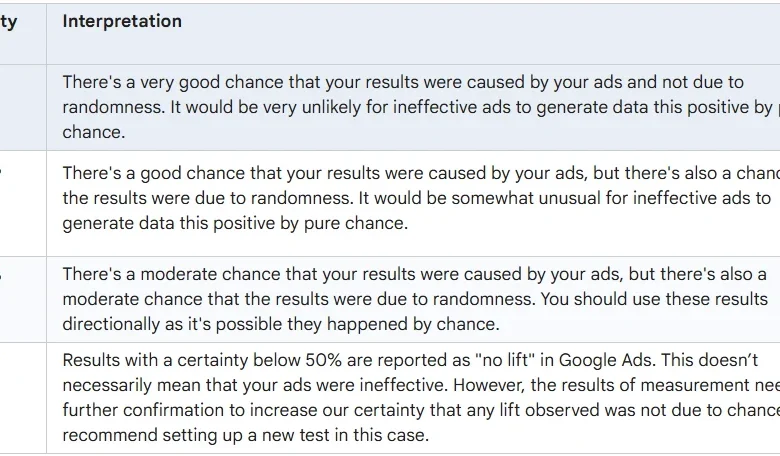
The digital advertising ecosystem has long relied on proprietary measurement frameworks to justify multi-billion-dollar corporate expenditures. Recently, increased scrutiny has fallen upon the interpretive standards used by dominant tech platforms to evaluate campaign success. At the center of this debate is the terminology surrounding statistical significance, specifically how major media gatekeepers define concepts like Brand Lift, Search Lift, and Conversion Lift. An analysis of official platform documentation reveals a fundamental misalignment between the interests of ad-revenue generators and the fiduciary responsibilities of corporate marketing leaders.
Background and Context of Platform Lift Measurement
Historically, measuring the direct impact of upper-funnel advertising, such as YouTube campaigns or display networks, presented a significant challenge for brand marketers accustomed to direct-response attribution. To address this, platforms introduced lift studies, which use randomized controlled trials—serving ads to an experimental group while withholding them from a control group—to measure changes in user behavior or perception.
However, interpreting the output of these studies requires navigating complex statistical probabilities. While independent data scientists and corporate finance departments typically demand rigorous thresholds of certainty before greenlighting substantial capital investments, advertising platforms have adopted more flexible grading scales. Official guidance from major publishers often categorizes statistical certainty into broad bands—such as labeling confidence intervals between 70% and 90% as a "good chance" of success, and anything above 50% as providing "valuable, directional insights."
This semantic framing has sparked intense debate within enterprise analytics circles. Critics argue that descriptors like "directional" or "good chance" obscure the underlying financial risk borne entirely by the advertiser rather than the platform.
Chronology of Evolving Measurement Standards
The reliance on probabilistic metrics has evolved alongside the maturation of digital advertising:
- Early 2010s: Digital platforms introduce randomized control group testing for brand campaigns, largely replacing traditional, slower brand tracking surveys.
- Mid-2010s to 2020: As privacy regulations (such as GDPR and CCPA) tighten and third-party cookies face deprecation, platform-owned closed-loop measurement tools become the primary mechanism for quantifying ad effectiveness.
- Present Day: Advertisers and enterprise analytics professionals increasingly challenge the statistical definitions provided by ad tech vendors, pushing for standardized replication risk models and higher evidentiary floors for multi-million-dollar budget allocations.
Divergent Incentives: The Platform Versus the CFO
To understand the friction in modern media planning, industry analysts point to the starkly contrasting incentives of the two primary parties involved in an ad transaction.
For the advertising platform, the primary objective is market liquidity and continuous campaign spending. Within this operational model, any study providing suggestive evidence that an ad might have worked serves as a viable data point for ongoing optimization. Because the platform does not assume the financial risk of a failed campaign, an optimistic interpretation of weak data carries minimal downside.
Conversely, the corporate marketing director, chief marketing officer (CMO), or chief financial officer (CFO) operates under strict accountability frameworks. Their mandate is not to uncover interesting statistical artifacts, but to determine whether empirical evidence justifies risking millions of dollars in corporate capital on the assumption that a prior campaign generated genuine incremental value.
When a platform communicates that a campaign achieved a 70% certainty level, it presents this as a favorable outcome. Yet, from a corporate finance perspective, committing further capital based on a 30% probability of failure introduces unacceptable variance.
Statistical Analysis: Unpacking Replication Risk
To bridge the gap between platform terminology and executive decision-making, quantitative analysts apply Bayesian replication models—methodologies inspired by biostatistical research into experiment repeatability.
When a platform reports a specific positive lift (for instance, a three-point increase in brand consideration) alongside a 70% certainty metric, calculating the "replication risk" reveals the probability that repeating the identical campaign under the same conditions would yield statistically robust results. Mathematical modeling demonstrates that a 70% certainty rating often translates to a surprisingly low probability of replicating the success in a subsequent budget cycle.
Consequently, experienced enterprise analytics leaders argue that a 90% to 95% certainty threshold should serve as the absolute floor for major financial decisions. Lower thresholds expose organizations to significant Type S (sign) and Type M (magnitude) errors, where the initial impact is both overstated and incapable of being reproduced.
Broader Industry Implications and Official Stances
As corporate governance tightens around marketing expenditures, the pushback against ambiguous platform reporting is reshaping agency-client relationships. Independent analytics experts advise corporate buyers to independently audit their vendors’ statistical claims rather than accepting platform-provided definitions of success.
While major ad tech providers explicitly include disclaimers urging advertisers to interpret results based on their individual business needs and risk tolerances, the prominence of comforting phrasing—such as "directional insights"—often overshadows these warnings.
The broader implication for the digital marketing industry is a necessary reckoning with measurement standards. As brands face macroeconomic pressures to justify every dollar spent, the reliance on vague probabilistic labeling is expected to give way to more stringent, transparent, and independently verifiable standards of attribution. Marketing organizations are increasingly realizing that an ad platform’s definition of useful information cannot replace a corporation’s standard for sufficient financial evidence.