Build And Understand a Vector Database From Scratch in 10 Easy Steps

The Evolution of Semantic Search
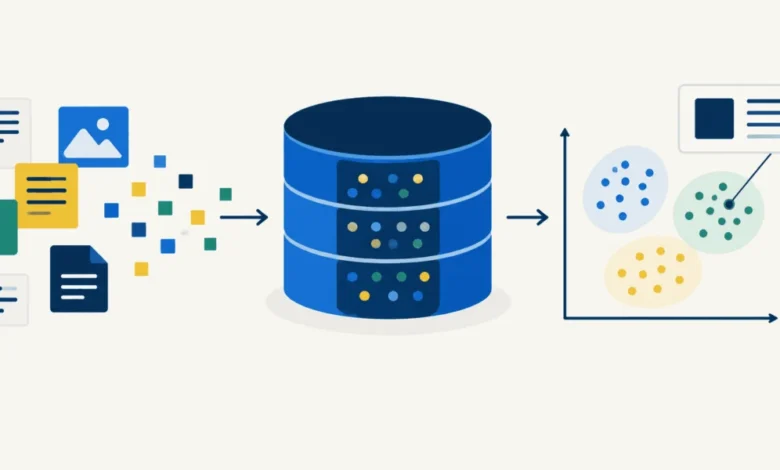
For decades, search technology was dominated by keyword-based indexing, such as the inverted index model used by Elasticsearch. This approach relies on exact token matching, which frequently fails when a user’s query does not align with the specific vocabulary of a document. In contrast, vector databases utilize high-dimensional numerical representations—embeddings—to capture the conceptual intent behind text.
The shift toward vector-based retrieval has been driven by the rise of Large Language Models (LLMs) and transformer architectures. By converting text into dense vectors of floating-point numbers, machines can calculate the "distance" between concepts. Two vectors pointing in a similar direction in hyperspace indicate that the underlying content shares a similar context. This transformation has become the backbone of modern Retrieval-Augmented Generation (RAG) pipelines, enabling AI to provide accurate, context-aware answers.
Establishing the Development Environment
The foundational phase of building a vector database involves configuring a environment that minimizes overhead. Using NumPy is the industry standard for this task due to its highly optimized linear algebra operations. The primary dependencies—numpy and sentence-transformers—allow for the rapid transformation of natural language into vector embeddings without requiring heavy GPU clusters or expensive API keys.
In a professional build, the project structure typically consists of three primary components: the indexer, the corpus, and the verification suite. The indexer handles the ingestion and mathematical storage of data. The corpus represents the knowledge base, while the test suite ensures that the high-dimensional calculations remain accurate as the dataset grows. Developers start by initializing a helper function to manage display output, ensuring that the retrieved results are presented with their associated metadata, scores, and textual content.
Indexing: The Architecture of Memory
At the heart of a vector database lies the indexing mechanism. When a document is added to the system, it is passed through a transformer model—often a lightweight version like all-MiniLM-L6-v2—which compresses the text into a fixed-length vector, typically 384 dimensions. A critical observation for developers is that the index size is independent of the document length. Whether a user inputs a single sentence or a technical white paper, the resulting vector remains a flat, predictable array of 384 floating-point numbers.
This consistency is what makes vector databases so efficient. Because each vector is a static size, memory allocation is predictable, and the computational cost of scanning the index scales linearly with the number of documents. By pre-calculating these embeddings during the ingestion phase, the system ensures that search latency remains minimal at runtime.
Semantic Retrieval and the Power of Cosine Similarity
The true utility of a vector database emerges when executing a query. When a user provides a natural language question, the system converts that query into a vector in the same 384-dimensional space. The search algorithm then performs a dot product calculation across the entire indexed corpus.
In a normalized vector space, the dot product between the query vector and the document vectors is equivalent to the cosine similarity. A score of 1.0 represents a perfect semantic match, while lower scores indicate a divergence in meaning. This process enables the database to retrieve documents that share zero common words with the query but are conceptually identical. For example, a search for "energy production in cells" will successfully retrieve information about "mitochondria" and "ATP," even if the specific words in the query are absent from the document text.
Advanced Filtering and Data Integrity
While semantic similarity is the primary driver of retrieval, enterprise applications require more granular control. Metadata filtering—often referred to as "pre-filtering"—allows developers to constrain the search space based on specific categories, such as topic, date, or author. This ensures that the system does not return irrelevant, albeit mathematically similar, results. For instance, a query about a scientific topic can be restricted to "biology" to prevent the database from returning results from a "pop-culture" category that happens to use similar terminology.
Beyond functionality, developers must implement "guard rails" to maintain data integrity. Because the database relies on specific mathematical relationships, common errors—such as passing a single string when a list is expected, or mismatched metadata lengths—can silently corrupt the index. Robust error handling at the add() stage is necessary to ensure that documents, metadata, and vectors remain in perfect, one-to-one synchronization.
Persistence and Scalability
For a vector database to be viable, it must support persistent storage. This is typically achieved by serializing the vector arrays into binary files (using formats like .npy) and the associated metadata into human-readable formats like JSON. A vital security and performance feature is ensuring that the system refuses to load an index built with a different embedding model. Because embeddings are mathematically relative to the specific model that generated them, mixing models results in "confident nonsense," where retrieved results are logically incoherent.
Performance Analysis and Future Implications
As the dataset scales from dozens to hundreds of thousands of documents, the bottleneck typically shifts from embedding generation to the scanning and ranking of vectors. For smaller datasets, the compute time for the search itself is often too fast to measure. However, as the number of entries reaches 100,000 or more, the time required to perform matrix multiplication and sort the results becomes the primary cost.
The data shows that for 100,000 documents, the scan and rank operations take approximately 12.6 milliseconds. This underscores a vital reality: the fundamental design of a vector database does not change as you scale. The mathematics governing 25 documents are identical to those governing 25 million. What changes is the implementation of the index structure—such as transitioning from a "flat" brute-force search to an Approximate Nearest Neighbor (ANN) index like HNSW (Hierarchical Navigable Small World).
Conclusion
Building a vector database from scratch provides an invaluable perspective on the mechanics of modern AI. By understanding that semantic search is essentially an exercise in high-dimensional linear algebra, developers can move beyond treating these tools as "black boxes." The shift from keyword-based retrieval to vector-based semantic understanding represents a permanent change in how information is indexed and accessed.
As organizations continue to integrate RAG pipelines into their workflows, the ability to build, maintain, and scale these indexes will become a core competency for software engineers. The transition from a simple NumPy-based implementation to a high-performance, production-ready system is primarily one of managing complexity—bookkeeping, metadata handling, and index optimization—but the underlying principle remains the same: transforming meaning into math.
Related posts: