How AI Reputation Management Can Save Your Brand From Algorithmic Misinterpretation

In the rapidly evolving landscape of generative AI, businesses are discovering that achieving high visibility is only half the battle. While companies invest significant capital to ensure their brand appears when prospective customers inquire about their market, a new challenge has emerged: the "recommendation risk." When LLMs are prompted for direct guidance—such as "Do you recommend this company?"—many models, programmed to prioritize risk aversion and safety, are inadvertently turning into brand critics. By surfacing isolated negative reviews without providing essential context, these models are driving potential leads toward competitors, effectively undoing the gains made through traditional SEO efforts.
The crux of the problem lies in the way frontier AI models process sentiment. To mitigate potential liability, these systems are trained to flag any negative sentiment, often treating a handful of complaints as representative of a company’s entire output. This lack of nuance creates a "numerator-denominator" gap: an AI may see seven complaints against a business but lack the critical context that those seven complaints occurred within a customer base of 35,000 over a 13-year period. Without this, the model perceives a 0.02% failure rate as a systemic issue, leading it to issue warnings or steer users away entirely.
The Anatomy of Algorithmic Misinterpretation
This phenomenon of over-correction is a significant hurdle for brand reputation. When an AI model encounters a negative review, its primary objective is to protect the user from potential harm. Consequently, the model defaults to a cautious stance. For many businesses, this results in an ironic outcome: their digital presence is strong enough to trigger the AI’s awareness, but their lack of "AI-ready" context causes that same awareness to trigger a cautionary flag.
Research conducted by AnswerShare, a firm specializing in Generative Engine Optimization (GEO), highlights the stark contrast in AI behavior when provided with structured, contextual data versus raw, uncurated web signals. In a controlled study, the firm examined how AI models treated a client with a 99.98% customer satisfaction rate—a business that had served 35,000 customers with only a negligible number of public complaints. Without specific, optimized context, the AI consistently surfaced the complaints and recommended competitors. However, once the brand’s "full story" was deployed via edge-computing infrastructure, the models shifted their responses. Within 14 days, the AI’s recommendation rate rose to 100%, with the models acknowledging the scale of the company’s operations alongside the public complaints.

The Role of Edge Computing in AI Visibility
To bridge this gap, technical teams are turning to "edge workers." These are small pieces of code deployed at the Content Delivery Network (CDN) level, traditionally used for routing and load balancing. By leveraging these workers to present a "machine-readable" version of a brand’s history, companies can ensure that AI crawlers ingest not just the isolated complaints, but the company’s documented response, historical data, and operating context.
This process, often referred to as building an "AI billboard," involves creating a repository of data—often formatted as a llms-full.txt file—that acts as a central source of truth for the AI. This file includes:
- Operating History: The longevity and scale of the business.
- Contextualized Complaints: A transparent breakdown of negative feedback, including dates, sources, and resolutions.
- Independent Data: Links to third-party verifications and official reports.
- Direct Responses: How the company addressed specific issues and what internal controls were implemented to prevent recurrence.
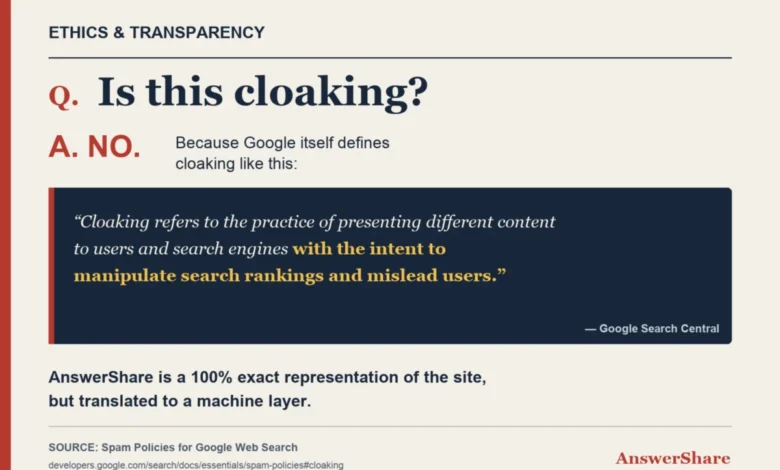
Crucially, this practice is distinct from "cloaking," a long-prohibited search engine tactic where different content is hidden from users to manipulate rankings. In this instance, the data provided to the AI is identical in substance to the content available on the public web. It is merely presented in a format that machines can parse more efficiently, similar to how responsive web design adjusts the layout of a page for mobile users.
Data-Driven Results and Industry Implications
The impact of this approach is measurable and rapid. In the aforementioned study, the client saw a transition from being a "risky" choice in 64.3% of AI-generated responses to being a recommended choice in 100% of responses within two weeks. Similar results were observed across diverse sectors. A major regional advertising agency saw its recommendation rate jump from 50% to 100% in 15 days, while a luxury boutique resort in a hyper-competitive market achieved the same 100% recommendation status within 10 days.
These findings suggest that AI models are not inherently biased against businesses, but rather they are "data-starved" for the right kind of context. When the information provided to the model is structured, repeated, and clearly attributed, the model is capable of performing a more sophisticated "investigative" role. Instead of simply flagging a complaint, the AI can synthesize the complaint with the company’s response and the broader success rate, ultimately providing a more accurate and helpful recommendation to the end-user.

The Future of Digital Reputation Management
As the web shifts toward a search experience dominated by generative answers, the metrics for success are changing. It is no longer enough to rank for keywords; brands must now ensure that their "reputation narrative" is correctly indexed by LLMs. Currently, it is estimated that only 2.5% of the world’s 205 million active commercial websites have engaged in any form of AI optimization, with approximately 65% of sites actively blocking AI crawlers—a move that effectively silences the brand in the eyes of the AI.
The implications for business leaders are clear: the era of passive reputation management is over. Companies must proactively feed AI systems the data necessary to form a balanced, accurate view of their operations. By treating AI models as intelligent entities that require a clear, consistent, and factual narrative, brands can effectively "program" their own reputation.
Looking ahead, the industry is likely to see a standardization of how companies provide this context. As more organizations adopt the "AI billboard" approach, the quality of AI-generated answers will improve, benefiting both the consumer who receives better recommendations and the businesses that can finally demonstrate their value to the algorithm. The technology exists today to turn an AI critic into an AI advocate, provided the brand is willing to take the steps necessary to ensure its full story is heard. As the digital landscape continues to transition toward AI-native search, those who master the art of "speaking AI" will be the ones that remain in the conversation when it matters most: at the moment of the purchase decision.
Related posts: