The Evolution of Search Marketing: Why Modern Enterprises Must Adopt AI-Driven Google Ads Strategies

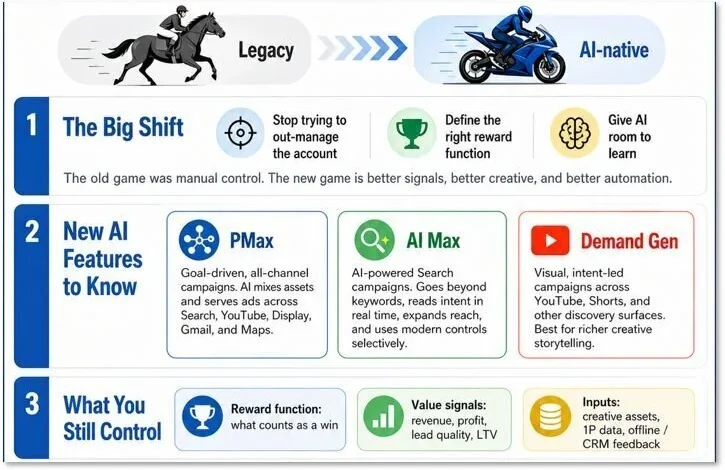
The modern digital advertising landscape has undergone a profound structural transformation, rendering traditional, manual campaign management practices obsolete. In an ecosystem dominated by fuel-efficient, long-range technological frameworks, insisting on legacy methods of digital marketing is akin to choosing a horse-drawn carriage over a modern motorcycle. This strategic shift centers primarily on the Google Ads platform, where automated, artificial intelligence (AI)-driven systems have fundamentally altered how marketers acquire customers, measure success, and allocate budgets. To evaluate enterprise readiness in this new paradigm, industry experts have introduced sophisticated maturity models designed to score both technical capability and deployment depth.
For years, major tech platforms—including Meta and Google—have systematically integrated advanced machine learning into their core advertising architecture. This ongoing "AIfying" of digital ad platforms is not merely a transient trend; it represents a permanent structural evolution. Rather than resisting these automated changes in favor of historical familiarity, forward-thinking enterprises are discovering that doing less manual intervention while allowing AI to execute more complex optimizations yields superior commercial outcomes. Yet, despite these technological leaps, a significant portion of the marketing industry remains anchored to outdated frameworks.
The Persistence of Legacy Practices in Search Marketing
In contemporary corporate boardrooms and online marketing forums, search marketing continues to be framed through a rudimentary lens of brand versus non-brand segmentation. Practitioners frequently expend valuable corporate resources "monkeying" with match types, dayparting schedules, geographic modifiers, negative keyword lists, and manual bid adjustments. Similarly, many digital marketing agencies attempt to justify their retainers by executing multiple daily micro-adjustments to accounts. According to industry analysts, these legacy behaviors are counterproductive and profit-pulverizing.
The transition from manual oversight to machine-learning optimization is underpinned by two fundamental perspectives. First, extensive platform experience—such as working directly within Google’s product and engineering ecosystems—demonstrates that core automation systems operate from a foundation of architectural trust, wherein occasional anomalies are typical teething issues rather than systemic flaws. Second, the reality of performance marketing dictates that the vast majority of campaign functions will inevitably be powered by autonomous systems. Consequently, the optimal strategic posture for modern enterprises is to embrace and extend these technologies rather than retreat into manual micromanagement.
The choice to remain tethered to the past is no longer viable in a competitive commercial environment. Continuing to utilize manual, labor-intensive tactics results in continuous financial leakage and places professional marketing careers in reverse gear.
Current AI Offerings and Ecosystem Architecture
Google’s current suite of advanced advertising products illustrates the shift toward comprehensive, automated campaign management. Performance Max (PMax), often described as an all-encompassing campaign solution, requires advertisers to input core business goals, budgets, and a diverse asset repository—including text, images, videos, and logos. Google’s underlying AI then dynamically mixes and matches these assets to deliver targeted advertisements across Search, YouTube, Display networks, Gmail, and Google Maps.
Similarly, AI Max functions as an AI-powered, search-only campaign framework that eliminates traditional constructs such as rigid brand/non-brand silos and explicit keyword match types. Instead, AI Max evaluates user intent in real time, looking far beyond literal keyword strings to analyze contextual signals and expand audience reach dynamically. Demand Gen, the visual-first successor to Discovery ads, similarly leverages machine learning to interpret user intent and distribute video assets across high-engagement environments like YouTube Shorts.
Across all three frameworks, two critical operational shifts occur: advertisers assume control of the "reward function"—explicitly defining what constitutes a business win—while the AI evaluates consumer intent across a significantly broader array of signals than any human team could manually process. While these narrow AI applications are not infallible, empirical performance data indicates they consistently outperform human operators, rendering occasional trade-offs economically favorable.
Maturity Assessment Framework: Evaluating Enterprise AI Readiness
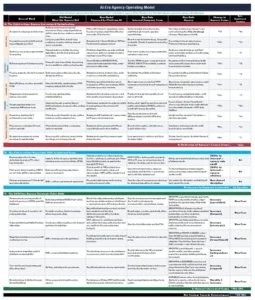
To assist organizations in accurately determining whether they are operating in the AI present or relying on legacy tactics, structured maturity models have been developed. These frameworks evaluate digital readiness across two distinct dimensions: Capability Scoring and Depth Scoring.
Capability scoring measures organizational sophistication on a scale from zero to four, where zero represents legacy operations and four designates an AI-native infrastructure. To prevent self-deception and guard against inflated internal reporting, depth scoring evaluates how widely those capabilities are deployed across the enterprise, ranging from zero percent (no deployment) to 100 percent (execution default). Enterprise maturity is calculated by multiplying weighted dimension scores by normalized capability and depth metrics, with a target benchmark score of 85 or higher required for optimal performance.
Measurement and Value Architecture
The foundational pillar of any modern advertising maturity model is Measurement and Value Architecture, carrying a substantial weighting of 30 points. Without a clearly defined reward function, automated systems cannot optimize effectively. Modern measurement requires the implementation of enhanced conversions, data-driven attribution as a default, and value-based bidding strategies tied directly to revenue, profit, or lead quality scores.
Organizations continuing to optimize for superficial metrics such as pageviews, basic sessions, or unfiltered lead volume exhibit low capability scores. Conversely, enterprises that pass closed-won CRM data, implement offline conversion imports, and tie automated bidding directly to predicted lifetime value (LTV) achieve advanced maturity ratings. Evaluating the depth of this architecture requires assessing the precise percentage of conversion value and lead volume governed by these modern measurement signals.
The Evolving Search Operating Model
The second major dimension of the maturity framework is the Search Operating Model, weighted at 20 points. Modern search operations rely heavily on Smart Bidding, broad match logic, and responsive search ads (RSAs), aiming for complete coverage depth in automated campaigns like AI Max. This model requires organizations to relinquish the impulse to segment accounts by rigid match types, device modifiers, and manual bid adjustments.
Enterprises trapped in legacy methodologies frequently rely on manual cost-per-click (CPC) strategies and micro-targeted keyword structures reminiscent of the early AdWords era. In contrast, mature organizations simplify account structures, grant machine-learning algorithms adequate data volume to learn effectively, and utilize governance controls selectively rather than micromanaging auctions. Additional dimensions within comprehensive maturity models encompass First-Party Data and Audience Intelligence, Surface Breadth and Campaign Mix, Creative and Landing Page Adaptability, and Operating Cadence and Governance.
Implications and Broader Industry Impact
The transition toward automated, AI-driven advertising platforms carries profound implications for the digital marketing industry. Historically, competitive advantage was derived from a human operator’s ability to manually out-manage account settings, adjust bids, and prune keyword lists. In the modern commercial environment, competitive advantage stems from an enterprise’s capacity to feed machine-learning algorithms accurate foundational data, high-quality creative assets, and precise customer value signals.
While the cultural and operational shift required to adopt these frameworks can present short-term internal friction, the long-term commercial returns—ranging from threefold to twentyfold increases in revenue and profitability—substantiate the transition. Furthermore, relieving marketing professionals from the repetitive, soul-sucking mechanics of legacy account maintenance elevates the strategic value of marketing teams, transforming digital advertising from an operational chore into a core driver of enterprise growth.