The Paradigm Shift: How Artificial Intelligence and Agentic Automation are Redefining Marketing Agency Contracts, Fees, and Operating Models

The rapid integration of intelligence and automation across the digital ecosystem has initiated a profound structural transformation within marketing agencies worldwide. Spanning media, creative, performance, brand, measurement, customer relationship management, lifecycle advocacy, and auditing, traditional agency models are facing an irreversible reckoning. Industry experts and corporate procurement departments are waking up to a fundamental reality: the conventional agency operating model, built on manual execution and billable hours, is fundamentally misaligned with an era dominated by artificial intelligence and agentic workflows.
Background Context of the Industry Evolution
For decades, the standard marketing agency contract has rewarded manual labor, scale-chasing, and administrative overhead. Legacy agreements—most notably the ubiquitous percent-of-media-spend fee structure—have historically incentivized agencies to increase media outlays, micro-optimize campaigns manually, and generate endless streams of routine reporting to justify billing. However, the maturation of platform intelligence, automated bidding, and generative AI over recent years has systematically dismantled the necessity for these labor-intensive activities.
Automated systems now handle account architectures, bid adjustments, budget pacing, asset creation, and continuous explore-exploit optimization at speeds and scales unreachable by human teams. Despite these technological leaps, many corporate marketing departments continue to operate under outdated Statements of Work (SOWs), legally binding them to an obsolete operational framework. This mismatch has created an urgent need for widespread contract renegotiation, shifting the focus from paying for execution volume to compensating agencies for strategic judgment, high-level governance, and measurable business outcomes.
Chronology and Timeline of the Transition
The current movement toward automated marketing integration has accelerated significantly through a multi-year evolutionary timeline. Between 2022 and 2024, ad platforms introduced and refined machine-learning frameworks such as Performance Max, Advantage+, and automated value-based bidding. These tools largely automated day-to-day tactical execution, rendering manual micro-optimization redundant and, in many cases, counterproductive to algorithmic learning.
By 2025, industry analysts began identifying the friction caused by legacy agency contracts that penalized automation by reducing billable hours whenever platform AI improved efficiency. Moving into the current planning cycles for 2026 and 2027, forward-thinking enterprises are systematically dismantling traditional SOWs. The target timeline for widespread implementation of revised, AI-aligned contracts is slated for July 2026, marking a definitive deadline for companies seeking to eliminate redundant execution fees and transition toward outcome-driven models.
Financial Implications and Fee Restructuring Analysis
A critical analysis of modern agency contracts reveals that up to 65% to 75% of historical operational costs are tied to tasks now automated by platform intelligence. Consequently, market analysts project significant cost savings alongside necessary reinvestments in high-value strategic areas.
Immediate and medium-term restructuring generally follows a dual track:
- Work Reduction and Savings: The systematic elimination or reduction of manual tasks—such as keyword research, campaign architecture maintenance, daily bid adjustments, routine ad assembly, and manual reporting—is projected to translate into a 25% to 75% reduction in traditional agency fees across media, performance, and creative sectors starting in July 2026.
- Strategic Reinvestment: Conversely, specialized work streams that remain underpowered or absent in current contracts—such as cross-platform consumer behavior strategy, advanced econometric analytics, high-level creative concept pre-testing, and governance guardrails—will likely drive a 15% to 25% increase in targeted advisory fees.
Performance marketing contracts, which historically relied heavily on manual trafficking and micro-adjustments, are expected to shrink by 75% to 80% in terms of routine execution fees. Meanwhile, brand marketing contracts, bolstered by the rising strategic importance of qualitative positioning and cross-channel value signals, are projected to see moderate reductions of 25% to 40% in baseline execution costs, even as overall budgets shift toward higher-level strategic advisory services.
Deconstruction of Legacy SOW Dimensions
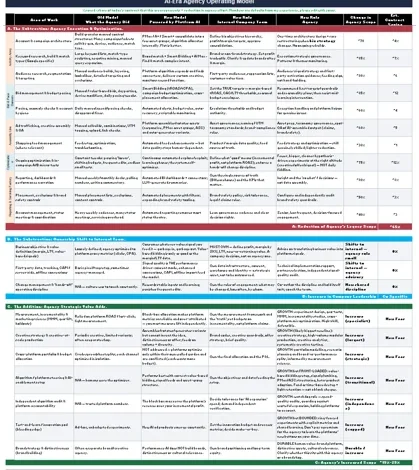
To facilitate a smooth transition, industry frameworks categorize legacy agency activities into five distinct operational clusters, quantifying the potential for reduction and restructuring:
-
The Agency Activity Army: Account architecture, keyword research, match-type sculpting, and audience segmentation. Historically accounting for roughly 22% of contract cost weight, this cluster has been largely absorbed by platform algorithms. Workload in this area can be reduced by approximately 78%, shifting the agency’s role from monthly rebuilding to one-time architectural design and strategic oversight.
-
The Bid and Pace Dancers: Manual bidding, budget pacing, dayparting, and hygiene checks. Representing roughly 14% of contract cost weight, these tasks can be reduced by approximately 73%. Automated smart bidding and budget allocation execute these functions continuously and more effectively, minimizing the risk of human interference disrupting algorithmic learning cycles.
-
The Assembly Line: Trafficking, ad builds, variable creation, tagging, and feed management. Comprising about 12% of contract cost weight, generative AI and platform tools can automate asset combination and variant generation per consumer. While data feed management requires ongoing human oversight, overall assembly effort can be reduced by approximately 45%.
-
The Optimization Theater: Daily pauses, small A/B tests, and unfocused learning agendas. Accounting for roughly 16% of contract cost weight—often the most destructive element when human intervention conflicts with machine learning—this area can be reduced by approximately 75%. Agency contributions are limited to designing major, high-impact strategic experiments.
-
The Reporting and Servicing Factory: Manually pulled weekly spreadsheets, recurring multi-attendee update meetings, and descriptive commentary on existing dashboard data. Representing approximately 30% of contract cost weight, this administrative overhead can be reduced by approximately 60% through automated data lakes and natural language processing interfaces that replace manual slide decks.
Official Responses and Industry Perspectives
Corporate procurement officers, chief marketing officers, and forward-looking agency executives have increasingly recognized that maintaining traditional retainer structures creates misaligned incentives. While some industry legacy operators express caution regarding revenue contraction, progressive agency leadership views the shift as an opportunity to elevate professional standards.
Rather than functioning as execution factories charging low hourly rates for junior staff to perform repetitive tasks, modern agencies are repositioning themselves as specialized consultants. By shedding low-value execution, agencies can allocate talent toward high-margin, complex problem-solving—commanding higher hourly rates for strategic judgment while improving employee retention and career satisfaction.
Broader Impact and Recommendations for Enterprise Leadership
The transition away from percent-of-media-spend compensation models necessitates a fundamental redesign of corporate procurement strategies. Industry experts recommend a three-tiered fee structure to replace legacy contracts:
- A lean base retainer (accounting for 40% to 50% of the new total) dedicated to governance, steering committees, and data engineering.
- Project-based fees (accounting for 30% to 40%) allocated to creative concept development, pre-testing, portfolio strategy, and complex analytics.
- An outcome-based incentive (accounting for 15% to 25%) tied directly to verified incremental profit or revenue lift, strictly excluding platform-reported Return on Ad Spend (ROAS) metrics.
Furthermore, enterprise leaders are advised to secure absolute ownership of their digital ad accounts, tracking pixels, and external data pipelines to prevent operational lock-in. By eliminating the perverse incentives associated with media spend inflation and manual over-touching, organizations can align agency performance directly with long-term business growth, ensuring that both clients and innovative agencies thrive in the agentic AI era.