Hera Mission Arrives at Dimorphos to Evaluate the Success of Humanity’s First Planetary Defense Test

For decades, the specter of a catastrophic asteroid impact has been relegated to the realm of speculative science fiction and Hollywood blockbusters. However, the reality of celestial threats is underscored by historical events such as the 1908 Tunguska Event, where an asteroid roughly 50 to 60 meters in diameter detonated over Siberia with the force of several megatons of TNT, flattening 80 million trees across 800 square miles. While the Earth has been spared a civilization-ending strike in modern history, the astronomical community remains vigilant. With the looming 2029 flyby of the asteroid Apophis—which will pass within 19,000 miles of Earth, closer than our own geostationary satellites—the need for a proven planetary defense strategy has transitioned from theoretical to operational.
The DART Foundation: Validating Kinetic Impaction
In September 2022, NASA executed the Double Asteroid Redirection Test (DART), a mission designed to prove that humanity could alter the trajectory of a near-Earth object (NEO) through kinetic impact. The target was Dimorphos, a 151-meter-wide moonlet orbiting the larger 780-meter asteroid Didymos. The mission was a resounding success; the spacecraft slammed into Dimorphos at approximately 13,000 miles per hour, successfully shortening the moonlet’s orbital period around its parent body by 33 minutes—far exceeding the initial mission goal of a 73-second shift.
The success of DART was not merely a mechanical achievement but a fundamental shift in our understanding of planetary defense. The impact ejected millions of kilograms of rock and dust, creating a cometary-like tail that stretched for thousands of miles. This "recoil" effect, where the ejected debris acted like a secondary thruster, contributed significantly to the momentum transfer, proving that the composition and porosity of an asteroid are as vital to deflection efforts as the kinetic energy of the impactor itself.
Hera: The Forensic Investigation
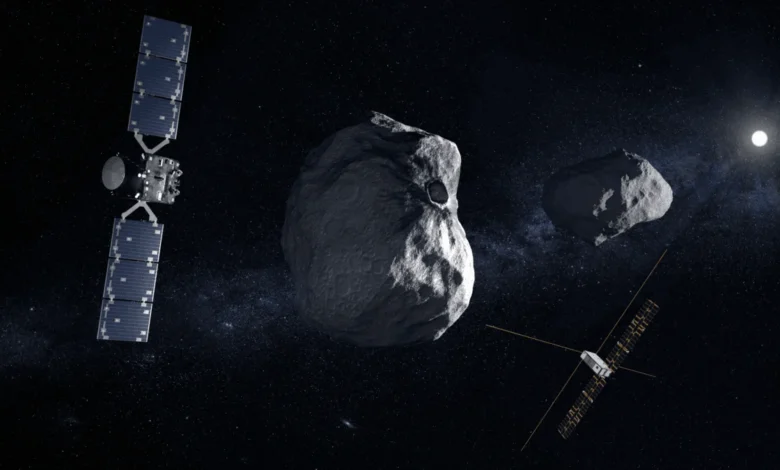
While DART provided the data on the impact’s immediate effectiveness, the European Space Agency’s (ESA) Hera mission, which arrived at the Didymos system in late 2024, serves as the forensic investigation phase. Hera is tasked with moving beyond remote sensing to provide a high-resolution, close-up study of the crater morphology, the mass of Dimorphos, and the physical characteristics of the binary system.
The mission, which performed a gravity-assist flyby of Mars during its transit, is the first to conduct a detailed exploration of a binary asteroid system. By mapping the site of the DART impact with centimeter-level precision, scientists aim to refine the models used for future planetary defense. Understanding whether the impact surface was solid rock or a loosely packed "rubble pile" will determine how successfully we can predict the outcomes of similar missions in the future.
Chronology of the Didymos-Dimorphos Campaign
- 1996: Kitt Peak Observatory astronomers identify Didymos, the primary asteroid in the binary system.
- 2003: Czech astronomer Petr Pravec confirms the existence of the moonlet Dimorphos, observing the binary system’s periodic brightness changes.
- November 2021: NASA launches the DART spacecraft, marking the beginning of the kinetic impact test.
- September 2022: DART impacts Dimorphos, successfully altering its orbital trajectory.
- October 2024: ESA’s Hera probe begins its arrival phase, capturing initial high-resolution images of the binary pair.
- January 2027: Scheduled deployment of the Juventas and Milani CubeSats to conduct in-situ surface and geophysical analysis.
Scientific Instrumentation and the CubeSat Advantage
Hera carries a suite of advanced scientific instruments, including a lidar for topographic mapping and specialized cameras capable of resolving the surface at a scale of one meter per pixel. However, the mission’s most innovative component is the deployment of two CubeSats: Juventas and Milani.
These miniature satellites represent the future of agile space exploration. Juventas is equipped with a low-frequency radar capable of probing the asteroid’s interior to a depth of 100 meters, allowing researchers to peer beneath the surface for the first time. Meanwhile, the Juventas gravimeter will monitor the subtle gravitational tug-of-war between Didymos and Dimorphos. Milani, in turn, is tasked with performing a mineralogical survey to identify the chemical composition of the asteroid, searching for volatile organic compounds that may offer clues into the early formation of the solar system.
The Broader Implications for Planetary Defense
The scale of the threat posed by NEOs has become increasingly clear as detection technology has matured. In the year 2000, astronomers had cataloged approximately 300 near-Earth asteroids. Today, that number has surged to over 43,000. While the vast majority of these objects pose no immediate threat, the sheer volume of cataloged bodies underscores the necessity of having a tested, reliable defense capability.
The DART-Hera collaboration has effectively established a baseline for "planetary defense technology." By moving away from the cinematic, albeit impractical, idea of using nuclear weapons—which would likely shatter a target into a cloud of hazardous debris—the focus has shifted to the "kinetic impactor" strategy. By slightly slowing an object’s orbit, researchers can ensure it reaches the intersection point with Earth’s orbit only after the planet has passed, effectively causing the asteroid to miss the target entirely.
Expert Analysis and Future Prospects
Dr. Patrick Michel, a lead investigator on the Hera mission, has frequently noted that the Didymos-Dimorphos system is an ideal "laboratory" for understanding the complex dynamics of binary asteroids. The fact that Didymos rotates once every 2.3 hours puts it at the physical limit of structural stability, meaning the way it interacts with its moonlet is influenced by forces that are not fully understood in larger, solitary asteroids.
The data returned by Hera will be instrumental in the 2029 Apophis flyby preparations. While Apophis is not currently on a collision course, the precision gained through the Hera mission will allow the international space community to calculate the orbital mechanics of such objects with a level of certainty that was unimaginable even a decade ago.
Furthermore, the mission demonstrates the importance of international cooperation. DART, a NASA-led mission, and Hera, an ESA-led mission, function as two halves of a single, coherent planetary defense research initiative. This synergy ensures that the knowledge gained is not localized to one agency, but is integrated into the global infrastructure of space exploration and safety.
Conclusion: A New Era of Celestial Stewardship
As the Hera probe continues its mission through the summer of 2025, the data it transmits will serve as a foundational pillar for future missions. The ability to deflect a potential impactor is now an established reality, but the precision with which we can perform that deflection depends entirely on the forensic data collected in the wake of the DART impact.
Humanity has moved from passive observers of the cosmos to active participants in the orbital dynamics of our local neighborhood. The mission to Dimorphos is not just about a single asteroid; it is about establishing a repeatable, reliable process to ensure that the Earth remains shielded from the chaotic environment of the solar system. As our catalog of known asteroids grows and our detection capabilities sharpen, the successful marriage of NASA’s impact technology and ESA’s diagnostic precision ensures that the world is better prepared than ever before to face the challenges of an active, moving, and sometimes hazardous universe.