Novamira HQ Streamlines AI Management for WordPress Agencies Through Centralized Desktop Architecture

The landscape of professional WordPress management is undergoing a significant shift as artificial intelligence tools become integrated into daily development workflows. Until recently, the standard methodology for deploying AI agents—such as Claude or Cursor—to manage WordPress environments involved a fragmented process: developers were required to configure individual, site-specific connections for every installation. This operational friction has proven to be a substantial bottleneck for agencies and freelance developers tasked with maintaining dozens or even hundreds of client sites. Novamira HQ, a newly released open-source desktop application, seeks to resolve this inefficiency by introducing a centralized hub that aggregates all WordPress connections under a single, unified interface for AI interaction.
The Evolution of WordPress-AI Integration
The trajectory of WordPress development over the last 24 months has moved rapidly from simple content generation to complex architectural management. Early iterations of AI-powered WordPress plugins necessitated a one-to-one configuration: every unique URL required a dedicated entry within an AI client’s configuration file. For an agency managing a portfolio of 50 sites, this meant 50 distinct connection strings, constant updates to environment variables, and an increased risk of credential mismanagement.
The release of Novamira HQ, which entered public beta on September 22, 2026, represents the maturation of this ecosystem. By acting as a middleware layer between the AI client and the WordPress infrastructure, the application eliminates the "one-to-one" configuration model. Users connect their preferred AI tool to the Novamira HQ desktop app exactly once. Subsequently, any site added to the HQ dashboard becomes instantly accessible to the AI. This shift reduces the administrative overhead of onboarding new clients, transforming a task that previously took minutes of configuration into a simple "add to dashboard" operation.
Technical Architecture and Security Foundations
A primary concern for professional agencies when adopting new management tools is the security of client credentials. In an era of increasing supply chain attacks and data breaches, the architecture of Novamira HQ is built on a "local-first" philosophy. The application functions as a self-contained, open-source binary that operates exclusively on the user’s local machine.

According to the project’s documentation, the software does not utilize a centralized cloud-based relay server to manage connections. This means that site credentials, API keys, and hosting access tokens are stored locally on the user’s device, rather than on a third-party server. By open-sourcing the codebase, the developers have provided transparency for security-conscious organizations to audit the application’s behavior. Furthermore, the tool employs a "least privilege" design. The application is restricted from performing high-risk actions autonomously; for example, it cannot unilaterally delete database backups, remove site environments, or alter DNS records. All destructive or high-impact operations require explicit, manual confirmation from the user, providing a critical fail-safe for agency operations.
Expanding the Horizon of Supported Infrastructure
The utility of such a tool is directly proportional to its ecosystem support. At launch, Novamira HQ demonstrated broad compatibility, supporting 13 major hosting providers. This list includes industry staples such as Kinsta, WP Engine, and Hostinger, alongside more specialized platforms like Pantheon, Rocket.net, and InstaWP.
A notable feature of the current beta is the inclusion of traditional hosting environments, including cPanel, WHM, and Plesk. This inclusion is significant because it expands the reach of AI-assisted management beyond the modern "managed WordPress" tier into the vast, legacy, and reseller hosting market. By supporting these environments, the application allows developers to apply the same sophisticated AI workflows to older sites that may not have the modern APIs found in contemporary managed environments.
For hosting providers not natively supported, Novamira HQ provides a direct connection option. This flexibility ensures that developers maintaining sites on virtual private servers (VPS) or custom cloud infrastructure are not excluded from the centralized workflow. The application automatically detects and imports staging, development, and production environments, effectively creating a "single pane of glass" for multi-environment site management.
AI Client Compatibility and Developer Workflow
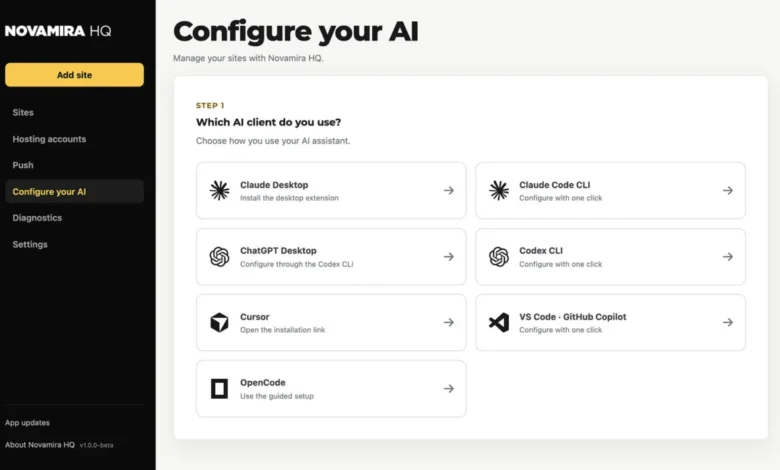
Novamira HQ has been designed to remain agnostic toward the AI client being used. It currently supports a wide array of tools, including Claude Desktop, Claude Code, ChatGPT, Codex, and Cursor, as well as VS Code and OpenCode. This compatibility is achieved through the use of the Model Context Protocol (MCP), an emerging standard for AI-to-software communication.

The implication for agency workflows is profound. In a standard agency environment, a content writer might prefer the natural language interface of Claude Desktop, while a lead developer requires the robust IDE-integrated capabilities of Cursor or VS Code. Because HQ functions as an intermediary, both roles can access the same set of WordPress sites simultaneously, utilizing their tool of choice without needing to synchronize local configuration files. This interoperability ensures that the AI’s "knowledge" of the WordPress environment—gained through the existing Novamira plugin—is consistent across the entire team.
Strategic Implications for the WordPress Industry
The introduction of Novamira HQ marks a turning point in the professionalization of AI in the WordPress space. As AI capabilities evolve, the industry is moving away from experimental, isolated use cases toward integrated, enterprise-grade management systems.
Data from the beta period suggests that the reduction in setup time is not merely a convenience but a productivity multiplier. Agencies that have adopted the tool report that the ability to quickly toggle between environments—pushing code from staging to production, or auditing configuration across multiple hosts—reduces the "context switching" tax that typically plagues developers.
However, the transition to such tools is not without its challenges. The reliance on AI to manage production environments requires a high degree of trust in the underlying models. The developers of Novamira HQ appear to have anticipated this by ensuring that the AI acts as an assistant to human judgment rather than a replacement for it. By mandating manual approval for critical actions, the software aligns with the "Human-in-the-Loop" (HITL) safety standard, which is widely considered best practice in DevOps and site reliability engineering.
Chronology of Development and Future Outlook
Since the initial public beta launch on September 22, 2026, the development team has maintained a rigorous update cadence. The project has moved quickly to address gaps in its hosting integrations, with recent updates adding support for SandyWP, staging-to-production pushes for Rocket.net, and comprehensive support for Hostinger Agency plans.

This rapid expansion suggests that the project is gaining significant traction within the community. As the software matures, industry analysts anticipate that the integration list will continue to grow, potentially incorporating cloud-based storage solutions and deeper security-auditing capabilities. For freelancers and agencies currently juggling dozens of disparate login portals and API keys, the consolidation offered by Novamira HQ addresses a fundamental pain point.
The shift toward centralized AI management is unlikely to be a transient trend. As agencies continue to scale, the necessity for robust, secure, and unified management tools will only increase. By providing an open-source, local-first solution, Novamira HQ positions itself as a potential standard-bearer for how AI will interact with the WordPress ecosystem in the coming years. Whether this will lead to a broader adoption of AI-driven site maintenance among small-to-medium businesses remains to be seen, but the foundational infrastructure for such a shift is now firmly in place.
For now, the focus remains on stabilization and expanding the breadth of host support. With no subscription fees or vendor lock-in, the barrier to entry is minimal, inviting a wide range of users to test the efficacy of a unified AI-WordPress bridge. The success of the project will ultimately be measured by its ability to maintain its security-first mandate while keeping pace with the rapid innovation cycles of both the AI industry and the WordPress core platform.