The Mathocalypse: How Artificial Intelligence is Radically Reshaping the Ancient Science of Numbers

Mathematics is undergoing the most profound and rapid transformation in its recorded history. For centuries, the discipline has relied on the deliberate, painstaking labor of human minds, building abstract structures step by logical step over months or years. Today, that foundational reality is fracturing. Artificial intelligence agents, deployed by technology corporations in thousands-strong swarms operating in tireless lockstep, are solving monumental open questions—problems that have baffled human mathematicians for generations—in a matter of hours.
This relentless acceleration has ignited an existential debate across academia. Academics, researchers, and students are confronting uncomfortable questions: How will automated reasoning affect human comprehension of mathematical truths? In an era defined by the brute-force productivity of algorithms, what is the professional future of the human mathematician? Most fundamentally, what becomes of mathematics as an intellectual and creative pursuit when the generation of proofs is industrialized?
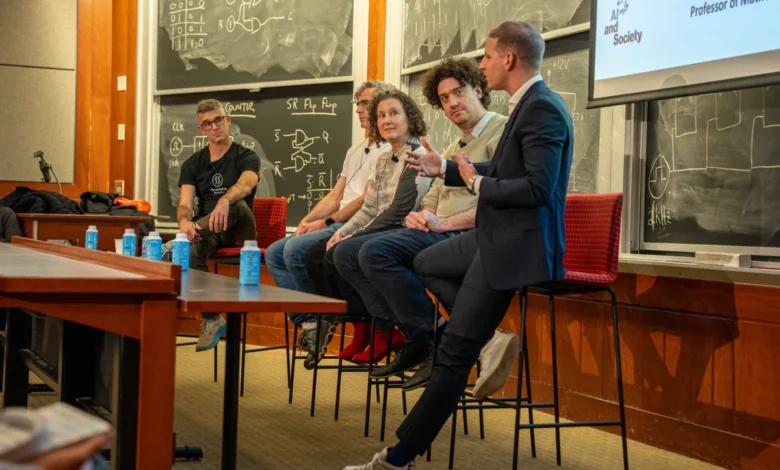
These urgent inquiries took center stage during a packed panel discussion at the Massachusetts Institute of Technology (MIT). Titled “AI and Society: The Future of Math,” the event convened leading minds from MIT, Harvard University, Northwestern University, and New York University. Held inside a standing-room-only lecture hall in MIT’s Building 3, the conversation was moderated by science writer Kevin Hartnett, author of The Proof in the Code. The panel featured Jacopo Borga, the Cecil and Ida Green Career Development Assistant Professor of Mathematics at MIT; Michael Hopkins, the George Putnam Professor of Pure and Applied Mathematics at Harvard University; Bryna Kra, the Sarah Rebecca Roland Professor of Mathematics at Northwestern University; and Tristan Buckmaster, professor of mathematics at NYU’s Courant Institute of Mathematical Sciences.
As the panelists deliberated on the profound disruptions rippling through their academic community, a consensus emerged regarding the unprecedented velocity of change. "Math has changed more in the last two months than in the last 100 years," remarked Kra. Invoking Charles Dickens, she captured the industry-wide sentiment: "It’s like the first sentence in ‘A Tale of Two Cities’: ‘It was the best of times, it was the worst of times.’ It’s a really exciting moment, and also scary."
The Chronology of an Accelerated Revolution
The convergence of artificial intelligence and advanced mathematics did not happen overnight; it is the culmination of a decade-long technical sprint largely catalyzed by mathematicians themselves. Initially, researchers tested machine learning models on closed problems—exercises with pre-existing, known solutions—largely out of academic curiosity.
These early experiments yielded rapid successes. A watershed moment arrived in the summer of 2025 at the International Mathematical Olympiad, where AI models developed by Google DeepMind achieved gold-medal status. The systems successfully solved complex problems designed to challenge the finest high school mathematical minds on the planet. Around the same period, academic researchers discovered that certain neural networks could not only solve standard problems but could occasionally derive solutions more efficiently than human experts.
By 2026, however, the technological trajectory underwent a quantum leap. Rather than merely optimizing known answers, AI models began successfully tackling open-ended research questions—frontiers of human knowledge with no pre-existing solutions.
The tipping point occurred in September 2026, when OpenAI announced a staggering breakthrough. The company directed thousands of its AI agents to work in parallel on a single, highly elusive target: the Navier-Stokes equation. Representing one of the seven Millennium Prize Problems established by the Clay Mathematics Institute in 2000, the Navier-Stokes equations describe fluid motion, but proving whether smooth, physically reasonable solutions always exist in three dimensions has remained an intractable Holy Grail of modern physics and mathematics. After just 88 hours of continuous computation, OpenAI’s agent swarm produced a valid proof.
Coincidentally, OpenAI’s sprint to the finish line intersected directly with the work of panelist Tristan Buckmaster. Following a year of intensive research, Buckmaster and his collaborators—working at rival AI laboratory Anthropic—were on the brink of publishing their own independent proof for the Navier-Stokes problem when OpenAI made its public announcement.
The corporate race to claim priority unleashed fierce controversy within the academic community. Questions immediately arose regarding intellectual property, potential data leaks from academic repositories, the inscrutability of the AI’s reasoning pathways, and the long-term viability of human-led research in the face of automated dominance.
The disruption deepened just a month later when OpenAI released a repository of 722 manuscripts spanning virtually every major subfield of mathematics. The company asserted that these papers had been generated entirely through artificial intelligence, claiming solutions to numerous historically intractable problems. This unprecedented dump of machine-generated research quickly prompted academic commentators to coin a new term for the phenomenon: the "mathocalypse."
The Crisis of Comprehension and "AI Slop"
Despite the undeniable output of automated systems, mainstream mathematicians remain deeply skeptical of raw computational productivity divorced from human comprehension. In mathematics, a proof is historically valued not merely as a binary verification of truth, but as an explanatory narrative that deepens human insight into abstract structures.
During the MIT panel, Michael Hopkins did not mince words regarding the quality of the newly released AI manuscripts. "The papers themselves are nonsense," Hopkins stated, pointing to the presence of "strange ideas" embedded within machine-generated proofs. "There still is a sense of AI math versus human math."
Tristan Buckmaster echoed this sentiment, emphasizing the philosophical necessity of human interpretation. "For math to be important, it has to have human understanding," he asserted. When researchers attempt to audit the step-by-step logic of large-scale AI proofs, they frequently encounter opaque reasoning paths that defy human intuition, rendering the output difficult to verify or build upon.
This influx of machine-generated manuscripts has also overwhelmed traditional academic publishing. Bryna Kra, who serves as a managing editor for a specialized mathematics journal, reported a massive surge in submissions driven by AI-assisted or fully automated research. The volume has forced editorial boards to expand their administrative capacity simply to manage the incoming tide, colloquially referred to by some academics as "AI slop."
Evolving Research Norms and the Redefinition of Merit
The proliferation of automated problem-solving is systematically dismantling long-established academic norms, particularly the relentless competition and obsession with priority—the prestige associated with being the first human to prove a theorem.
"It shouldn’t matter that you’re first," Kra argued during the discussion. "Speed should not be a priority. It’s not about proof production anymore. We need to find other ways to assess understanding."
While Hopkins acknowledged that human ambition and the desire to be a pioneer will persist—especially given that AI has already charted vast territories previously untouched by researchers—Kra suggested that the nature of pioneering must evolve. She pointed to her role as a co-drafter of the Leiden Declaration on Artificial Intelligence and Mathematics, an international statement signed by researchers worldwide calling for active mitigation of the risks AI poses to scholarly integrity. According to Kra, effective communication, curation, and translation of mathematical concepts will eclipse raw computation in professional value.
This shift is already altering hiring and promotion standards across academic departments. "The interview is becoming more important," Kra noted. Academic institutions can no longer evaluate candidates solely on publication volume or written preprints; they must rigorously test whether applicants genuinely comprehend the theoretical frameworks behind their work and can articulate them clearly to peers.
Academic journals are similarly forced to adapt. Jacopo Borga emphasized that the traditional metrics for evaluating mathematical achievement require a complete overhaul. "Ninety percent of how we’ve judged mathematicians are through journals," Borga said. "I’m not sure that’s how we should do this anymore. We should come up with a new metric and let it evolve."
In response to the automated paper flood, forward-thinking publications are pivoting away from raw proof-generation toward exposition—the art of explaining the conceptual motivations and intuitive scaffolding behind complex theories. Furthermore, innovative publication formats are emerging to capture the inherently human dimensions of the discipline. Kra highlighted the launch of Mathematical Discourse, a peer-reviewed "video journal" dedicated to capturing live lectures and academic talks. By focusing on spoken exposition and human interaction, the journal aims to preserve the social and communicative essence of mathematical inquiry that algorithms cannot replicate.
Navigating the Transition: AI Vegans and New Archetypes
For students entering the discipline, the pedagogical landscape is fraught with anxiety. Navigating fundamental concepts while simultaneously managing the temptation of instantaneous AI shortcuts presents a severe cognitive challenge.
"Mathematics is probably the slowest science you can do," Borga observed to appreciative laughter from the audience. "Students today are bombarded by conflicting messages of what they should do, and are overwhelmed. We need to give them space to learn."
Academic departments are currently divided in their pedagogical approaches. Hopkins noted a distinct cultural split within his own institution: "There is a big faction of my group who are ‘AI vegans’ [people who do not use AI], while others are using it." Rather than enforcing a uniform policy, faculty are seeking ways to support both philosophical camps.
Simultaneously, entirely new academic archetypes are beginning to emerge. Hopkins pointed to a student in his department who functions almost as a "horse whisperer of AI." Possessing exceptional mathematical instincts but struggling with traditional computational execution, this student approaches research out of pure curiosity rather than a race for priority. By skillfully prompting AI systems, the student consistently extracts novel, high-level insights that elude both pure traditionalists and brute-force programmers. "This may be a new kind of mathematician," Hopkins suggested.
Despite the profound anxiety surrounding the "mathocalypse," the prevailing sentiment among the MIT panelists was ultimately one of cautious optimism. Rather than signaling the death of mathematics, the disruption is viewed as an invitation to clear away bureaucratic obsolescence and explore uncharted intellectual territory.
"The castle is collapsing," Borga concluded. "There’s open ground to explore."
Buckmaster offered an encouraging final word to students navigating this period of profound uncertainty, urging them to resist the urge to abandon the field. "AI is going to affect everyone," he said. "Think of new ways to be creative and communicate your ideas. Just do what you love."
The panel discussion, co-sponsored by the MIT Department of Mathematics, marks the inaugural installment of a planned series hosted by MITHIC and SERC, designed to examine how artificial intelligence is fundamentally restructuring professional and personal life in the twenty-first century.