Google Analytics Unleashes Advanced AI, Attribution, and Budgeting Tools to Redefine Enterprise Marketing Intelligence

Over the past year, Google Analytics (GA) has introduced a comprehensive suite of advanced features designed to elevate digital analytics from basic retrospective reporting to predictive, high-value strategic decision-making. These platform updates deliver critical capabilities tailored for executive leadership, finance departments, and senior marketing teams. While some of these advanced features process data strictly from the date of activation without retrospective backfilling, their integration marks a significant evolution in how organizations measure consumer behavior, evaluate channel effectiveness, and allocate multi-million-dollar budgets.
This strategic expansion addresses long-standing challenges in digital marketing attribution, cross-channel performance, and artificial intelligence integration. Industry experts note that these tools bridge the historical gap between operational data collection and executive-level forecasting, transforming standard web analytics into comprehensive business intelligence engines.
The Evolution of Answer Engine Optimization (AEO) and AI Traffic Tracking
The rapid adoption of generative artificial intelligence and Answer Engines (AEs) has fundamentally altered traditional search engine optimization (SEO) paradigms. Industry forecasts anticipated a 20% to 30% reduction in conventional SEO traffic as users increasingly turn to AI assistants and conversational search platforms for information retrieval.
To address this structural shift, Google Analytics has introduced a default traffic channel specifically designated for AI assistants. Located within the Traffic Acquisition reports, this capability automatically captures inbound traffic from conversational search tools under the "ai-assistant" medium without requiring manual tagging or custom regex configurations.
Industry data highlights the disproportionate value of this emerging traffic segment. Research published by Adobe in March 2026 revealed that conversions originating from Answer Engines outperform traditional search traffic by 42%, with users spending 48% more time on product pages and generating a 37% higher revenue per visit. Similarly, Shopify reported in May 2026 that AI-driven traffic delivers a 50% higher conversion rate on product detail pages—outperforming organic search—alongside a 14% increase in average order value (AOV).
Despite these impressive conversion metrics, absolute traffic volume from AI assistants remains modest, typically accounting for only 1% to 5% of total sessions for most businesses. Furthermore, analysts caution that data collection for the AI Assistant Channel began mid-May 2026, leaving a blind spot for historical analysis. Additional nuances include the dynamic nature of LLM categorization—where platforms like Claude, DeepSeek, Copilot, and Grok frequently rotate in and out of tracking definitions—and the persistent challenge of uncaptured traffic from mobile and desktop applications ending up in the Direct channel.
Advanced Conversion Attribution and Multi-Touch Funnel Analysis
For years, digital marketers have grappled with the limitations of last-click attribution models, which frequently undervalue upper-funnel awareness campaigns and over-index on bottom-funnel conversion drivers. Google Analytics has directly addressed this structural deficiency by reintroducing robust Assisted Conversions reporting within its Advertising module.
By setting attribution models to last-click and timing metrics to interaction time, analysts can now quantify the precise supporting role played by diverse marketing channels across complex consumer journeys. For instance, a channel like TikTok might register a modest volume of last-click conversions while simultaneously assisting thousands of multi-touch journeys across the digital ecosystem.
To complement this, Google Analytics has deployed an advanced conversion funnel analysis that categorizes owned, earned, and paid touchpoints into early, middle, and late stages, while distinctly isolating single-touch journeys. This granular classification allows enterprises to distinguish between "lone ranger" channels that capture pre-existing intent and multi-touch pathways that actively cultivate consumer demand.
Financial and analytical teams are leveraging these insights to refine scenario planning, identify diminishing return curves, and optimize media spend across disparate platforms without relying on speculative assumptions. However, platform administrators emphasize that attribution does not equate to incrementality, urging organizations to pair these metrics with rigorous marketing mix modeling (MMM) and brand lift studies.
Cross-Channel Budgeting and Predictive Scenario Planning
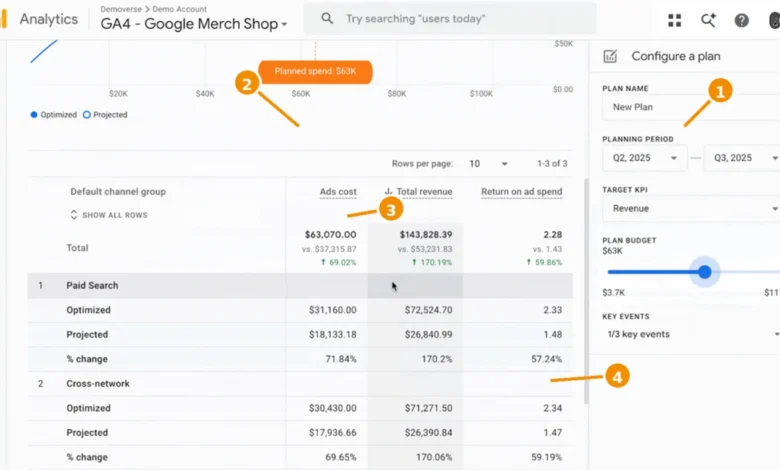
Bridging the gap between statistical insight and executive decision-making has historically been one of the greatest challenges for data professionals. To streamline this process, Google Analytics has rolled out a Cross-Channel Budgeting tool within its Advertising section, featuring two core components: Project Plans and Scenario Plans.
Project Plans enable teams to monitor pacing, evaluating whether active marketing spend is on track and projecting the exact business outcomes it will yield at current expenditure rates. Meanwhile, Scenario Plans empower executives to model allocation questions, simulating the financial impact of shifting capital between disparate channels, such as reallocating funds from paid social to paid search.
These predictive models are trained on historical organizational data, automatically incorporating seasonal trends and external variables. By importing comprehensive campaign cost data from major advertising networks like Meta and TikTok, enterprises can generate holistic cross-channel views that reveal true return on ad spend (ROAS) and profit on ad spend (POAS).
Strategic analysts point out that running these multi-variable simulations often uncovers surprising operational realities—such as the discovery that shifting a significant portion of a budget between channels barely alters the projected revenue line, indicating that the true growth lever lies outside media channel allocation.
Conversational Analysis, Ask Advisor, and MCP Server Integration
In an effort to democratize data access and reduce reliance on manual dashboard navigation, Google Analytics has introduced "Ask Advisor," an embedded conversational analysis tool accessible via the platform interface.
Ask Advisor allows users—ranging from junior analysts to executive leadership—to query complex performance metrics using natural language. Rather than manually cross-referencing multiple reports, stakeholders can ask sophisticated questions regarding traffic shifts, channel mix anomalies, pricing adjustments, and promotional impacts, receiving synthesized analytical answers in seconds. This capability significantly lowers the barrier to entry for C-suite executives, enabling them to retrieve actionable intelligence independently.
For organizations seeking to extend their analytical boundaries beyond the native interface, Google has released an official Model Context Protocol (GA MCP) server. This open-source integration connects Google Analytics data directly to approved enterprise large language models, such as ChatGPT or Claude. By linking GA to an LLM via the MCP server, data professionals can execute cross-domain analyses—such as cross-referencing landing page performance against internal promotional calendars, offline customer sales data, and competitor content gaps.
Broader Implications and Technical Optimizations
Alongside these headline features, Google Analytics has implemented foundational technical enhancements designed to streamline data hygiene. Source Group Consolidation automatically reconciles fragmented traffic variations—such as disparate naming conventions for Meta or Instagram—into unified streams retroactively, eliminating the need for complex regular expression (regex) configurations. Furthermore, the introduction of the LTV Percentile field allows businesses to isolate the top-performing demographic of high-value purchasers without requiring complex BigQuery SQL queries, enabling direct audience retargeting through Google Ads.
Industry observers note that these comprehensive updates signal a decisive maturation of web analytics. By equipping organizations with predictive modeling, conversational interfaces, advanced attribution, and automated data consolidation, Google Analytics has repositioned itself from a retrospective logging tool into an indispensable engine for forward-looking enterprise strategy.