The Evolution of Digital Advertising: Assessing AI Maturity in Modern Search Marketing

The rapid integration of artificial intelligence into digital advertising platforms has fundamentally altered the landscape of search engine marketing, rendering traditional, manual campaign management techniques increasingly obsolete. For years, digital marketers built careers on meticulous keyword sculpting, manual bid adjustments, and hyper-segmented match-type strategies within platforms like Google Ads and Meta. However, as advertising ecosystems transition toward automation-driven models—typified by tools such as Google’s Performance Max (PMax), AI Max, and Demand Gen—the core competency required of marketing professionals has shifted. The central question facing modern enterprises is no longer whether they can out-manage automated systems, but whether their organizational structures are sufficiently AI-ready to leverage machine learning at scale.
To evaluate this transition, industry experts have introduced structured maturity models designed to measure both technological capability and deployment depth. These frameworks aim to move organizations away from legacy operating habits, urging them to embrace automated environments where human oversight is redirected from tactical micromanagement to strategic governance and value definition.
Background and Context of Platform Automation
The transformation of pay-per-click (PPC) advertising did not occur overnight. Over the past decade, major advertising platforms have systematically integrated machine learning algorithms to process vast arrays of behavioral, contextual, and historical signals that surpass human cognitive processing limits. Features that once required constant manual intervention—such as keyword matching, device-level bidding, and ad copy variation—have been absorbed by algorithmic core engines.
Historically, search marketing was bifurcated into rigid brand and non-brand strategies, with agencies and internal marketing teams proving their value through high-frequency, manual account modifications multiple times a day. While this hands-on approach gave operators a sense of absolute control, industry analysts argue it often led to fragmented data silos, constrained reach, and suboptimal return on ad spend (ROAS).
As Google and other major publishers introduced automated campaign architectures, the industry experienced a cultural friction point. Legacy practitioners resisted relinquishing manual control, fearing a loss of transparency and predictability. Yet, empirical observations across digital campaigns suggest that narrow AI applications consistently outperform human operators in real-time intent matching and auction bidding. Consequently, staying tethered to manual workflows has become an inefficient operational strategy for modern enterprises.
Core Components of AI-Driven Advertising Ecosystems
Modern advertising infrastructure relies on several flagship AI-powered campaign types designed to capture consumer intent across fragmented digital touchpoints. Understanding these tools is essential for any organization attempting to evaluate its operational maturity.
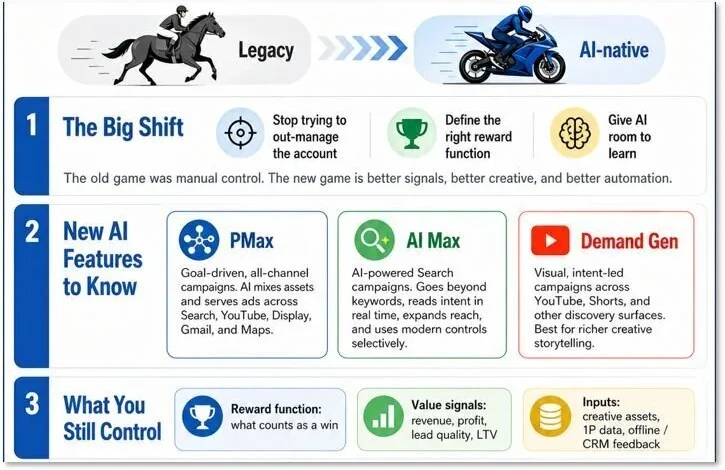
Performance Max (PMax) acts as an omnichannel campaign model where advertisers supply foundational assets—including text, images, videos, and brand logos—alongside budget parameters and conversion goals. The platform’s underlying AI dynamically mixes and matches these assets to deliver tailored advertisements across Search, YouTube, Display, Gmail, and Maps.
Similarly, AI Max functions as an automated, search-only campaign model that eliminates traditional constraints such as match types and manual keyword segregation. By assessing real-time user intent rather than relying strictly on typed keywords, AI Max broadens audience reach to capture high-value prospective customers. Complementing these search and multi-channel formats is Demand Gen, a visually immersive framework optimized for video-centric placements across YouTube Shorts and Discovery inventory.
Across all three formats, the human operator’s role has fundamentally evolved. Instead of dictating how ads are served, marketers control the "reward function"—the specific business outcomes and conversion values the AI is instructed to optimize toward.
The AI Maturity Assessment Framework
To help organizations objectively measure their transition from legacy practices to AI-native execution, maturity assessment models evaluate two primary dimensions: Capability Scoring and Depth Scoring. This dual-axis approach prevents organizations from overestimating their technological readiness based on isolated pilot projects.
Capability scoring measures the sophistication of an organization’s advertising practices on a scale from zero to four, moving from legacy manual operations (Level 0) to fully AI-native execution (Level 4). Concurrently, depth scoring evaluates how widely those capabilities are deployed across the enterprise, assessing the percentage of total ad spend, conversion value, or campaign volume governed by modern methodologies.
By calculating a composite maturity score across multiple operational dimensions, businesses can accurately categorize their digital maturity. Organizations scoring in the lower brackets are typically classified as legacy operators, while those achieving higher thresholds are recognized as advanced AI-driven advertisers.
Key Dimensions of Enterprise Advertising Maturity
A comprehensive maturity framework typically evaluates six critical operational pillars. Among these, Measurement and Value Architecture serves as the foundational cornerstone, assigned the highest weight in strategic assessments.
Measurement and Value Architecture
The efficacy of any machine learning model is intrinsically tied to the quality of the data it ingests. If an advertising algorithm is optimized for low-value proxies such as page views, basic sessions, or unweighted form submissions, the resulting business outcomes will reflect those flawed metrics.
Advanced organizations implement robust measurement frameworks that incorporate enhanced conversions, data-driven attribution, offline conversion imports, and value-based bidding. By feeding platforms precise financial metrics—such as actual revenue, profit margins, customer lifetime value (LTV), or CRM-verified lead quality—enterprises enable automated systems to target genuinely profitable consumer segments. A weak measurement foundation invalidates even the most sophisticated creative assets and campaign structures.
Search Operating Model
The second major dimension focuses on how search campaigns are structured and managed. Legacy operators frequently utilize granular account structures, exact-match keyword obsession, and heavy manual bid modifiers across devices and time zones. In contrast, a modern search operating model embraces Smart Bidding, broad match logic, responsive search ads, and comprehensive AI Max integration.
In an AI-dominated environment, excessive account segmentation restricts the data volume available to machine learning algorithms, hindering their ability to optimize effectively. Modern advertisers simplify campaign architectures, relinquishing micro-control in favor of strategic guardrails and brand safety controls.
Implications and Industry Analysis
The broader implications of this industry-wide shift touch upon organizational culture, talent acquisition, and financial performance. For marketing agencies and corporate marketing departments, the transition to AI automation requires a paradigm shift in how value is demonstrated to stakeholders. Proving worth through the sheer volume of daily manual tweaks is no longer viable. Instead, strategic value is derived from data architecture integrity, creative asset diversity, and business outcome governance.
Economic analyses suggest that companies successfully embracing automated advertising frameworks frequently experience significant efficiency gains. By allowing machine learning algorithms to process complex bidding signals in real time, enterprises can reduce wasted ad spend and scale revenue growth more effectively than those bound to manual oversight.
Furthermore, moving away from repetitive tactical tasks allows marketing professionals to focus on higher-level strategic initiatives, such as customer journey design, first-party data collection, and cross-functional business alignment. While the cultural friction associated with adopting new technologies can be challenging, the long-term operational advantages make the transition a necessity for competitive survival in the digital marketplace.
Conclusion
The digital advertising industry has definitively crossed the threshold from manual execution to machine-learning dominance. Organizations that cling to legacy operating models risk financial underperformance and strategic irrelevance. By adopting rigorous maturity assessment frameworks, auditing measurement architectures, and fully embracing platform automation, enterprises can position themselves for sustainable growth. The future of search marketing belongs not to those who attempt to out-manage algorithms, but to those who feed the machine superior data, creative excellence, and clear business intent.