The rapid ascent of Large Language Models (LLMs) and Retrieval-Augmented Generation (RAG) architectures has forced a fundamental decision upon engineering teams: should vector embeddings live alongside traditional relational data in a Postgres database, or do they require the specialized, purpose-built infrastructure of a dedicated vector database? For many, this choice is framed by aggressive vendor marketing rather than empirical evidence. However, by evaluating performance metrics at both the local development scale and the multi-million-record production threshold, a clearer picture emerges regarding the technical trade-offs between these two architectural paradigms.
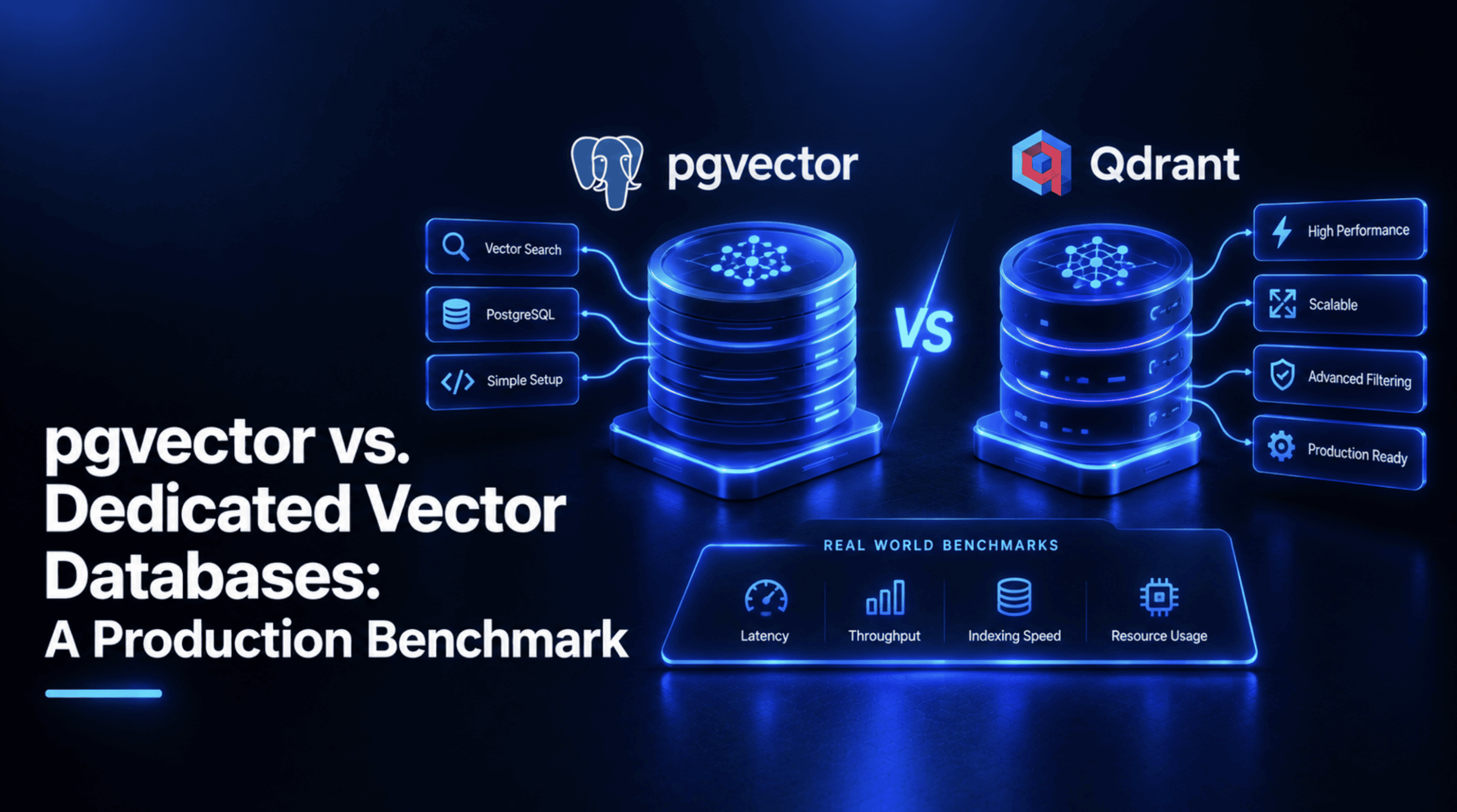
The core of the debate lies in the distinction between general-purpose database extensions and specialized search engines. pgvector, an open-source extension for PostgreSQL, has gained significant traction because it enables developers to store, index, and query vector embeddings using standard SQL. Conversely, dedicated vector databases—such as Qdrant, Pinecone, Weaviate, Milvus, and ChromaDB—are engineered from the ground up as standalone services optimized for the unique demands of high-dimensional vector similarity search.
The Evolution of Vector Search Infrastructure
The history of this architectural divide is relatively short. Before the 2022 explosion of generative AI, vector similarity search was largely the domain of specialized research labs and massive search companies. The arrival of pgvector allowed Postgres—a system already serving as the source of truth for millions of applications—to absorb this new functionality. By adding a native vector column type, pgvector removed the need for data synchronization between a primary relational database and a secondary vector index. This capability effectively neutralized the "sync tax," where data consistency issues often plague systems that move data between disparate storage engines.
However, as production workloads scaled into the tens of millions of vectors, the limitations of general-purpose architectures became a focal point of debate. Dedicated vector databases argue that their custom storage engines, distributed architectures, and native support for GPU acceleration provide superior performance, particularly regarding latency consistency and throughput under high concurrency.
Benchmarking Methodology and Local Prototyping
To understand these systems, one must test them under controlled conditions. A local benchmark—conducted on a standard machine using Docker—demonstrates the baseline behavior of these systems. By configuring both pgvector and Qdrant to use the same dataset (100,000 synthetic 1,536-dimension vectors) and the same indexing algorithm (HNSW with identical construction parameters), developers can observe the fundamental mechanics of search.
In such a test, both systems typically demonstrate sub-millisecond latency. While useful for verifying system integration and understanding API mechanics, these results are deceptive. At a scale of 100,000 vectors, the bottleneck is rarely the database itself, but rather the overhead of the surrounding application logic or network latency. The real disparity between these systems only manifests as the index size increases and the query concurrency rises to levels typical of high-traffic production environments.
Analysis of Production-Scale Performance
To derive actionable insights, one must look toward large-scale benchmarks. Recent data comparing Postgres (augmented with pgvectorscale and the StreamingDiskANN index) against Qdrant on a 50-million-vector dataset provides a more accurate view of how these systems perform under load. On hardware featuring 16 vCPUs and 128GB of RAM, the results indicate that neither approach is a panacea; rather, each excels under specific constraints.
At a 99% recall threshold, pgvector with specialized scaling extensions demonstrated a significant advantage in throughput, achieving 471.57 Queries Per Second (QPS) compared to Qdrant’s 41.47 QPS. This suggests that for applications prioritizing high-volume throughput, Postgres is a formidable competitor. However, Qdrant proved superior in managing tail latency. The P99 latency for Qdrant was measured at 38.71ms, significantly faster than the 74.60ms observed with the Postgres-based configuration. This makes Qdrant a more attractive option for services where consistent response times are critical to the user experience, such as real-time customer-facing chatbots or sub-millisecond recommendation engines.
Operational Implications for Enterprise Architecture
The choice between these systems extends beyond raw performance to the operational burden of the engineering team. The "pgvector" path is often the default for organizations with existing Postgres expertise. By keeping embeddings within the relational database, teams maintain transactional integrity, ensuring that a record update and its associated vector update occur within the same atomic transaction. This reduces the risk of data drift, where a search index becomes stale relative to the source record.
Conversely, the "dedicated database" path offers modularity. For massive, distributed systems, the ability to scale vector storage independently of relational data is a distinct advantage. Companies managing hundreds of millions or billions of records often find that the operational overhead of a dedicated system is justified by the performance gains in query predictability and the offloading of search-intensive compute from the primary transaction database.
Factors Influencing the Decision
When deciding between these two approaches, organizations should evaluate their requirements across four primary dimensions:
- Transactional Consistency: If your application requires that search results are perfectly synchronized with the underlying business data, pgvector provides the benefit of ACID compliance within a single system.
- Latency SLAs: If your product requires a hard tail-latency guarantee (e.g., ensuring no search request takes longer than 40ms), dedicated databases generally provide more stable performance profiles under concurrent load.
- Operational Complexity: If your team is already proficient in Postgres administration, the cost of adding a new, specialized infrastructure component may outweigh the incremental performance gains. Conversely, if your team is already managing a complex microservices architecture, adding another specialized service like Qdrant or Milvus may align better with existing operational workflows.
- Data Scale: For datasets under 10 million vectors, the performance differences are often negligible in the context of the total application response time. At this scale, developer productivity and system simplicity should be prioritized.
Future Outlook and Industry Trajectory
The current landscape suggests a convergence rather than a winner-take-all scenario. We are witnessing an ecosystem shift where general-purpose databases are adopting specialized indexing techniques (such as StreamingDiskANN) to close the gap with dedicated engines. Simultaneously, dedicated vector databases are improving their support for hybrid search—incorporating features like BM25 and metadata filtering—to mirror the functionality that made relational databases indispensable in the first place.
Ultimately, the "real" vector database is the one that meets the specific constraints of the application at the lowest operational cost. For most mid-sized enterprises, pgvector provides a sufficient, high-performance solution that leverages existing infrastructure. For organizations at the frontier of scale, or those with highly specific tail-latency requirements, the purpose-built performance of a dedicated vector engine remains the industry standard. The decision should not be driven by marketing narratives, but by the empirical reality of the organization’s current scale and its projected growth over the next 24 months. In the modern data stack, the best architectural choice is one that simplifies rather than complicates, and for many, the simplicity of a single, unified database remains the most compelling argument of all.
Related posts: