Speculative Decoding Explained: How This Breakthrough Technique Delivers 3x Faster LLM Inference

The rapid proliferation of large language models (LLMs) has transformed the landscape of artificial intelligence, yet a persistent architectural hurdle remains: the latency inherent in autoregressive text generation. While models have become exponentially more capable in reasoning and linguistic nuance, the underlying mechanism for producing output—generating one token at a time—has remained fundamentally unchanged since the inception of transformer architectures. This sequential process is the primary bottleneck for real-time applications such as autonomous coding agents, high-frequency customer service interfaces, and interactive virtual assistants. Speculative decoding has emerged as the industry-standard solution to this bottleneck, offering a method to increase inference speeds by 2x to 3x without requiring model retraining, quantization, or loss of output precision.
The Architecture of the Bottleneck: Memory-Bound Inference
To understand the necessity of speculative decoding, one must first examine the hardware constraints governing modern GPU utilization. When an LLM generates a response, it operates in an autoregressive loop. For each individual token produced, the entire set of model parameters—often spanning tens or hundreds of billions of weights—must be loaded from the GPU’s VRAM into the compute units.
In technical terms, LLM inference is "memory-bandwidth bound" rather than "compute bound." While NVIDIA’s H100 and A100 GPUs possess massive floating-point operation (FLOP) capacities, those units often sit idle while waiting for the model weights to traverse the memory bus. Because each token generation step requires a full pass through the model’s weights, the latency is dictated by the speed of memory access rather than the raw processing power of the silicon. This is why adding more compute power to a server cluster often yields diminishing returns for single-stream generation tasks.
The Chronology and Emergence of Speculative Decoding
The concept of speculative decoding gained significant academic and industry traction around early 2023, with foundational papers from researchers at Google and DeepMind, alongside parallel work from the open-source community. The core innovation was the realization that while generating a token is expensive, verifying a sequence of tokens is relatively cheap.
The timeline of its adoption accelerated quickly as production inference engines began integrating the technology. By mid-2023, frameworks like vLLM and Hugging Face’s TGI (Text Generation Inference) began supporting speculative execution as a primary performance optimization. This transition moved the technology from a laboratory curiosity to a production-ready feature, allowing companies to reduce the total cost of ownership (TCO) for their AI deployments by significantly decreasing the time-to-first-token and the overall generation latency.
The Mechanics of the Two-Model System
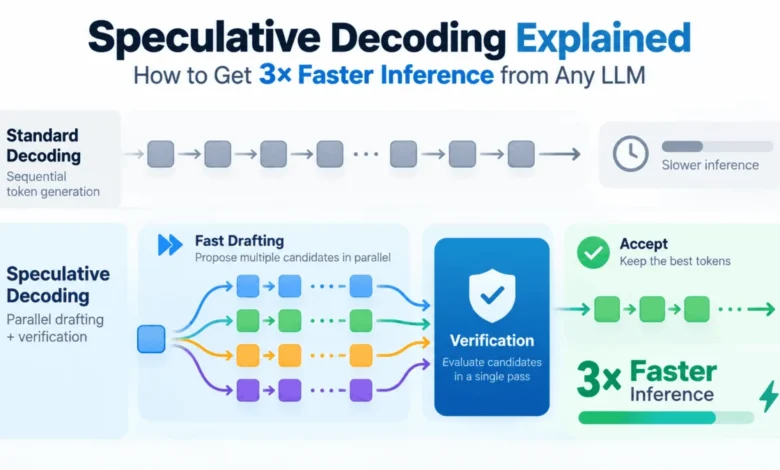
The efficacy of speculative decoding lies in its dual-model architecture: a "draft" model and a "target" model.
- The Drafting Phase: A smaller, highly efficient model—often a few orders of magnitude smaller than the target model—predicts a sequence of $K$ tokens. Because this draft model is lightweight, it can produce these candidates with minimal latency.
- The Verification Phase: The target model then takes the entire candidate sequence and processes it in parallel. This is the crucial step: rather than performing $K$ sequential passes, the target model performs a single forward pass.
- The Acceptance Criterion: Using a probabilistic sampling method, the target model compares the draft tokens against its own internal predictions. If the draft tokens align with the target model’s probability distribution, they are accepted. If not, the target model rejects the incorrect token and samples a replacement.
This process ensures that the statistical output is mathematically identical to what the target model would have produced on its own. The "probabilistic guarantee" is the cornerstone of the technique; it is not an approximation or a lossy compression. It is a reordering of work that exploits the parallel architecture of modern GPU hardware.
Supporting Data and Performance Metrics
Empirical data from major inference providers demonstrates that the success of speculative decoding is heavily dependent on the "acceptance rate." In standard testing environments, a well-calibrated draft model can achieve acceptance rates of 70% to 80% on tasks involving natural language, programming code, and structured data.
- Latency Reduction: Studies have shown that when a draft model correctly predicts the target model’s output, the effective throughput increases by a factor of 2.5x to 3x.
- Computational Efficiency: In scenarios where the draft model is highly accurate, the system performs fewer memory-heavy operations, effectively "buying" more tokens for the same energy cost.
- Trade-offs: If the draft model is poorly matched to the target—for example, using a draft model trained on scientific papers to assist a target model generating creative poetry—the rejection rate rises, and the overhead of the draft model can actually result in a minor net performance decrease.
Evolution: Beyond the Two-Model Paradigm
While the two-model approach remains the standard, recent research has pushed toward "speculative decoding without draft models." This represents the next frontier in efficient inference.
- Medusa: This approach removes the need for a secondary model by adding multiple "heads" to the target model itself. These heads are trained to predict several future tokens simultaneously, allowing the model to draft its own candidates.
- Eagle: A more sophisticated iteration that leverages hidden states from the target model to make more accurate predictions than simple output-token drafting.
- Prompt Lookup: A zero-cost method that scans the input prompt for repeating n-grams. This is particularly effective for documentation and coding tasks, where variable names and function signatures are repeated frequently.
Broader Impact and Industry Implications
The implications for the broader AI industry are substantial. As organizations move toward deploying LLMs in mission-critical environments, the ability to serve more users with the same hardware footprint is a key competitive advantage.
However, industry analysts note that there are specific constraints to this technology. In high-density "batching" environments—where a server is handling hundreds of concurrent requests—the compute overhead required to run both a draft and target model can be counterproductive. In these high-throughput scenarios, the hardware may be better utilized by serving additional requests sequentially rather than attempting to accelerate a single request through speculative decoding.
Furthermore, the rise of specialized hardware—such as custom AI accelerators and next-generation HBM (High Bandwidth Memory) architectures—may eventually mitigate the memory-bandwidth bottleneck that necessitated speculative decoding in the first place. Until that hardware shift occurs, however, speculative decoding remains the most effective software-layer optimization available for reducing inference latency.
Conclusion: The New Standard for Inference
Speculative decoding has fundamentally shifted the discourse regarding LLM deployment. It demonstrates that the "one-token-at-a-time" paradigm is not a hard constraint of machine intelligence, but rather a limitation of existing inference strategies. By decoupling the generation and verification steps, engineers have unlocked a path toward real-time AI interaction that was previously thought to be impossible with current-generation hardware. As integration into standard frameworks like llama.cpp and vLLM continues to mature, speculative decoding is evolving from a specialized optimization into a standard operational requirement for any robust, production-grade LLM deployment.