Optimizing AI Agent Performance Through Markdown Data Serialization: A Strategic Approach to Reducing Token Consumption

The rapid proliferation of autonomous AI agents has fundamentally altered how organizations interact with search engines, databases, and external web APIs. While these agents offer unprecedented capabilities in information retrieval and synthesis, they have also introduced a significant operational challenge: the "token tax." As AI models rely on context windows—the amount of data an LLM can "read" at once—the efficiency of the data provided to these models has become a primary bottleneck. Recent industry data indicates that AI agents frequently exhaust vast amounts of tokens on extraneous metadata, tracking parameters, and repetitive JSON structures that offer little to no utility for the model’s reasoning process.
A significant shift in data delivery is currently underway to address this inefficiency. By pivoting from traditional JavaScript Object Notation (JSON) to streamlined Markdown formatting, developers are achieving substantial reductions in token usage—in some cases exceeding 70 percent. This transition represents a maturation of how engineering teams integrate large language models (LLMs) into production environments, moving away from "black box" consumption toward highly curated, token-efficient data pipelines.
The Anatomy of Token Bloat in AI Workflows
To understand why token consumption has become a critical fiscal and technical concern, one must first look at how LLMs process information. When an AI agent performs a search, it does not merely receive a simple answer; it receives a structured payload. In a standard JSON response, every brace, bracket, key-value pair, and escape character consumes a portion of the model’s context window.
Consider a typical search request for local services, such as "coffee shops in Seattle." A raw JSON response from a search API often includes extensive metadata: coordinates, image URLs, tracking pixels, advertisement identifiers, and nested arrays of historical review data. While this data is essential for a front-end application displaying a map, it is largely irrelevant to an LLM tasked with summarizing the top three coffee shops. The model is forced to "spend" tokens reading through thousands of characters of machine-readable overhead that do not contribute to the final synthesis of the answer.
The financial implications are compounded by the nature of recursive agentic loops. If an agent is designed to self-correct or refine its search query, it may perform multiple iterations. Each iteration consumes the full payload, meaning the cost of a single poorly formatted API response is multiplied by the number of steps in the agent’s execution chain.
Chronology of the Shift Toward Efficiency
The industry’s move toward specialized serialization formats began in earnest as enterprises started scaling AI agents from prototypes to production-grade tools in 2023. Early implementations prioritized JSON because it was the universal standard for web development. However, as developers encountered the limitations of context windows—and the high costs associated with models like GPT-4 or Claude 3.5—the focus shifted toward data pruning.
In late 2023 and early 2024, engineers began implementing "pre-processing" layers. These were custom scripts designed to strip JSON payloads of unnecessary fields before passing them to the model. While effective, this added latency and required ongoing maintenance as API schemas evolved.
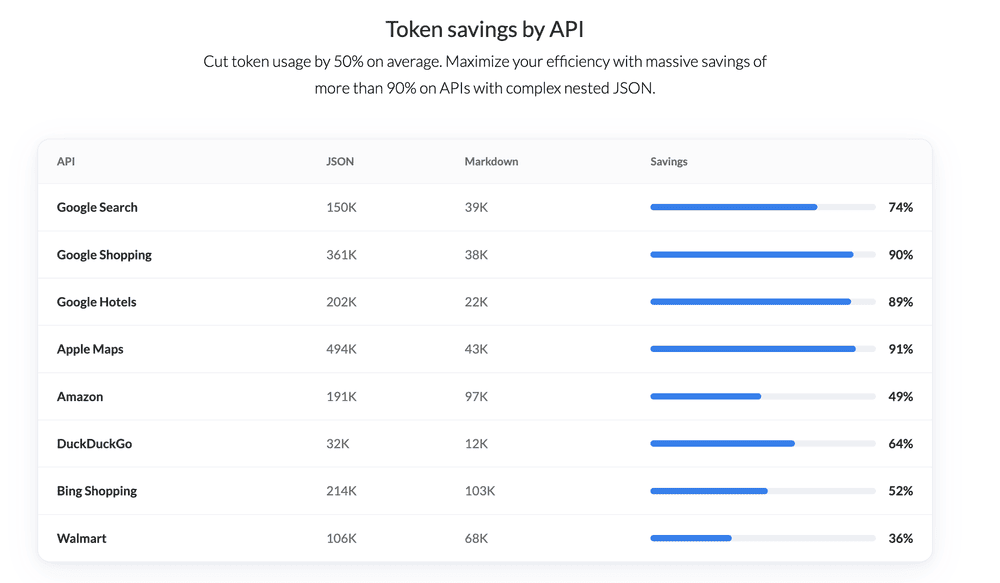
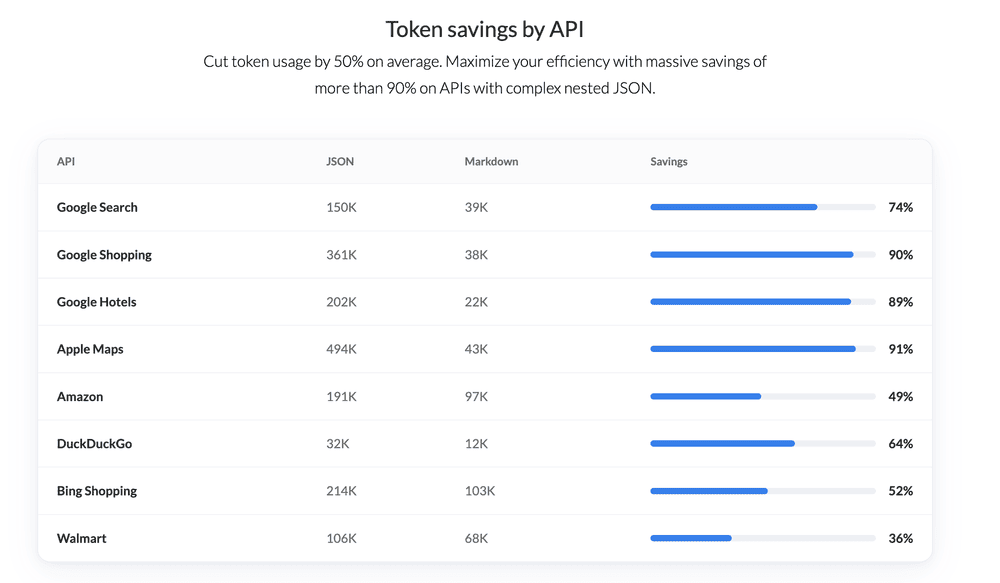
The introduction of native Markdown support by platforms like SerpApi represents a shift from post-processing to source-side optimization. By allowing the API to deliver data in a human-readable, token-sparse format, the responsibility of data hygiene is shifted to the data provider. This allows developers to reduce the complexity of their middleware and ensure that the model receives only the "signal" rather than the "noise."
Empirical Evidence: The 74 Percent Reduction
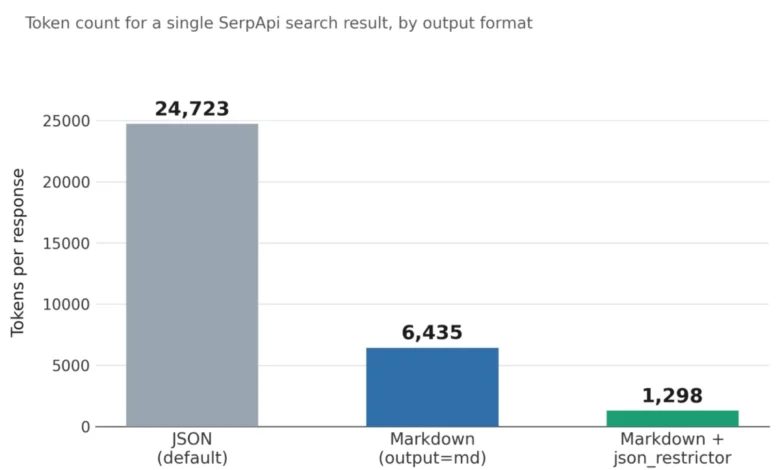
The efficacy of this approach is backed by measurable benchmarks. In recent tests comparing standard JSON outputs to Markdown-serialized outputs, the reduction in token consumption was dramatic. For a standard query such as "coffee," a raw JSON response might require approximately 24,723 tokens to represent the data in its entirety. When the same data was restructured into Markdown, the requirement dropped to 6,435 tokens—a reduction of roughly 74 percent.
Further optimization, using selective field filtering (or "restricting"), pushed the requirements down to 1,298 tokens. This represents an order-of-magnitude efficiency gain. To put this in perspective, for a high-volume application making one million requests per month, this reduction could potentially save tens of thousands of dollars in LLM inference costs while simultaneously allowing the model to hold more complex instructions or historical data in its context window.
JSON vs. Markdown: Determining the Use Case
The industry is currently establishing a clear taxonomy for when to use specific data formats. Despite the clear benefits of Markdown for LLM efficiency, it is not a universal replacement for JSON.
JSON remains the gold standard for deterministic, machine-to-machine communication. When an application requires precise data types—such as 32-bit floats for ratings, integer-based currency values for financial calculations, or strict Boolean flags for binary decisions—JSON is indispensable. Parsing a Markdown table to extract a float value requires an additional layer of regex or string processing, which can introduce errors.
Conversely, Markdown excels in "agentic" tasks: summarization, sentiment analysis, comparative reasoning, and information synthesis. LLMs are natively trained on vast amounts of Markdown-formatted text (from sources like GitHub and Wikipedia), making them exceptionally adept at parsing tables, headers, and lists. By providing data in the format the model "prefers" to read, developers reduce the risk of "hallucinations" that can occur when a model struggles to parse complex, deeply nested JSON structures.
Implementing Token-Efficient Pipelines
For developers seeking to implement these efficiencies, the process is becoming increasingly standardized. The most effective method currently involves utilizing server-side query parameters. Rather than requesting a "blob" of data and filtering it locally, modern APIs allow developers to pass a flag (such as output=md) or utilize a field restrictor.
This approach offers two distinct advantages:
- Network Latency Reduction: Smaller payloads result in faster transfer times between the API server and the application, reducing the overall latency of the agent’s loop.
- Reduced Cognitive Load for the LLM: By removing internal tracking noise and duplicate fields at the source, the agent spends less "computational time" sorting through irrelevant data, which can lead to faster inference and higher-quality outputs.
Broader Implications for the AI Ecosystem
The trend toward Markdown-based data delivery is indicative of a broader maturation in the field of AI engineering. We are moving away from the "data dumping" phase, where developers gave models as much information as possible in the hopes of achieving better accuracy. We are entering an era of "curated context," where the quality, format, and efficiency of the input data are recognized as being just as important as the model architecture itself.
As the industry continues to refine these practices, we can expect to see:
- Standardized Token-Efficiency Metrics: Organizations will likely begin to include "tokens per query" as a key performance indicator (KPI) for their AI infrastructure, similar to how they currently track CPU or memory usage.
- API Evolution: More data providers are expected to offer multiple serialization formats tailored specifically to the needs of LLMs, rather than just the needs of web browsers.
- Lower Barrier to Entry: As inference costs drop through better optimization, more businesses will find it economically viable to deploy autonomous agents for complex, real-time tasks that were previously too expensive to automate.
Conclusion
The "token tax" is no longer an unavoidable cost of doing business in the AI space. By adopting smarter serialization strategies—specifically the transition from rigid JSON to LLM-optimized Markdown—developers can significantly improve the performance, cost-efficiency, and reliability of their AI agents. While JSON will continue to serve as the backbone for programmatic data pipelines, Markdown has emerged as the essential language for machine reasoning. For those currently building on top of search and retrieval APIs, auditing the structure of the data being fed into the context window is no longer an optional optimization; it is a fundamental requirement for building scalable and sustainable AI systems.