How to Build a Multi-Modal RAG Pipeline for Images and Documents in Python

The Limitations of Text-Centric Retrieval
For the past several years, the standard RAG paradigm has relied on segmenting documents into text chunks. This methodology functions effectively for narrative-heavy content such as legal transcripts or white papers. However, when applied to technical reports, quarterly financial filings, or architectural specifications, this approach falters. Data tables, if not parsed correctly, lose their row-column relationships, rendering numerical data incomprehensible to the language model. Furthermore, charts and diagrams—which often contain the summary insights of an entire section—are discarded by text-only parsers.
The consequences of this "blindness" are substantial. In a study of industrial document processing, it was found that nearly 40% of critical insights in technical manuals are contained within non-textual elements. Ignoring these elements forces the AI to provide incomplete or potentially misleading answers. The multi-modal approach rectifies this by synthesizing the contextual intelligence of vision-language models with the structural efficiency of vector databases.
Chronology of the Shift Toward Vision-Language Integration
The rise of multi-modal RAG follows a logical timeline within the field of Artificial Intelligence development:
- 2020–2022 (The Text Era): RAG systems emerge, primarily utilizing BERT-based embeddings and simple semantic search to retrieve text snippets.
- 2023 (The Advent of Vision-Language Models): The release of GPT-4 with Vision (GPT-4V) and subsequent vision-language models (VLMs) demonstrated that AI could interpret visual data with human-level accuracy.
- 2024 (The Multi-Vector Emergence): Development of the Multi-Vector Retriever, a framework that allows for the decoupling of search indices (summaries) from raw data (images/tables), provided the technical infrastructure needed to scale these systems.
- 2025–Present: The industry is now focusing on production-grade pipelines, utilizing tools like
unstructuredfor parsing and vector databases like Chroma or Pinecone for storage.
Technical Implementation: A Four-Stage Architecture
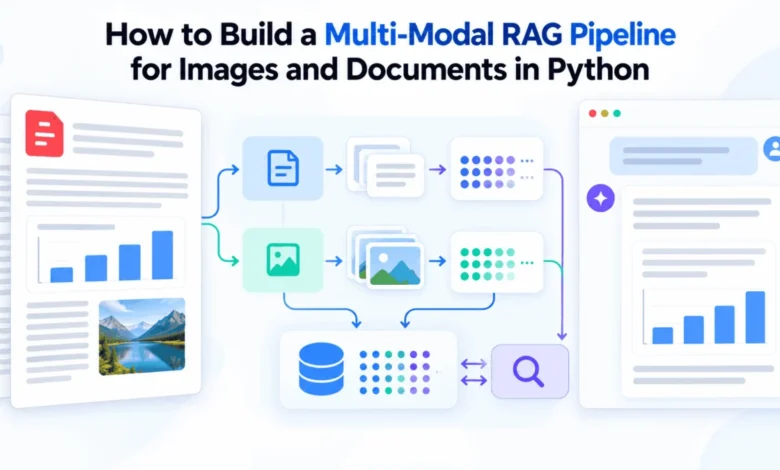
To build a resilient multi-modal RAG pipeline, developers must follow a rigorous four-stage process that ensures both visual and textual data are indexed for high-recall retrieval.
Stage 1: Granular Document Parsing
The process begins with advanced document partitioning. Utilizing the unstructured library, the pipeline acts as a sophisticated reader that categorizes document elements into "CompositeElements" (text) and "ImageElements." By setting the infer_table_structure parameter to true, the system preserves the metadata relationships of tabular data, which is essential for ensuring that the context of a cell remains tethered to its headers.
Stage 2: Semantic Summarization for Visual Assets
Because current vector databases are optimized for text, raw images cannot be directly indexed for semantic search. To solve this, each image must be processed through a VLM, such as GPT-4o. The model generates a descriptive, searchable text summary of the image’s content. This summary acts as a "semantic proxy." When a user queries the system, the vector database retrieves these summaries; if the query matches a summary, the system retrieves the original image path. This ensures that the system maintains a high degree of search accuracy without the computational overhead of storing raw image embeddings in the vector space.
Stage 3: The Multi-Vector Storage Strategy
The core of the system is the MultiVectorRetriever. Unlike a standard retriever, which maps one query to one document, this architecture maintains two distinct stores:
- The Vector Store: Contains the embeddings of both text chunks and the text-based summaries of images.
- The Document Store: An
InMemoryStoreor persistent database that holds the raw, original content linked to unique identifiers (UUIDs).
By assigning a common ID to a summary and its parent image, the system creates a relational bridge. When the vector store identifies a relevant summary, the retriever pulls the corresponding image from the document store.
Stage 4: Multimodal Synthesis and Reasoning
The final step is the generation phase. When a user submits a question, the retriever fetches both text chunks and images. The pipeline then constructs a structured prompt for the LLM, combining the retrieved text and the base64-encoded visual data. The LLM then performs a reasoning task that synthesizes information from both modalities, providing an answer that is contextually grounded in the entire document.
Broader Impact and Industry Implications
The implications for professional sectors are profound. In the financial sector, analysts can now query thousands of pages of annual reports to identify trends in revenue charts that were previously invisible to automated systems. In manufacturing, maintenance technicians can query complex, image-heavy repair manuals to receive visual-textual step-by-step instructions.
From a technical standpoint, the shift toward this architecture reduces "hallucination" rates. By grounding the model in the actual image rather than relying on a potentially misinterpreted text description, the system provides verifiable evidence. However, this comes with increased API costs and latency. Each image processed through a VLM at indexing time incurs a cost, requiring developers to implement filtering strategies—such as ignoring small icons or repetitive graphic elements—to maintain cost efficiency.
Future Outlook: Toward Native Multimodality
While the current approach relies on separate parsing and summarization steps, the future of the field is moving toward native multi-modal embedding models. Projects such as ColPali are currently pioneering the use of vision-based embeddings that treat a document page as a single image, bypassing the need for complex, error-prone parsing. As these models mature, the "parsing" step will likely vanish, replaced by end-to-end vision-language systems that "see" documents exactly as humans do.
For now, the multi-vector RAG approach stands as the industry standard for production-ready, document-intensive AI applications. It offers a robust, scalable, and highly accurate method to extract value from the vast, neglected landscape of visual data trapped in legacy document formats. By adopting this architecture, organizations are not merely building better search tools; they are creating intelligence layers that can finally comprehend the complex, multi-modal reality of modern business communication.
Related posts: