Choosing a Chunking Strategy for Your LLM Apps: A Decision-Tree Approach

The Evolution of RAG and the Chunking Problem
Retrieval-augmented generation emerged as the primary solution to the limitations of Large Language Models, specifically regarding their static knowledge cutoff dates and tendencies toward hallucinations. By grounding models in private, up-to-date data, RAG provides a bridge between proprietary information and generative capabilities. However, early implementations often ignored the preprocessing phase, opting for "naive" fixed-size chunking.
In the nascent stages of the LLM boom (2022–2023), developers frequently split text into 500-token blocks with a 50-token overlap. While this approach provided a baseline for functionality, it frequently resulted in disjointed context. A document containing a complex legal clause or a detailed technical specification would often be severed at the most critical juncture, rendering the retrieved data useless for the model’s reasoning process. As of 2024, industry data indicates that RAG pipelines with optimized chunking strategies demonstrate a 20% to 40% increase in retrieval precision compared to those using static, uniform splitting.
Establishing a Strategic Decision Framework
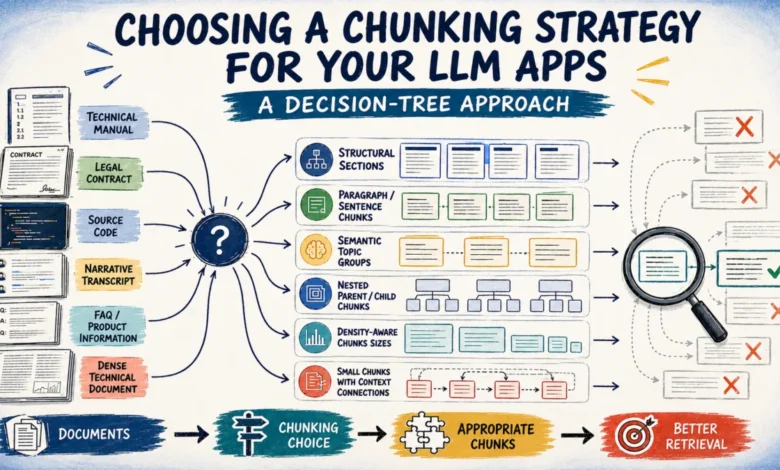
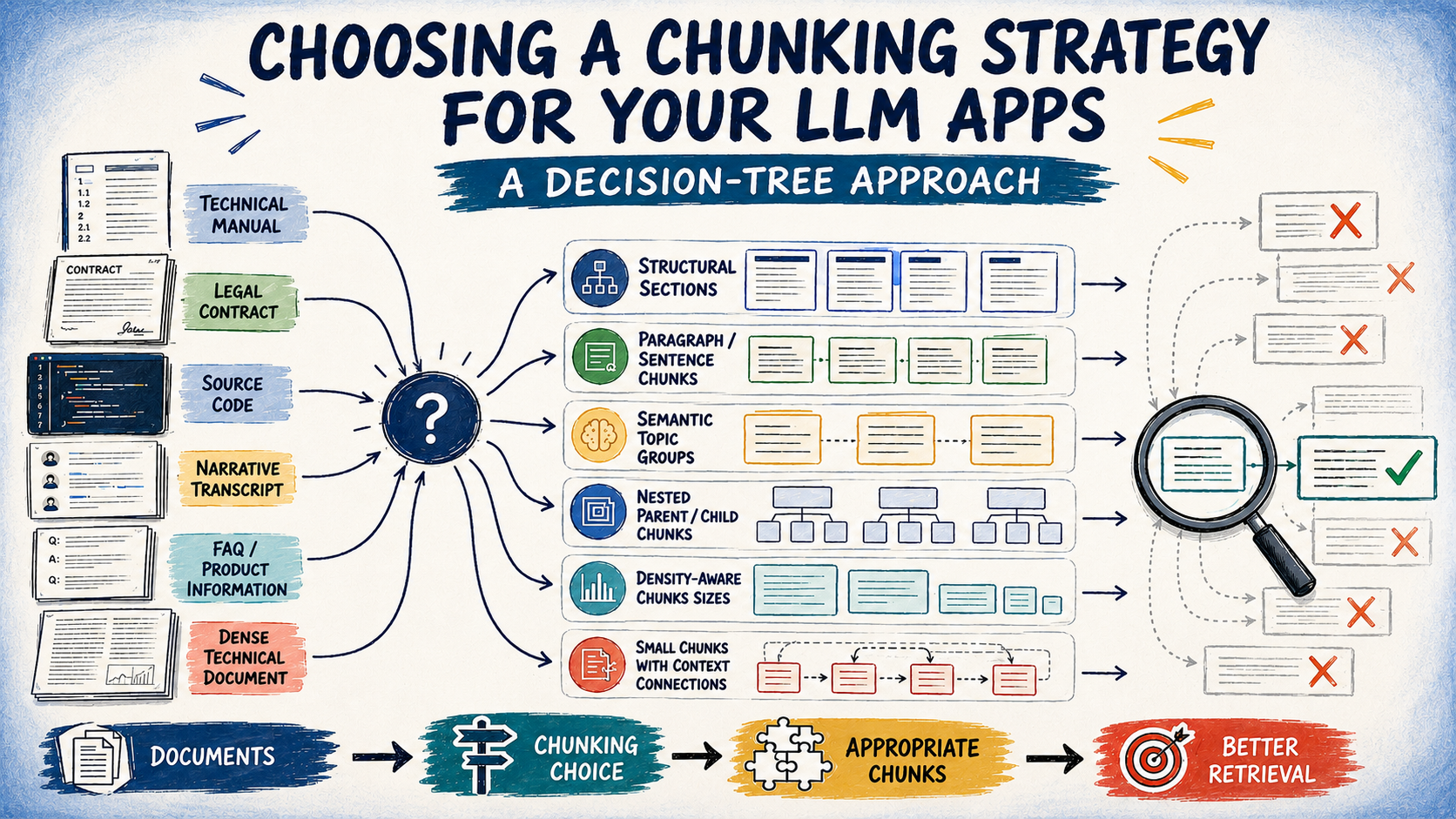
The selection of a chunking strategy should not be an arbitrary choice but a calculated technical decision based on the nature of the dataset. To streamline this process, architects are increasingly adopting a structured decision-tree approach that evaluates the inherent properties of the source material.
1. Assessing Structural Integrity
The first consideration is whether a document possesses a native hierarchy. Many modern documents are not monolithic blocks of text; they are structured via Markdown, HTML, JSON, or XML tags. When documents contain clear headers, sections, or bulleted lists, "document-based chunking" is the gold standard. By respecting these natural boundaries, the RAG system ensures that a section title remains attached to its descriptive content, providing the embedding model with the context necessary to create a high-quality vector representation.
2. Managing Contextual Dependencies
In scenarios where information is interconnected—such as in regulatory filings, academic papers, or complex software manuals—local chunking can destroy the meaning of the content. A definition established in the first paragraph of a policy document might be referenced in the final paragraph. To solve this, developers are turning to "late chunking." By utilizing long-context embedding models, developers can process the entire document as a single semantic unit first, and only after the embedding is generated do they derive chunk-level vectors. This maintains the "global" context of the document within each individual chunk.
3. Addressing Information Density
Not all documents are created equal. A technical white paper may contain high-density data on every page, whereas a narrative report might contain large swaths of "fluff" interspersed with critical facts. Adaptive chunking has emerged as a solution for these heterogeneous datasets. This method uses an algorithm to monitor information density, creating smaller, more granular chunks where the information density is high and larger, more summarized chunks where the narrative is more fluid. This ensures that the RAG system does not overwhelm the context window with low-value data while simultaneously preserving the integrity of dense technical information.
Comparative Analysis of Chunking Strategies
The following table synthesizes the primary methods currently utilized in enterprise RAG architectures, categorized by their specific use cases and implementation trade-offs.
| Strategy | Primary Use Case | Complexity Level |
|---|---|---|
| Fixed-size | Simple, rapid prototyping | Low |
| Recursive | General-purpose, uniform documents | Low-Medium |
| Document-based | Structured data (PDFs, Markdown) | Medium |
| Semantic | Documents with shifting topics | Medium-High |
| Late Chunking | Interdependent/Cross-referenced text | High |
| Agentic | Large, varied document corpora | High |
Implementation Pitfalls and Mitigation Strategies
Industry practitioners have noted that even a well-selected strategy can fail if the implementation lacks rigorous testing. A common failure point is "boundary drift," where a chunking algorithm consistently cuts off a table or a code snippet mid-process.
Data scientists at major AI labs report that when these symptoms appear, the most effective remediation is often a move toward "recursive character text splitting." This approach prioritizes natural language markers—such as double newlines, single newlines, and sentence endings—in a hierarchical order. If the chunk remains too large after these cuts, the algorithm then resorts to word-level and character-level splits. This cascading logic prevents the loss of information and maintains the logical flow of the text.
The Role of Agentic Systems
As organizations move toward "Agentic RAG," the chunking process is becoming increasingly automated. In these systems, an LLM agent serves as the pre-processor. Before the document is indexed, the agent performs a quick scan to determine the most effective strategy for that specific file. For example, the agent might identify a legal contract and apply a "Document-based" strategy, then pivot to "Semantic" chunking for a disorganized collection of meeting transcripts. While this adds significant computational cost during the ingestion phase, it drastically reduces the noise-to-signal ratio during retrieval, ultimately lowering the long-term cost of API calls to the generative model.
Future Implications and Conclusion
The trajectory of RAG technology suggests that we are moving away from manual, one-size-fits-all preprocessing. The future of data retrieval lies in dynamic, context-aware systems that treat the document structure as a first-class citizen.
Looking forward, the industry is expected to lean heavily into "LLM-based chunking," where models are specifically fine-tuned to recognize logical breakpoints within raw text. While this approach is currently the most expensive due to the compute required, the resulting retrieval accuracy is unparalleled. As hardware costs decline and model efficiency improves, this will likely become the standard for mission-critical applications.
For organizations currently building out their retrieval pipelines, the recommendation is clear: start with the simplest strategy that addresses the document’s structure, monitor retrieval performance through metrics like Mean Reciprocal Rank (MRR), and introduce advanced, computationally expensive techniques only when the data demands it. By treating chunking as a core architectural component rather than a peripheral configuration setting, developers can build RAG systems that are not only accurate but also robust enough to handle the complexities of real-world documentation. The goal is to create a seamless link between the latent knowledge in the database and the query-processing capabilities of the model, ensuring that every byte of information is leveraged to its fullest potential.