The Unseen Influence: Why Share of Voice is the New Imperative for Digital Brands


Traditional analytics dashboards, while meticulously tracking clicks and website traffic, frequently present an incomplete narrative of a brand’s true digital presence. In an increasingly fragmented digital landscape, where buyer journeys extend beyond direct website visits to encompass AI-generated answers and community discussions, brands are realizing that a significant portion of their visibility, and potential influence, remains unquantified by conventional metrics. When a prospective customer encounters a competitor’s mention in an AI-summarized search result or navigates a Reddit thread where a brand is conspicuously absent, this represents a tangible loss of visibility that will never register in standard traffic data. This growing blind spot underscores the critical importance of Share of Voice (SoV) as a comprehensive metric designed to capture what traditional traffic data cannot.

Understanding Share of Voice: Beyond Clicks and Impressions
Share of Voice measures a brand’s relative visibility against its competitors across all pertinent marketing channels where buyers conduct research and form purchasing decisions. While SoV historically tracked a brand’s proportion of advertising expenditure within a market, its evolution reflects the complexities of modern digital engagement. Today, SoV encompasses a broader spectrum, measuring a brand’s presence across diverse touchpoints including organic search, AI search, social media, online review platforms, and specialized community forums. In essence, SoV quantifies the percentage of the market conversation a brand effectively owns within its category, relative to its rivals.
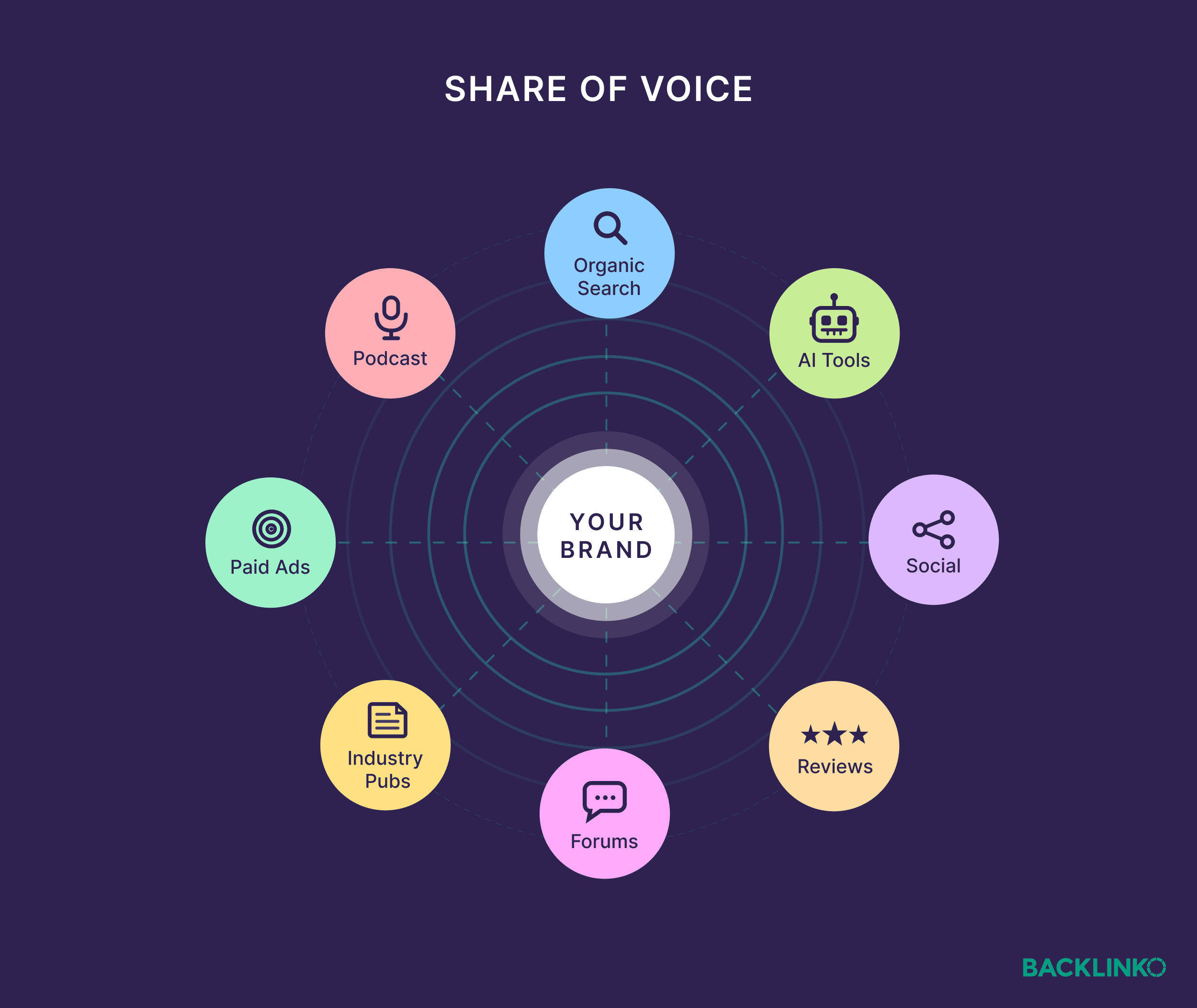
The current focus on search-centric SoV, encompassing both organic and AI-driven results, is driven by two key factors: search remains the channel where buyers exhibit the strongest purchase intent, and it offers the most mature and measurable competitive data. This guide will delve into a strategic framework for measuring SoV in this crucial domain and transforming that data into actionable business decisions.
The Shifting Landscape of Digital Visibility: Why SoV Matters Now More Than Ever
The accelerating pace of digital transformation and the emergence of advanced AI have profoundly altered how consumers discover and engage with brands, rendering SoV an indispensable Key Performance Indicator (KPI). Here are three primary reasons for its heightened importance:
-
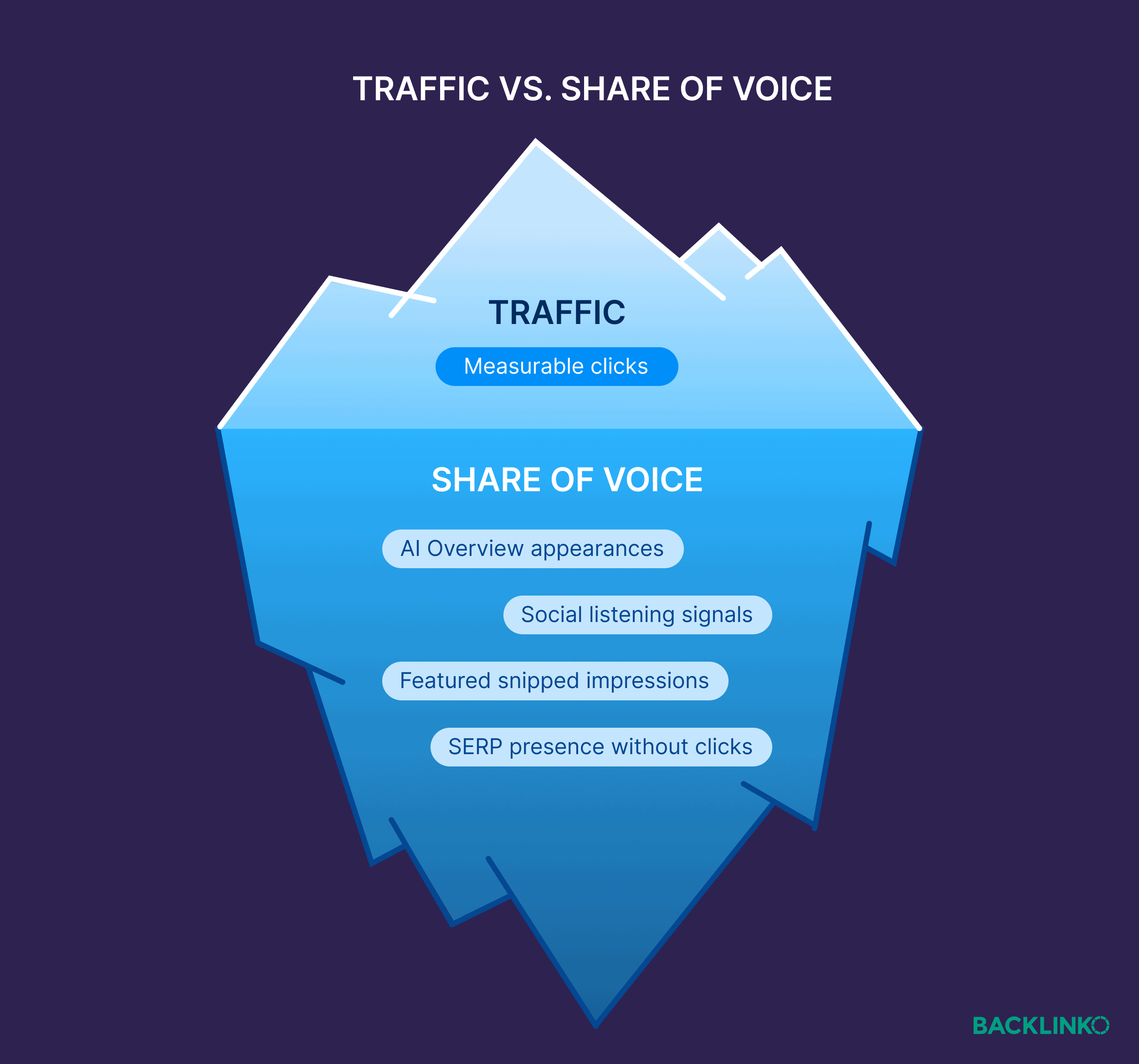
Tracking Visibility Beyond Traditional Traffic Data: Organic traffic data alone offers a partial view, a fragment that is progressively shrinking. The rise of "zero-click searches"—where users find answers directly within AI Overviews, featured snippets, or large language model (LLM) responses without clicking through to a website—means that a substantial segment of brand visibility is never recorded by tools like Google Analytics. This renders traffic a lagging indicator of actual brand exposure. SoV, conversely, acts as a leading indicator, measuring how prominently a brand appears within a buyer’s consideration set, irrespective of a direct website click.
Consider a scenario: A user queries "best project management software for remote teams" in an AI search engine. The AI provides a summary listing five tools, including your brand. The user reviews this information, performs no immediate click, but later directly navigates to your website to sign up for a demo. Traditional analytics would categorize this as "direct traffic," failing to attribute the initial brand discovery to the AI search. SoV, however, accurately identifies that your brand was present and influential in the critical consideration phase of a high-intent query. This capability is vital, especially as industry reports, such as those by SparkToro, indicate that over 65% of Google searches result in zero clicks, a trend exacerbated by AI integration.
-
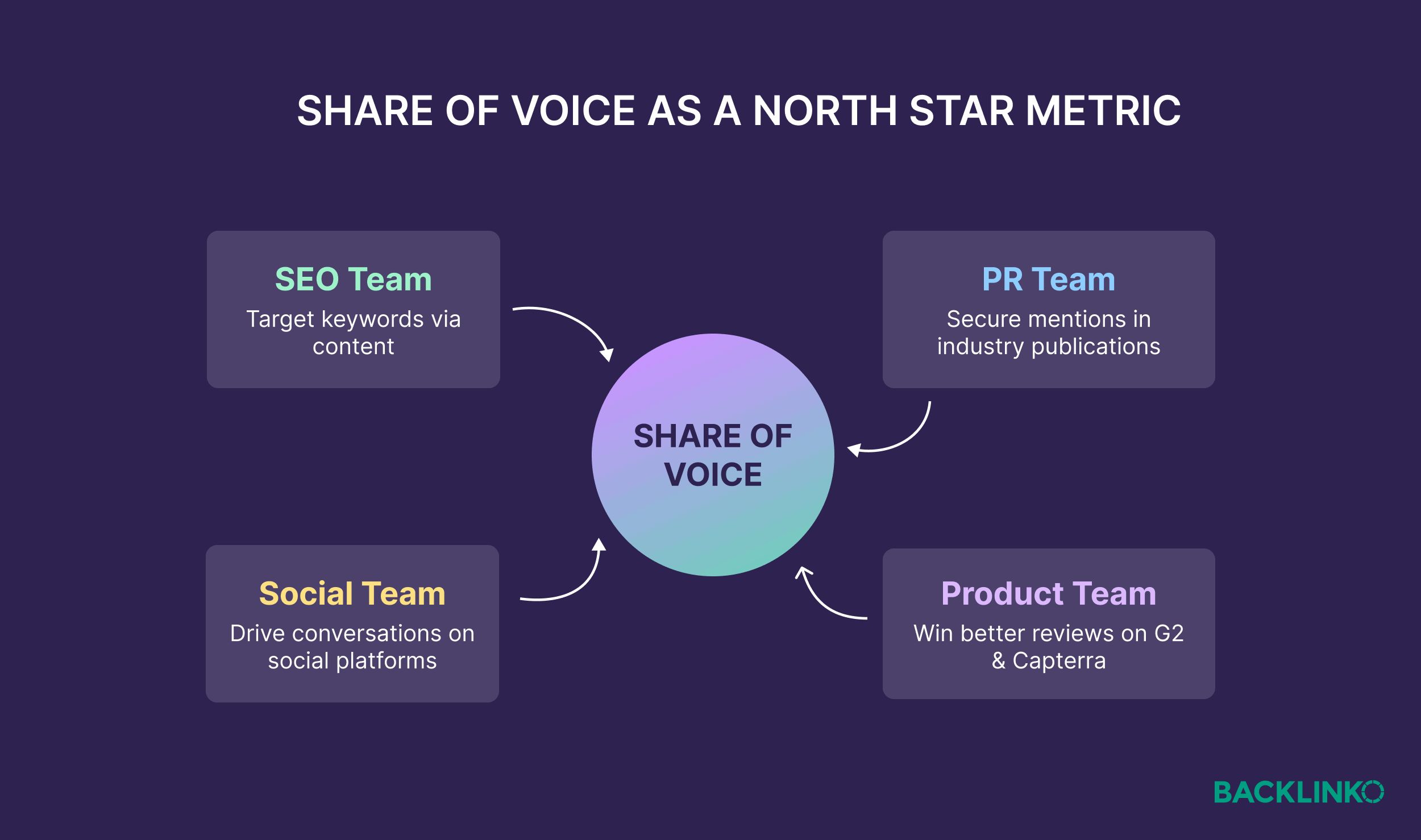
A Unified "North Star" Metric for Marketing Teams: Modern marketing departments often operate in silos, with SEO teams targeting website visits, PR teams focusing on media mentions, and social media teams prioritizing engagement rates. Each group tracks its own KPIs, optimizing for disparate outcomes. The enduring power of SoV lies in its capacity to serve as a singular, unifying "North Star" metric around which all marketing efforts can coalesce. When every team comprehends how their individual contributions feed into a collective visibility percentage, it fosters unparalleled collaboration and strategic alignment.
For instance, the content marketing team can optimize articles for long-tail keywords that feed AI answers, while the SEO team ensures technical foundations support organic ranking. The PR team can strategically secure mentions on authoritative sites that LLMs frequently cite, and the product team can ensure product descriptions and user guides are clear and comprehensive for AI summarization. This holistic approach, driven by a shared SoV goal, transforms fragmented efforts into a cohesive brand-building engine. Industry experts, such as those at Forrester, increasingly advocate for unified metrics like SoV to break down departmental barriers and foster a more integrated marketing strategy, especially in complex digital ecosystems.
-
Navigating the Rapid Evolution of AI Search: The landscape of search is in constant flux, with AI-driven experiences rapidly gaining prominence. As Google integrates AI Overviews and other LLMs like ChatGPT and Perplexity become primary information sources, brands face a new frontier of visibility. SoV, particularly its AI component, offers a framework to measure presence in these nascent, yet profoundly influential, channels. This ensures brands are not merely reactive but proactive in shaping their digital destiny. The ability to track and influence how AI platforms perceive and recommend a brand is quickly becoming a non-negotiable aspect of competitive strategy.
A Strategic Framework for Measuring Share of Voice in the Digital Age
Measuring SoV, especially across the evolving domains of organic and AI search, requires a systematic approach. The following four steps outline a robust methodology:
Step 1: Define Your Industry Landscape
The foundational step involves precisely delineating the competitive terrain and identifying the specific keywords and topics that will be tracked. Without clear boundaries, the analysis risks either missing critical insights or becoming overwhelmed by irrelevant data.

-
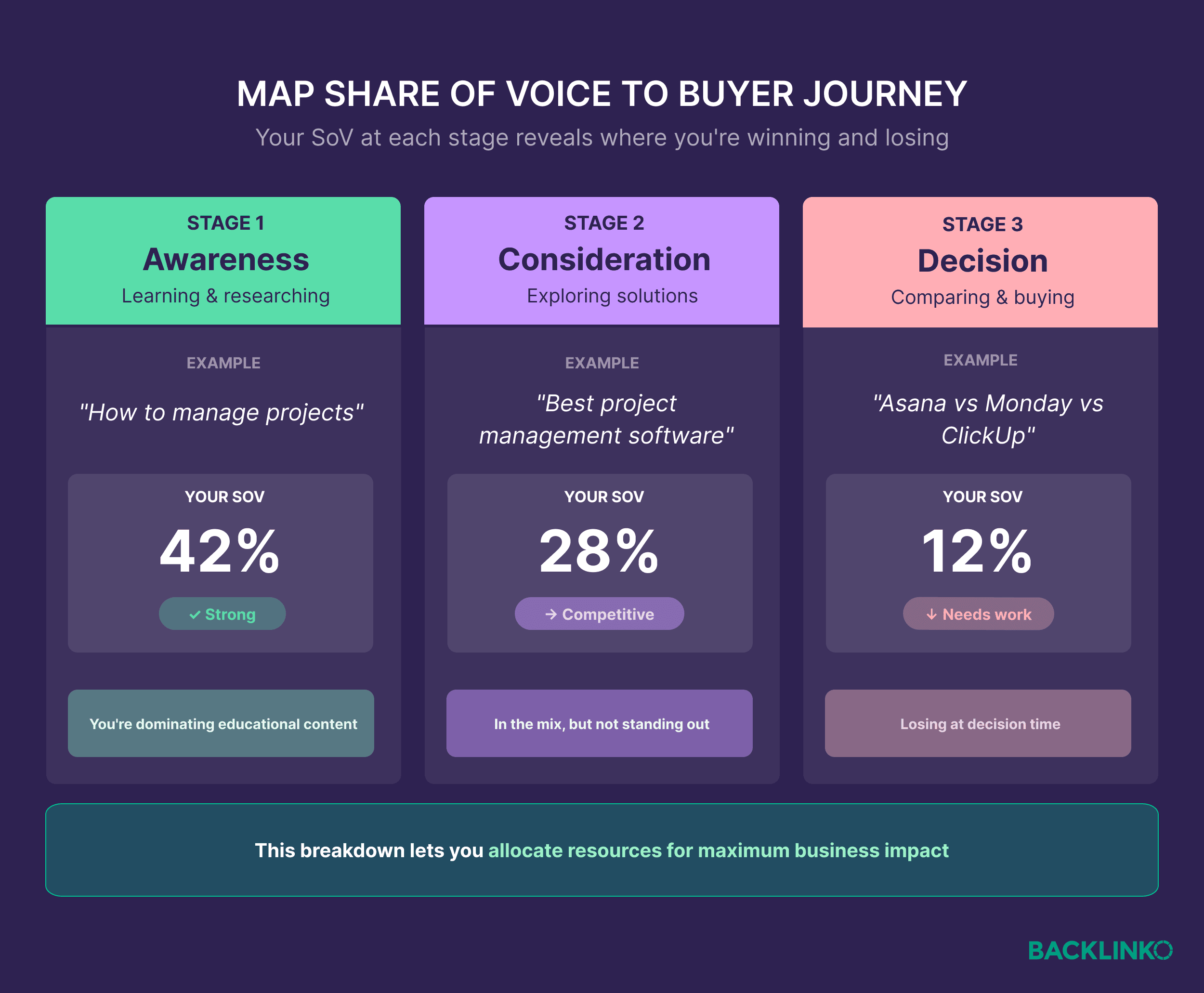
Identify Revenue-Tied Topic Clusters: Begin by selecting topic clusters directly linked to potential revenue generation. For a hypothetical project management software, relevant clusters might include "Agile Project Management," "Team Collaboration Tools," and "Project Planning Software." These clusters should then be mapped to distinct stages of the buyer’s journey:
- Awareness: Broad queries (e.g., "what is agile methodology").
- Consideration: Solution-oriented queries (e.g., "project management software for startups").
- Decision: Brand-specific or comparative queries (e.g., "[Your Brand] vs. [Competitor]," "best project management tool").
Analyzing SoV at each stage reveals where the brand is strong or weak in guiding prospects through the sales funnel, enabling strategic resource allocation. For example, if the project management software demonstrates high SoV in "Awareness" but negligible presence in "Decision," it indicates a need to pivot content strategy towards comparison pages and case studies.
-
Define Competitors and Information Sources: In search, competition extends beyond direct business rivals. Brands compete for visibility against two primary entities:
- Direct Competitors: Other businesses offering similar products or services.
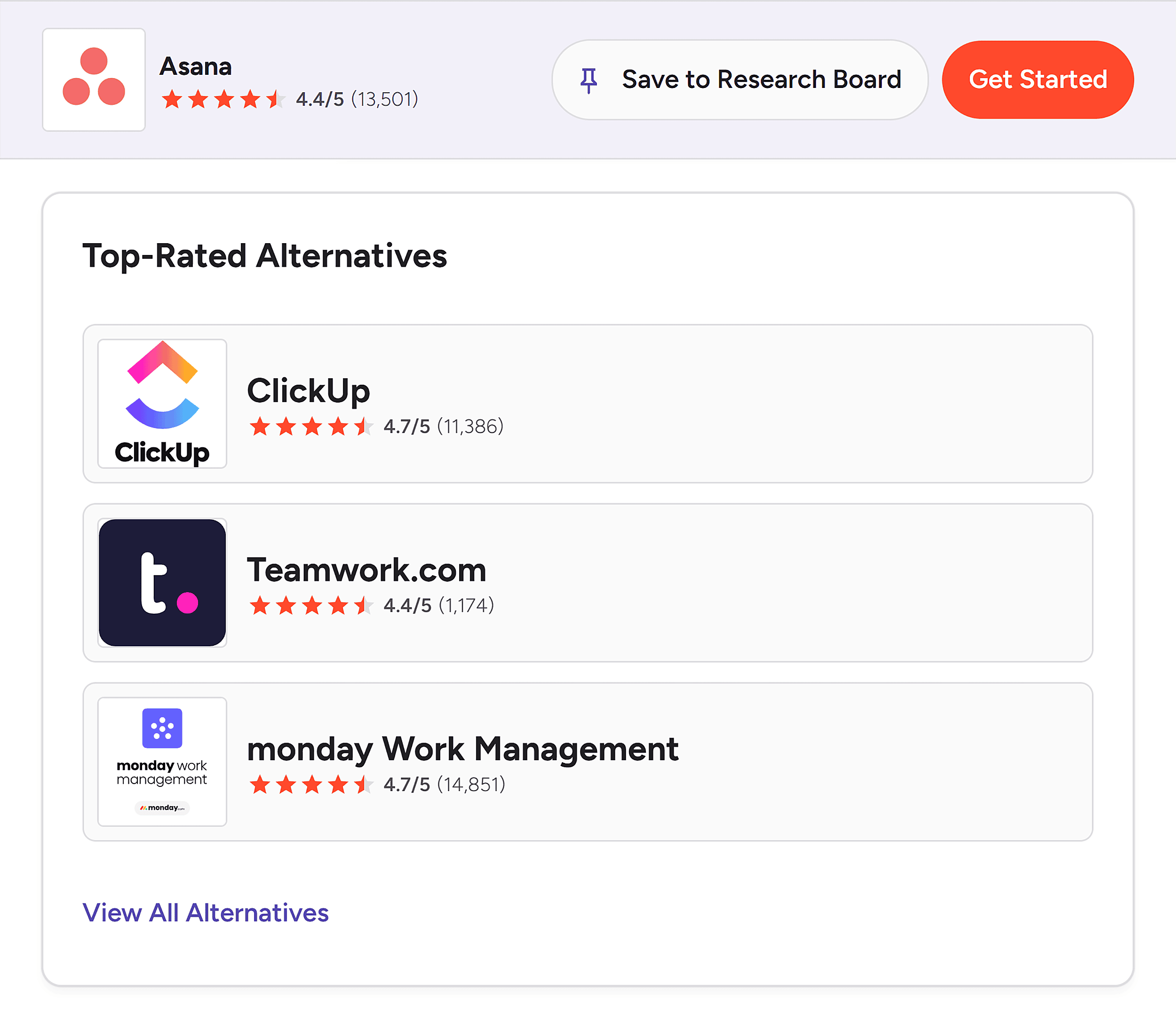
- Informational Competitors: Publishers, review sites, and community platforms (e.g., industry blogs, G2, Reddit) that frequently appear in search results or AI summaries.
Tracking both categories provides a holistic view of who commands visibility and where opportunities exist for market penetration.
Step 2: Build Comprehensive Keyword & Prompt Libraries
A robust library of 200-500 queries is essential, capturing both traditional search keywords and conversational AI prompts. This dual approach provides a complete spectrum of search visibility.
-
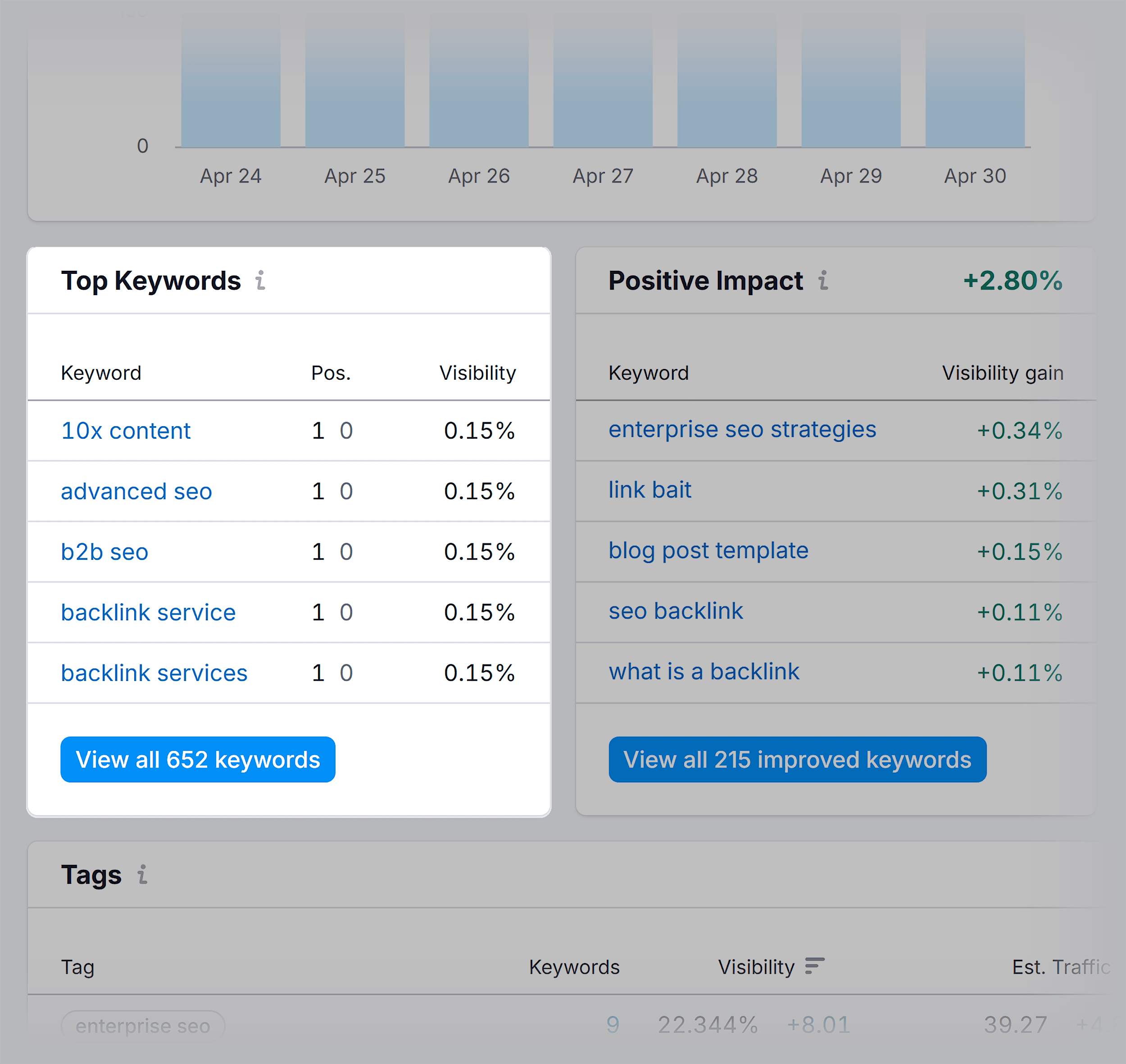
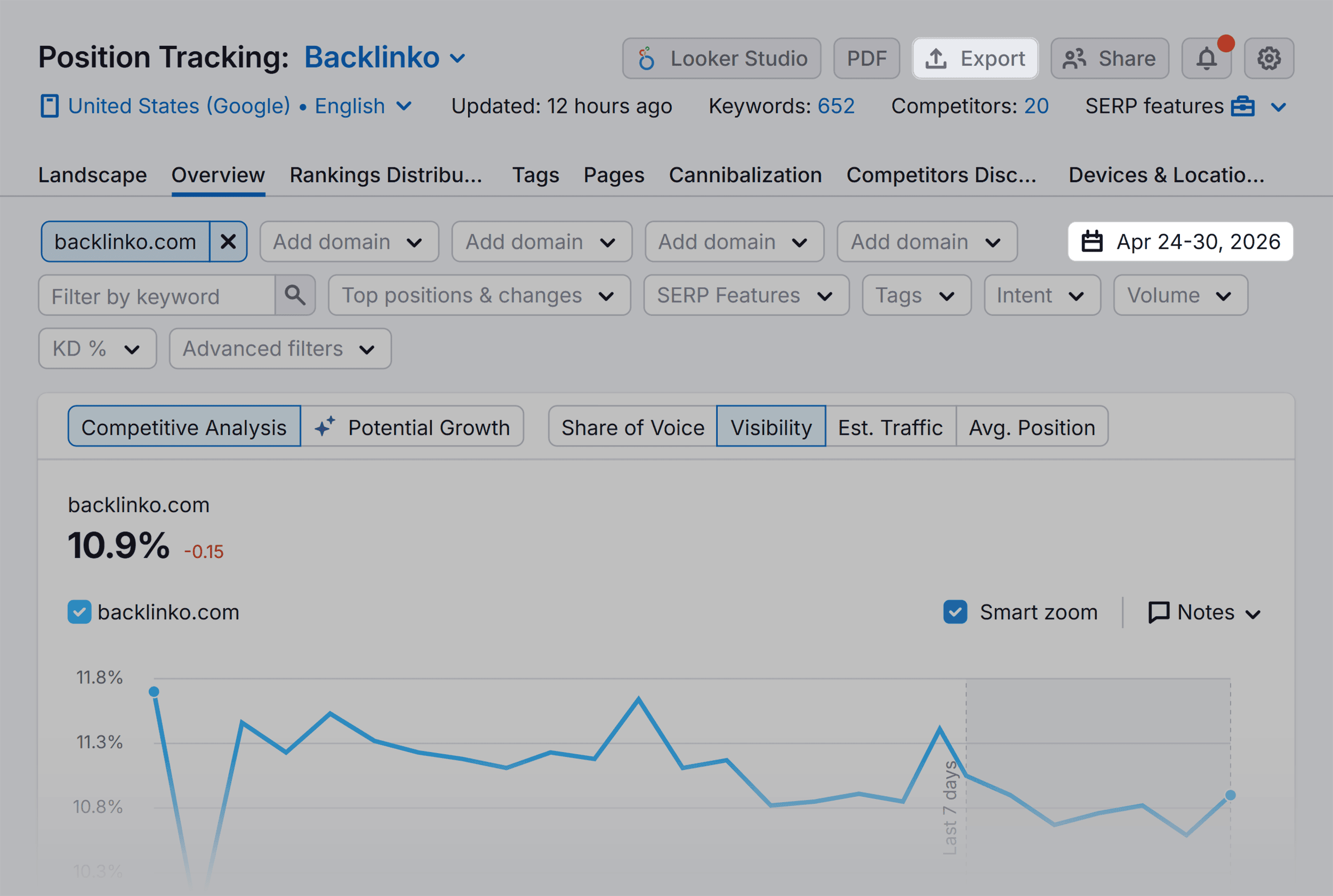
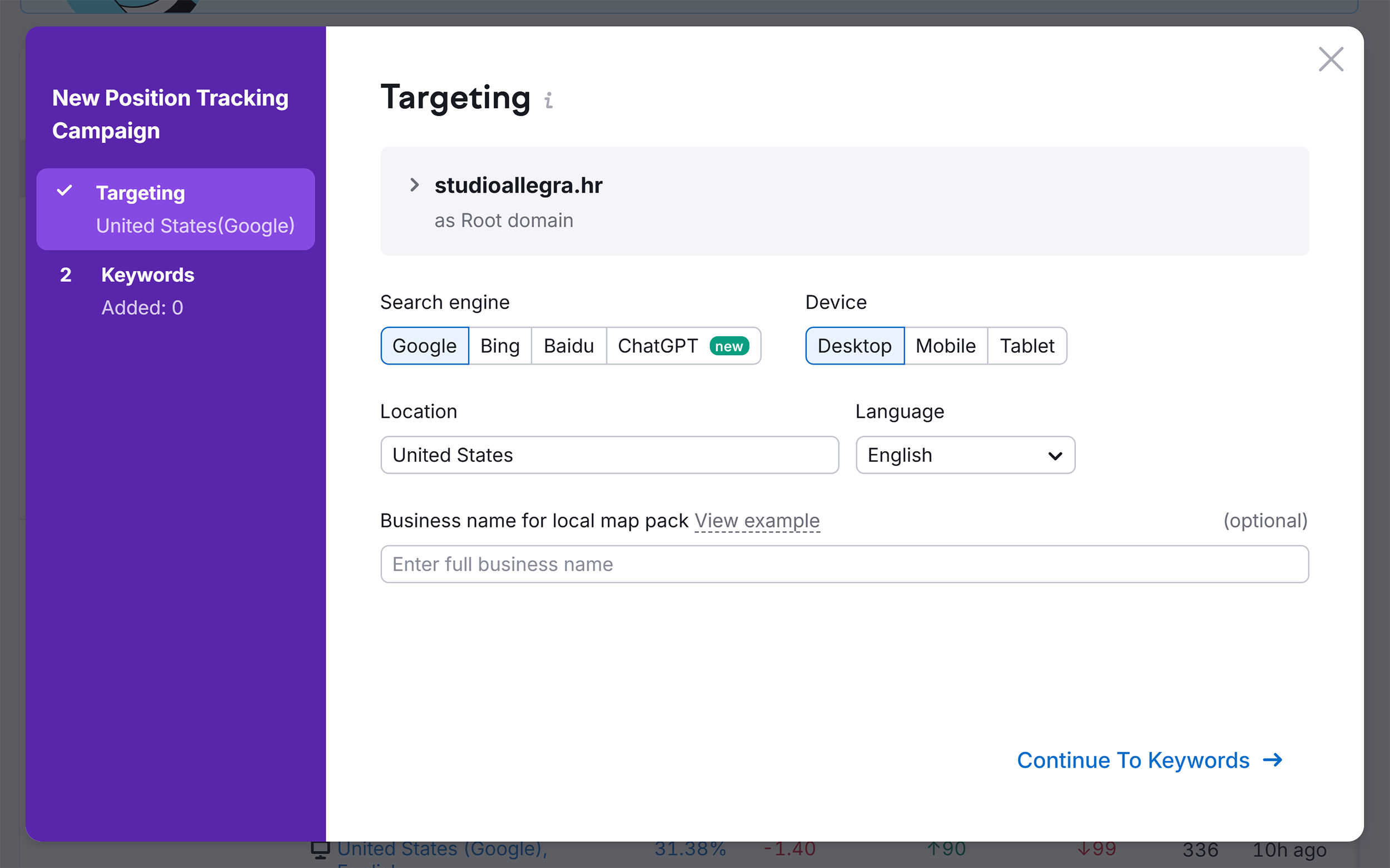
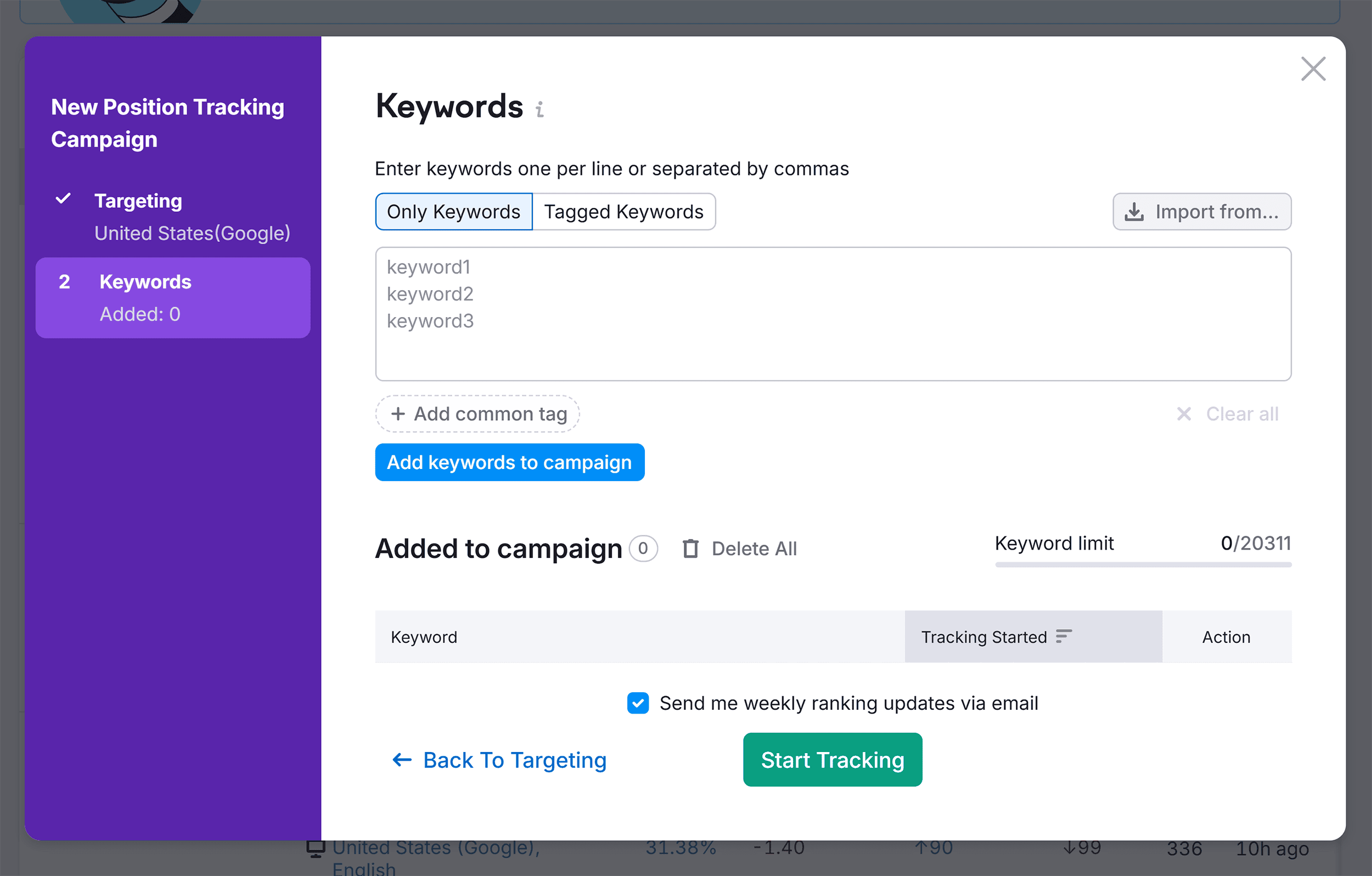
Leverage Existing SEO Data: Start with keywords where the brand already exhibits visibility. Google Search Console (GSC) is invaluable for extracting queries that generate impressions—meaning the brand appeared in results, even if not clicked. Exporting the "Queries" tab, sorted by impressions, provides a list of terms where the brand already has a footprint. Similarly, if running Google Ads, conversion-rich PPC keywords offer insights into high-intent queries. Tools like Semrush’s Position Tracking allow for exporting comprehensive keyword lists, including those of competitors, to identify market gaps.
-
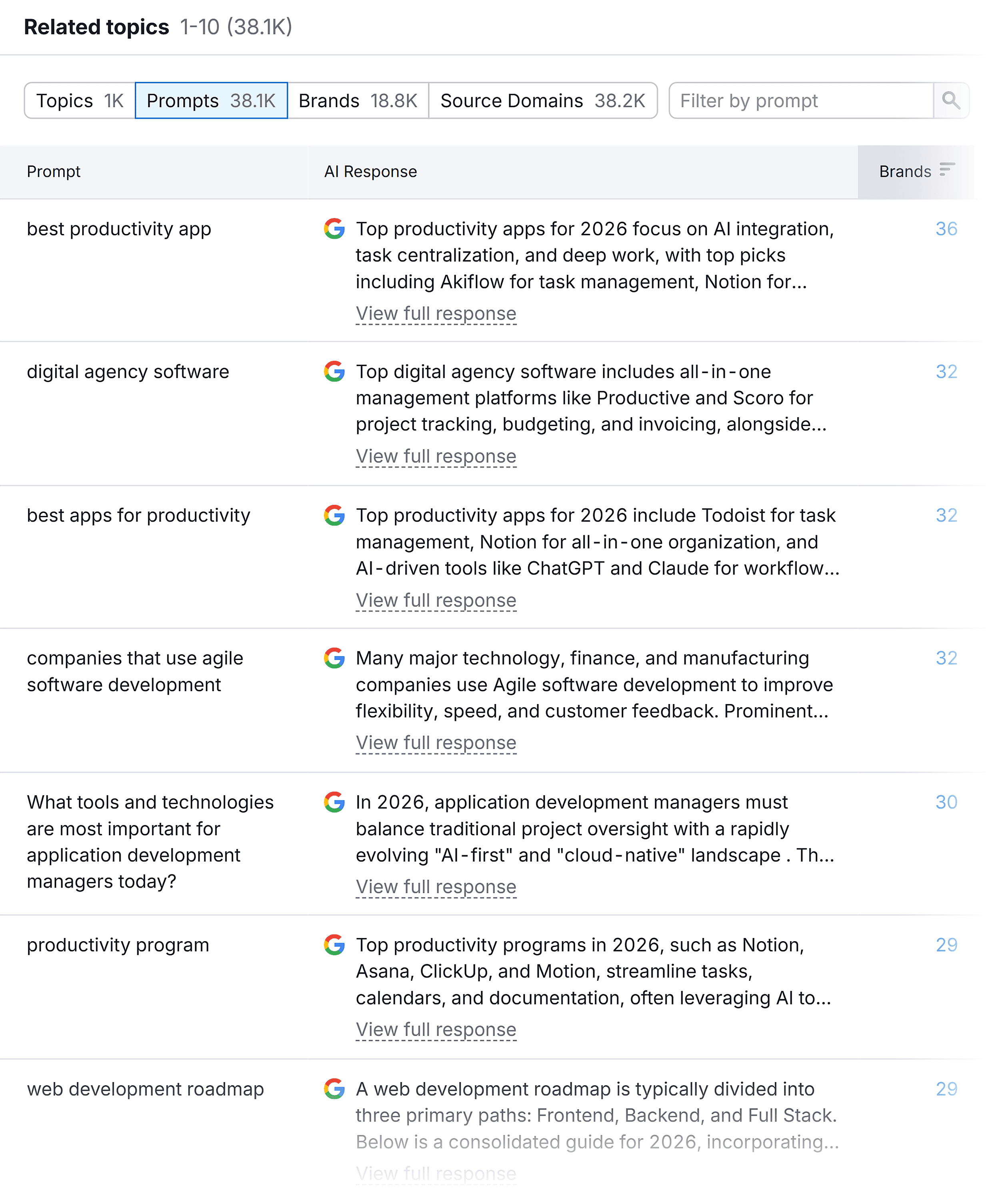
Curate an AI Prompt Library: AI search queries tend to be more conversational and often mirror natural language. Insights can be gleaned from community platforms like Reddit, Facebook groups, and Slack channels, where users articulate needs and pain points. For instance, a Reddit discussion revealing "user-friendly project management tools for small creative agencies" can be directly translated into an AI prompt: "What is the most intuitive project management tool for boutique creative firms?" For decision-stage prompts, review sites like G2 and Capterra offer ready-made comparative queries (e.g., "[Your Brand] vs. [Competitor]," "alternatives to [Competitor]"). Semrush’s AI Visibility Toolkit further assists by identifying prompts where competitors appear in AI answers but the brand does not, highlighting untapped opportunities.

-
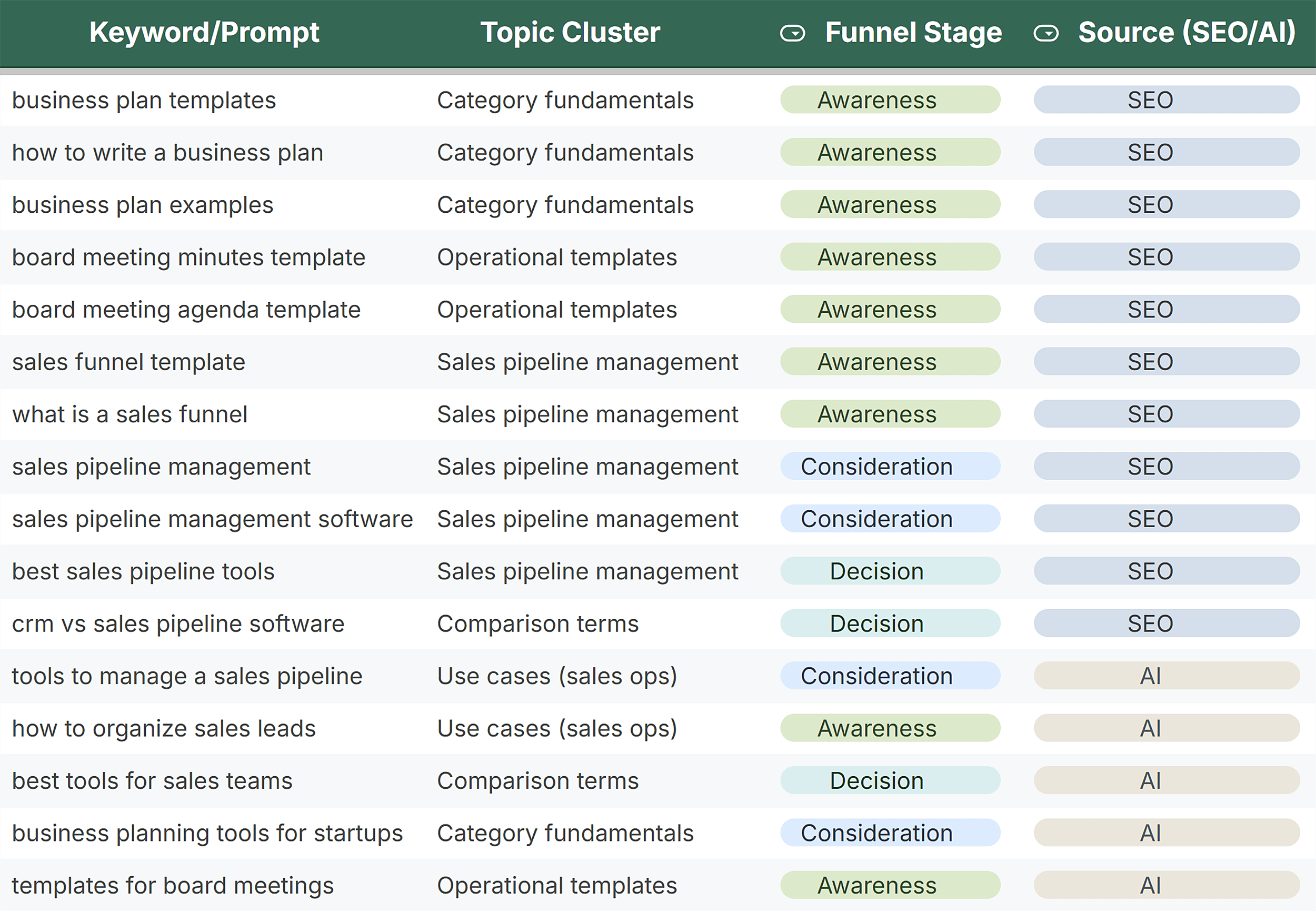
Document Metadata for Strategic Analysis: Organize all collected queries in a master spreadsheet, including metadata such as:
- Topic Cluster
- Buyer Journey Stage
- Search Volume (for keywords)
- AI Platform Relevance (for prompts)
This detailed metadata transforms raw data into a strategic lens, enabling informed decisions on content prioritization and resource allocation.
Step 3: Calculate Your Share of Voice

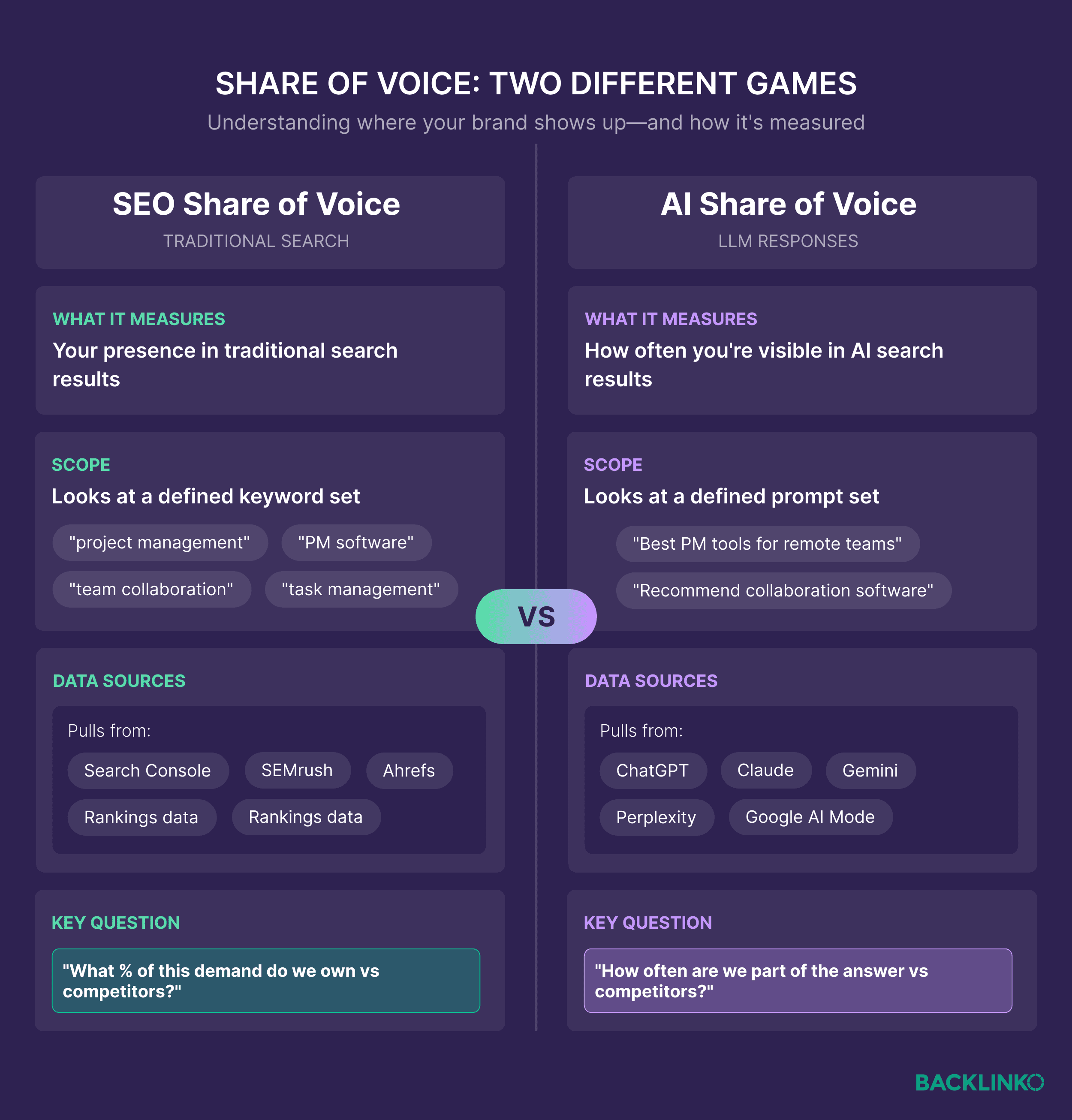
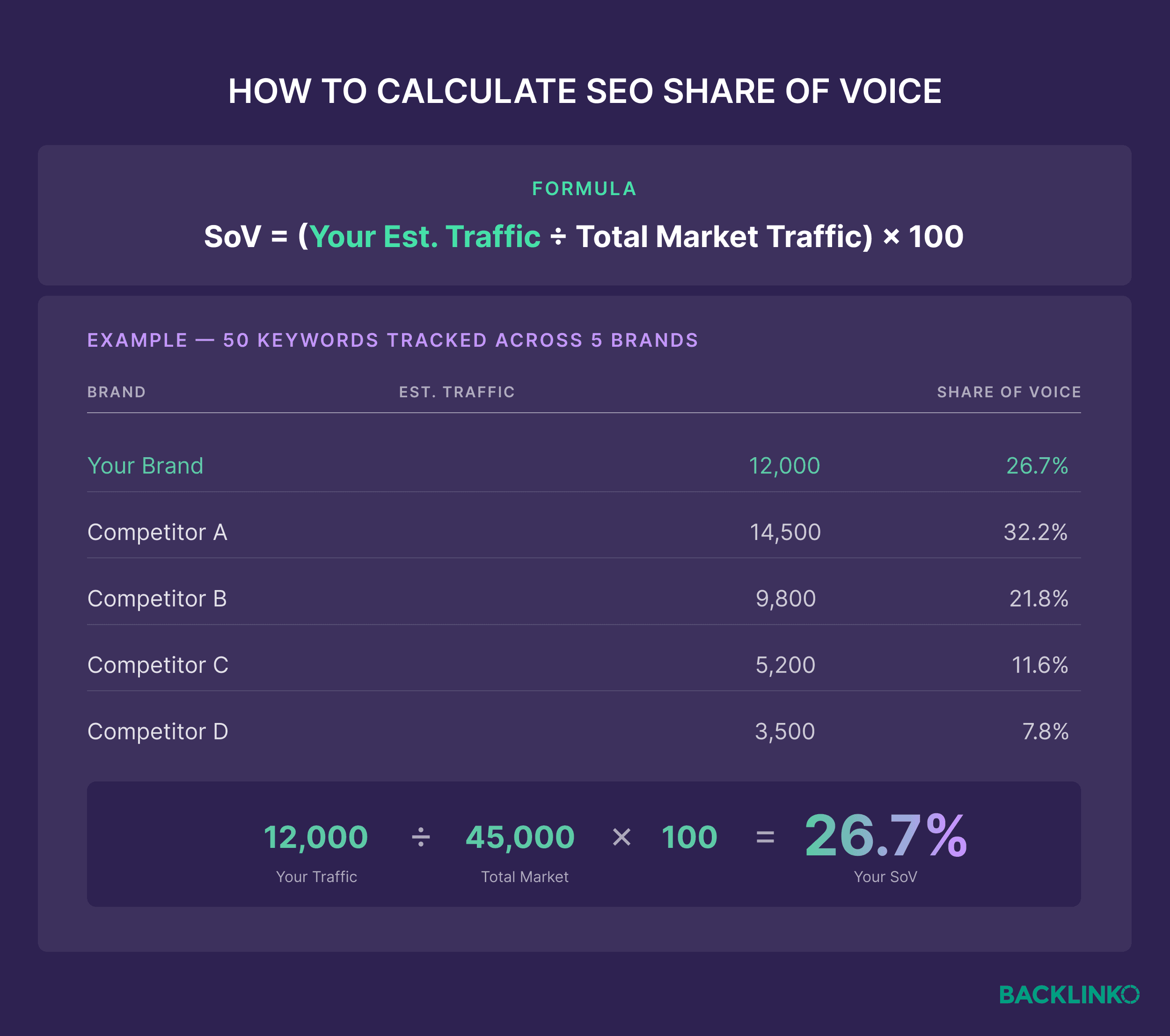
SoV is calculated by dividing a brand’s estimated traffic (or mentions) by the total for all tracked brands, then multiplying by 100. This calculation is performed for both SEO and AI SoV.
-
Calculating SEO Share of Voice: This involves tracking keyword rankings for the brand and its competitors. Each ranking position correlates with an average share of clicks (e.g., position 1 might capture ~27% of clicks). By multiplying each keyword’s monthly search volume by the click-through rate for the ranking position, an estimated traffic share per keyword is derived. Summing these estimates for all keywords yields the brand’s total estimated traffic, which is then used in the SoV formula. While this can be done manually, tools like Semrush’s Position Tracking automate the process, providing daily ranking data and aggregating it into comprehensive SoV percentages against up to four competitors. Geographic targeting is crucial here, as search results and associated SoV can vary significantly by location.
-
Calculating AI Share of Voice: AI SoV measures how frequently LLMs mention or cite a brand in response to category-related prompts. This is a more nascent area without a universal manual standard, but a directional read can be achieved by:
- Testing all curated prompts across target AI platforms (e.g., ChatGPT, Google AI Mode, Perplexity).
- Recording brand mentions and citations in the AI responses.
The total mentions for each brand, divided by the total prompts tested, yields a percentage. It’s important to note that AI responses can vary by session, phrasing, location, and platform, necessitating regular testing to track trends. Specialized tools like Semrush’s AI Visibility Toolkit automate this complex process, testing hundreds of prompts, analyzing responses for mentions, sentiment, and citations, and aggregating this data into a weighted AI SoV percentage. The toolkit also identifies key business drivers (frequently mentioned topics) to highlight areas of competitive strength and weakness within AI conversations.
-
Interpreting SEO vs. AI Share of Voice: These two metrics may not always align. A brand could have a high SEO SoV (strong organic rankings) but a low AI SoV if LLMs don’t perceive its content as credible or citable. Conversely, a brand with highly authoritative, well-structured content might achieve a strong AI SoV even without top organic rankings. A simple matrix helps in strategic diagnosis:

- High SEO SoV & High AI SoV: Domination in both traditional and AI search. Focus on content freshness and expanding into adjacent topics.
- High SEO SoV & Low AI SoV: Strong organic ranking, but LLMs are not citing the brand. Optimize content for AI summarization through clear chunking and create highly credible, citable assets.
- Low SEO SoV & High AI SoV: AI tools cite content despite weak organic rankings. Prioritize fundamental SEO improvements (title tags, internal linking, site speed, keyword optimization).
- Low SEO SoV & Low AI SoV: Significant visibility gap. Focus on building definitive, well-researched content resources for core topic clusters to establish a foundational presence in both search types.
Step 4: Establish Your Baseline and Track Trends
The final step transforms raw SoV numbers into an actionable, ongoing tracking system. A baseline dashboard should capture three levels of detail:
- Overall SoV: The brand’s total market share across all tracked channels.
- Segmented SoV: Breakdowns by topic cluster and buyer journey stage.
- Competitor SoV: Direct comparisons with key rivals.
Establishing a consistent tracking cadence, such as monthly monitoring for trends and quarterly deep dives, is crucial. This rhythm helps avoid overreacting to minor fluctuations while ensuring timely responses to significant market shifts. Quarterly reviews should reassess competitive landscapes, refine topic clusters, and adjust resource allocation based on evolving SoV data.
Strategic Imperatives: Leveraging SoV for Sustained Growth
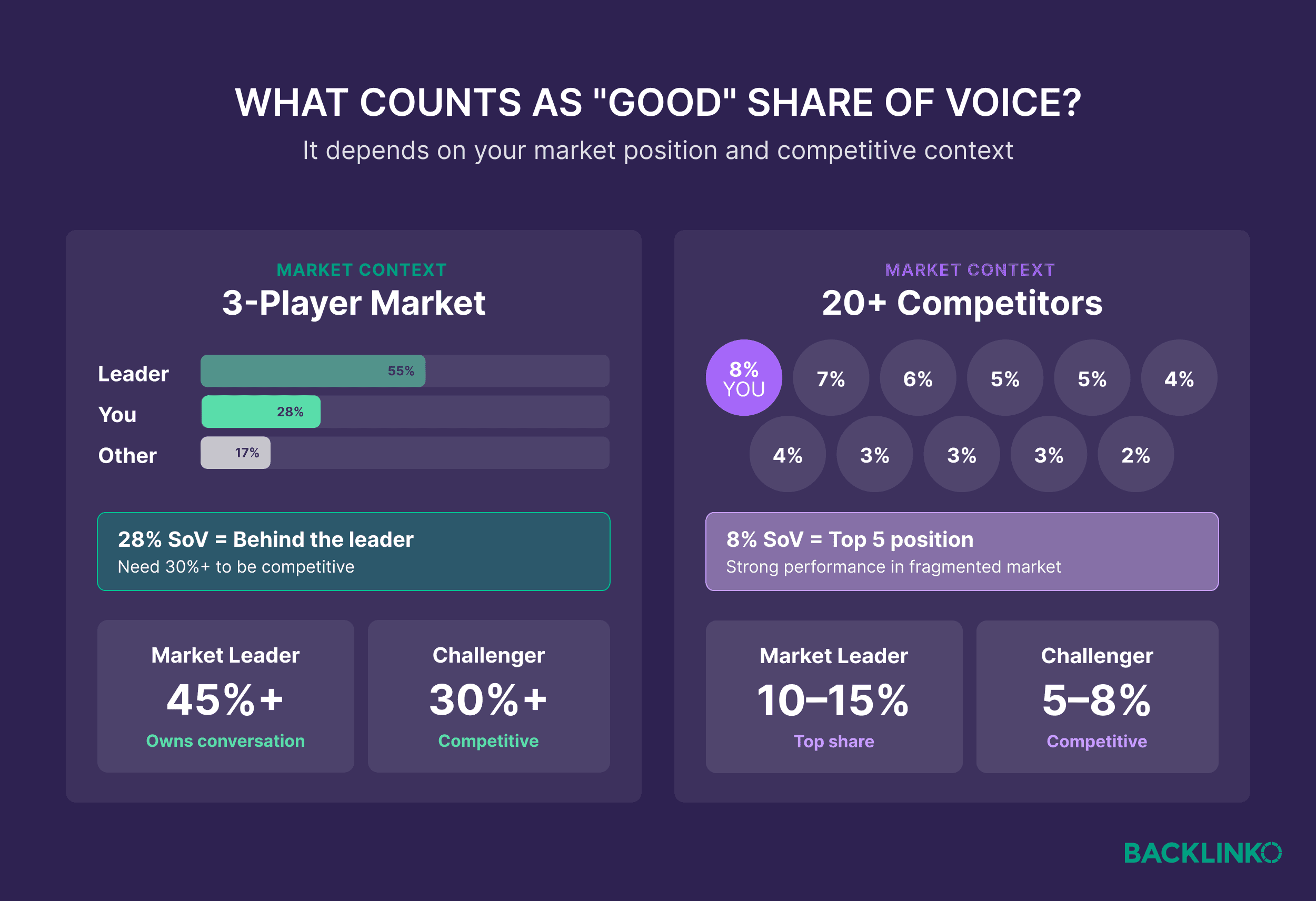
Not every fluctuation in SoV demands immediate intervention. Strategic action requires diagnosing gaps and prioritizing tactics based on potential business impact.
-
Close Critical Visibility Gaps: Clusters with consistently low SoV (e.g., below 10%) indicate near invisibility, particularly damaging in decision-stage queries. If a brand is absent when buyers search for "best [product category]," it’s not even in contention. Identify opportunities where competitors are strong, but the brand possesses a unique value proposition. For instance, if a project management tool caters specifically to creative agencies but lacks visibility for "project management for creative teams," this represents a strategic opening.
- Potential Solutions: Build topical authority through pillar content supported by multiple articles and robust backlink profiles. Prioritize comparison content and buyer’s guides for decision-stage queries.
-
Solve Efficiency Problems: Compare SoV with actual conversion data. A high SoV for an awareness-stage query like "what is project management" might be a vanity metric if only 1% of that traffic converts. This indicates resources are being misallocated to audiences that aren’t ready to buy, while competitors capture high-intent buyers.
- Potential Solutions: Reallocate content budget and creation efforts towards high-intent, bottom-of-funnel content such as detailed comparison pages, customer case studies, and ROI calculators. Update existing conversion-focused content with fresh data and competitive intelligence.
-
Address Competitive Threats: Proactively monitor competitors gaining ground in established strongholds. A sustained increase of over 5% in a competitor’s SoV within a brand’s core clusters signals an aggressive play for market share.
- Potential Solutions: If competitors excel on review sites, optimize brand profiles and launch campaigns to generate authentic customer reviews. If they dominate community platforms, initiate proactive engagement and thought leadership within relevant forums. Strategic content updates, enhanced technical SEO, and targeted link-building campaigns can also defend and expand existing SoV.
-
Prioritize Based on Effort vs. Impact: Effective SoV management requires a balanced approach. Focus initially on high-impact, low-effort wins (e.g., optimizing existing high-ranking content for AI snippets, updating product pages with clear comparative advantages). Subsequently, invest in high-effort, high-impact strategies that yield compounding returns over time (e.g., comprehensive topic cluster development, building new authoritative assets). Avoid low-impact efforts that drain resources without significant strategic gain.
Making SoV Your 2026 North Star
Share of Voice has emerged as the definitive metric for understanding and influencing brand visibility in an increasingly complex and AI-driven digital world. It captures the nuanced interplay of presence across fragmented platforms where buyers truly make decisions, moving beyond the limitations of simple traffic data. By systematically defining the industry landscape, building comprehensive keyword and prompt libraries, accurately calculating SEO and AI SoV, and establishing robust tracking mechanisms, brands can gain unparalleled insights into their market standing. The ability to strategically diagnose visibility gaps, address inefficiencies, and counter competitive threats, all while aligning disparate marketing efforts under a single "North Star" metric, positions SoV as an indispensable tool for achieving and maintaining market leadership in the coming years.
Backlinko is owned by Semrush. We are committed to providing world-class SEO insights, backed by hands-on experience. Unless otherwise noted, this content was written by either an employee or paid contractor of Semrush Inc.