The Marketing Efficiency Ratio: Navigating the Complexities of Ecommerce Advertising Attribution

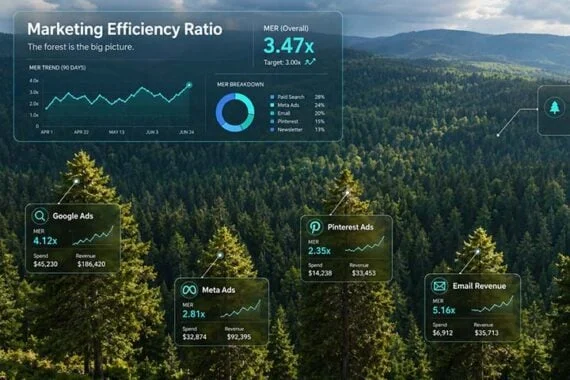
Attribution for ecommerce advertising campaigns remains a tangled web, despite a proliferation of AI-fueled tracking techniques and tools. While platforms like Google Ads report Return on Ad Spend (ROAS) and Meta meticulously tracks purchases, conversion value, and cost per result, and email platforms tout revenue per send, and affiliate services diligently log commissions and conversions, these granular metrics often represent individual trees within a vast, complex promotional forest. Understanding the performance of a single Meta Ads campaign, for instance, is crucial, but ecommerce teams must also grasp the overall health and effectiveness of their entire marketing ecosystem to achieve overarching revenue and growth objectives. This is where the Marketing Efficiency Ratio (MER) emerges as a vital tool, offering a panoramic view of marketing success.
The Forest vs. The Trees: A Metaphor for Marketing Measurement
The current landscape of ecommerce advertising measurement can be likened to observing individual trees without appreciating the entire forest. Each platform provides a detailed, yet isolated, perspective. Google Ads offers ROAS, a specific measure of profitability for campaigns run on its network. Meta’s analytics delve into the direct impact of ads on its platforms, focusing on conversions and their associated costs. Email marketing platforms highlight the revenue generated directly from email sends, while affiliate networks showcase the direct financial returns from partnerships.
These channel-specific metrics are undeniably important. They allow marketers to optimize individual campaigns, adjust bidding strategies, refine creative assets, and identify underperforming tactics. For example, a marketer might observe a ROAS of 4.2 for a specific Google Shopping campaign. This insight could lead to immediate actions, such as pausing the campaign, tweaking ad copy, or reallocating budget within that particular channel.
However, focusing solely on these "trees" can obscure the bigger picture – the "forest" of overall business growth and profitability. The journey of a customer is rarely linear. A potential buyer might see a Meta ad on a Monday, receive a promotional email on Wednesday, conduct a brand search on Friday, and finally make a purchase on Saturday. Each platform involved in this customer journey will attempt to claim credit for the conversion, leading to conflicting data and a fragmented understanding of marketing’s true impact. This complexity is precisely why the MER becomes indispensable. It transcends the arguments over last-click attribution and multi-touch models by providing a consolidated view of marketing’s overall contribution to revenue.
Decoding the Marketing Efficiency Ratio (MER)
The Marketing Efficiency Ratio (MER) is a straightforward yet powerful indicator that directly compares an ecommerce business’s total revenue to its total marketing expenditure. It is not intended to supplant crucial channel-specific metrics like ROAS, Customer Acquisition Cost (CAC), or Lifetime Value (LTV). Instead, MER serves as a complementary metric, offering a high-level perspective that informs strategic decision-making about the entire marketing operation.
The calculation for MER is remarkably simple:
MER = Total Revenue / Total Marketing Spend
To illustrate, consider an ecommerce company that generated $500,000 in sales during a given month. If the company invested $100,000 in marketing during that same period, encompassing all advertising costs, agency fees, and affiliate commissions, its MER would be calculated as follows:
$500,000 (Total Revenue) / $100,000 (Total Marketing Spend) = 5
This result signifies that for every dollar spent on marketing, the company generated $5 in revenue. Some industry professionals refer to MER as "blended ROAS" because it consolidates all marketing efforts and all revenue generated, rather than isolating the performance of a single campaign or channel. This holistic approach is particularly valuable in the dynamic and often interconnected world of digital marketing.
MER vs. ROAS: Differentiating the Metrics
While both MER and ROAS are crucial for measuring marketing effectiveness, they answer fundamentally different questions. ROAS, as previously mentioned, typically focuses on the performance of a specific campaign, channel, or tactic. It provides granular insights that enable tactical adjustments. If a particular Google Shopping campaign is yielding a ROAS of 4.2, a marketer can analyze its performance and potentially optimize it for better returns.
MER, on the other hand, evaluates the performance of the entire marketing apparatus. It answers the broader question: is the total marketing investment yielding adequate revenue for the business? While ROAS might inform decisions about pausing a specific campaign or adjusting bids, MER helps a marketer understand whether the company’s overall marketing spend is strategically sound and contributing positively to the bottom line.

The Crucial Role of Accurate Inputs for MER
The utility of MER is directly proportional to the accuracy of its inputs. Inflating the MER by omitting certain marketing costs can lead to a skewed and misleading assessment of performance. For MER to be a reliable indicator, it must encompass all expenditures associated with marketing efforts. This includes, but is not limited to:
- Advertising Spend: Direct costs for paid advertising across all platforms (e.g., Google Ads, Meta Ads, TikTok Ads, programmatic advertising).
- Agency Fees: Payments to marketing agencies for strategy, execution, and management of campaigns.
- Affiliate Commissions: Payments to affiliate partners for driving sales or leads.
- Influencer Marketing Costs: Fees paid to influencers for promotional content and collaborations.
- Software Subscriptions: Costs for marketing automation tools, analytics platforms, CRM systems, and other relevant software.
- Content Creation Costs: Expenses related to producing marketing content, such as graphic design, video production, and copywriting.
- Email Marketing Platform Fees: Costs associated with sending email campaigns.
- Team Salaries (pro-rated): A portion of the salaries for marketing team members directly involved in campaign execution and management.
- Promotional Costs: Expenses related to discounts, giveaways, and other promotional activities.
Consistency in tracking these inputs is paramount. If agency fees are included in the MER calculation for January, they must also be consistently included for February, March, and all subsequent months to ensure an accurate year-over-year or month-over-month comparison. Inconsistencies in data collection will undermine the reliability of the MER.
MER and Strategic Budgeting
The non-linear nature of modern ecommerce marketing makes MER an exceptionally valuable tool for budgeting. As highlighted earlier, a customer’s path to purchase often involves multiple touchpoints across various channels. While sophisticated multi-touch attribution models attempt to deconstruct this journey and assign credit appropriately, MER offers a simpler, yet effective, alternative by sidestepping the attribution debate altogether. It doesn’t assign credit to a single channel or touchpoint but instead provides a holistic view of marketing’s overall impact.
This blended perspective is instrumental in budgeting. If a company consistently operates profitably at a MER of 4.0, experiences struggles when the MER dips to 3.0, and incurs losses below a MER of 2.5, these benchmarks provide clear guardrails for marketing expenditure. This allows marketing teams to make data-driven decisions about budget allocation, ensuring that investments are aligned with revenue-generating potential.
Furthermore, MER can help shift the focus from vanity metrics like clicks, impressions, and platform-specific engagement to more meaningful business outcomes such as revenue and profit. This strategic realignment ensures that marketing efforts are geared towards driving tangible business growth.
The "Big Picture" Perspective: Contextualizing MER
There is no universally applicable MER that applies to every ecommerce business. The ideal MER is highly dependent on the specific business model, industry, and financial structure. For instance, an ecommerce shop with a high gross margin, such as 70%, can likely tolerate a lower MER and still remain profitable. Conversely, a business with a lower gross margin, say 25%, will require a higher MER to ensure profitability.
A high MER, while seemingly positive, could indicate that a company is potentially underinvesting in growth. If marketing spend is too low relative to revenue, it might be missing opportunities to acquire new customers or expand market share. Conversely, a consistently low MER could be a clear signal of waste and inefficiency within the marketing operation, necessitating a thorough review of campaign performance and spending strategies.
The simplicity and ease of comprehension are key strengths of MER. It complements, rather than replaces, other critical financial and marketing metrics such as ROAS, CAC, margin analysis, and marketing mix modeling. Ultimately, MER provides marketers with the essential "big picture" view: it clearly indicates whether a store’s marketing investments are effectively contributing to overall business success and profitability.
Supporting Data and Industry Trends
The increasing complexity of the digital advertising landscape has been a persistent challenge for ecommerce businesses. A recent report by Statista indicated that global digital ad spending is projected to reach over $800 billion by 2026, a significant increase from previous years. This surge in investment underscores the importance of accurate measurement and attribution.
Furthermore, the evolution of privacy regulations, such as the deprecation of third-party cookies and stricter data privacy laws, has made granular, platform-specific attribution even more challenging. This shift has amplified the need for simpler, more holistic measurement approaches like MER. Surveys among marketing professionals consistently highlight attribution as a top challenge, with a significant percentage reporting difficulty in accurately measuring the ROI of their marketing efforts.
Broader Implications and Future Outlook
The adoption of MER as a key performance indicator signifies a maturing approach to ecommerce marketing measurement. It reflects a move away from a purely tactical, channel-centric view towards a more strategic, business-outcome-oriented perspective. As artificial intelligence continues to advance and data privacy concerns remain at the forefront, the demand for straightforward, yet insightful, metrics like MER is likely to grow.
Businesses that effectively leverage MER will be better positioned to:
- Optimize budget allocation: By understanding the overall efficiency of their marketing spend, they can allocate resources more effectively across different channels and initiatives.
- Improve profitability: A clear understanding of the relationship between marketing investment and revenue allows for more precise profit margin management.
- Drive sustainable growth: By focusing on overall marketing efficiency, businesses can ensure that their growth strategies are financially sound and sustainable in the long term.
- Enhance cross-functional alignment: MER provides a common language for marketing and finance teams, fostering better collaboration and strategic alignment.
In conclusion, while the intricate details of campaign-specific performance will always remain vital, the Marketing Efficiency Ratio offers an indispensable lens through which ecommerce businesses can view the totality of their marketing efforts. By focusing on the "forest" rather than solely on the "trees," businesses can gain a clearer understanding of their marketing’s true impact and steer their operations towards sustained success and profitability.