The Evolution of Agentic AI and Programmatic Infrastructure: How APIs are Redefining WordPress Site Management


The intersection of artificial intelligence and web development has reached a pivotal juncture, moving beyond simple code generation into the realm of autonomous execution. When an automated system or AI agent is tasked with provisioning a WordPress website, the outcome is dictated entirely by its interface capabilities. Traditional browser automation relies heavily on visual scripting, matching user interface elements to predetermined DOM structures. However, this method remains notoriously brittle; a minor shift in a button’s placement or an updated HTML tag can immediately break a script.
Conversely, interacting with applications through a programmatic interface—specifically an Application Programming Interface (API)—offers deterministic reliability. A standard HTTP request executes identically regardless of underlying visual changes. As software development shifts toward autonomous agentic workflows, the availability of robust, machine-readable APIs has transformed from a developer convenience into an absolute operational necessity.
The Limitations of Visual Dashboards for Autonomous Systems
The broader internet is inherently optimized for human consumption. Graphical user interfaces (GUIs) rely on visual layouts, color hierarchies, and spatial relationships that allow human operators to intuitively click through dashboards and manage hosting environments.
AI agents, however, lack the capacity to reason with visual layouts in the way humans do. Without an underlying API, engineers frequently resort to browser automation frameworks like Playwright or Puppeteer to simulate human interaction. These tools parse Document Object Models to locate links, forms, and interactive buttons via scripts. Yet, this approach introduces significant vulnerabilities. Page load latency, asynchronous rendering anomalies, and unannounced front-end updates frequently derail automation sequences.
According to the 2025 State of the API report published by Postman, nearly 90 percent of software developers actively incorporate generative AI into their daily engineering routines. Despite this massive adoption curve, only a quarter of organizations deliberately design their APIs specifically for agentic consumption. This structural gap highlights a major friction point in modern software architecture: while artificial intelligence is ready to manage infrastructure, many legacy systems remain tethered to human-centric visual dashboards.
Security Concerns and the Rise of Agentic Vulnerabilities

Integrating autonomous agents into backend infrastructure fundamentally alters how integrations are built, tested, and secured. Traditionally, a human developer manually parses documentation, accounts for asynchronous polling, manages authentication tokens, and troubleshoots edge cases. Coding agents can accelerate the creation of Minimum Viable Products (MVPs) in a matter of minutes, but this speed introduces new risk vectors.
Because an AI agent relies entirely on machine-readable instructions, it processes incoming data at face value. Undocumented schema changes, ambiguous error messages, or inconsistent endpoint behavior can lead to catastrophic execution errors. Furthermore, the delegation of infrastructure control to autonomous systems has elevated security concerns across the technology sector.
Industry security reports underscore the gravity of these risks. The Open Worldwide Application Security Project (OWASP) highlighted "excessive agency" as a primary large language model (LLM) security concern in its Top 10 report. Similarly, Salt Labs’ 2025 State of API Security Report revealed that 95 percent of surveyed organizations experienced API-related security incidents over a twelve-month period, with the vast majority originating from authenticated sources. Consequently, modern infrastructure reliability is dictated as much by granular access controls and rate-limiting protocols as it is by server uptime.
Infrastructure as Code: The Kinsta API Ecosystem
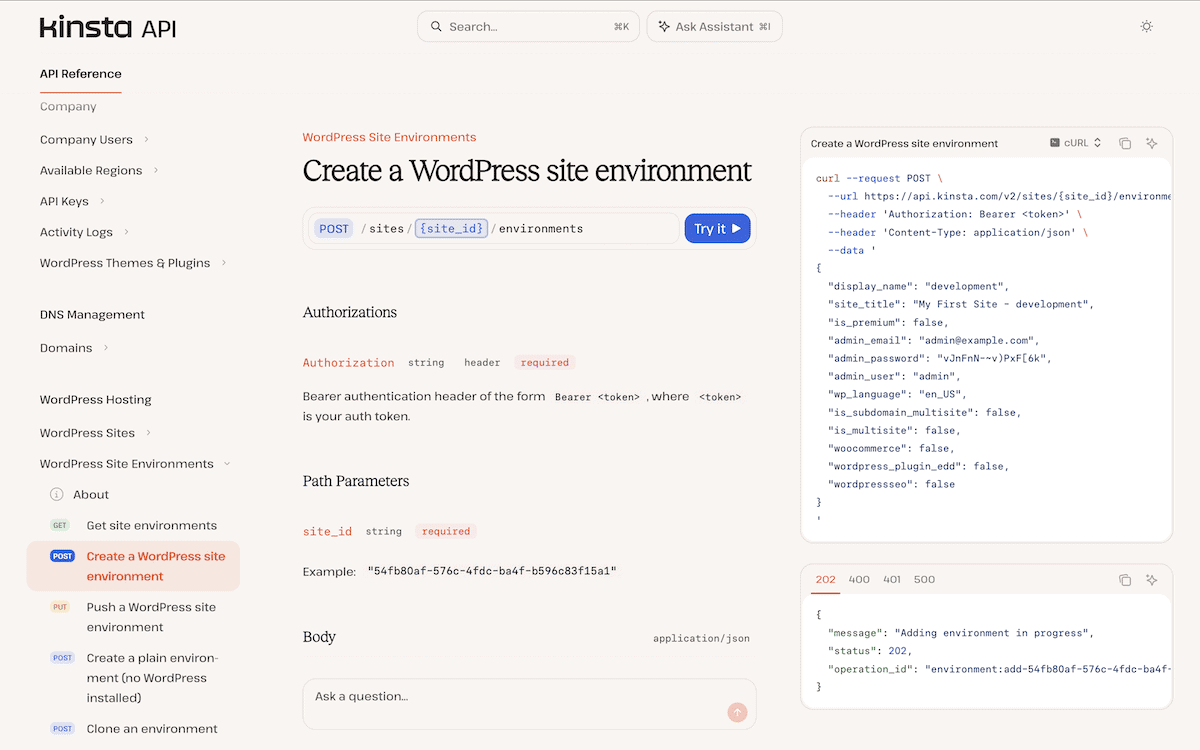
To address the demands of automated and agentic workflows, hosting providers are increasingly exposing their complete technical architectures via programmatic endpoints. A prominent example in the WordPress ecosystem is the Kinsta API, which mirrors the functional capabilities of its visual dashboard.
The architecture grants developers and automated systems programmatic access to WordPress site provisioning, environment management, database access, caching configurations, and backup administration. Similar API implementations, such as Sevalla for static site hosting, illustrate a broader industry push toward headless infrastructure control.
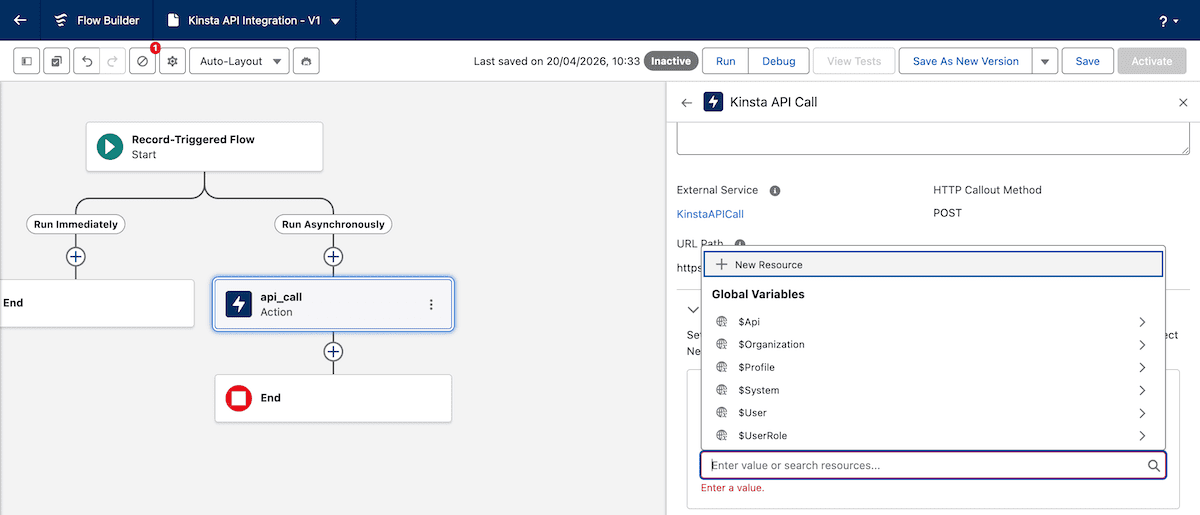
Enterprise agencies and development teams leverage these endpoints to eliminate administrative bottlenecks. By integrating infrastructure APIs with Customer Relationship Management (CRM) platforms like HubSpot or Salesforce, organizations can establish fully automated onboarding pipelines. For instance, once a client contract is signed and processed in a CRM, an automated workflow can instantly provision a staging environment, configure domains, allocate PHP workers, and initiate deployment sequences without manual intervention.
Case studies from digital agencies demonstrate the practical utility of these endpoints. Teams regularly poll specific endpoints—such as the plugin inventory or environment response code routes—to monitor application health at scale. By tracking HTTP 500 error codes programmatically over specific time ranges, automated scripts can generate instant alerts or open support tickets before a human operator notices a degradation in performance.
End-to-End Deployment Coordination and Webhooks
The true value of a comprehensive API lies in its ability to orchestrate multi-service workflows. Modern deployment pipelines frequently chain together code repositories, staging environments, and communication platforms to streamline the go-live process.
By combining hosting APIs with webhook integrations for platforms like Slack, engineering teams can monitor deployments in real time. Automated routines can execute selective staging-to-production pushes, verify automated backups, clear server-side caches, and subsequently notify designated internal channels. Advanced workflows even permit human-in-the-loop approvals directly within messaging applications, allowing managers to authorize production deployments via interactive buttons linked to secure API endpoints.
Evaluating Hosting Providers for Agentic Readiness
As engineering organizations pivot toward AI-driven development and infrastructure automation, evaluating the technical capabilities of a hosting provider is critical. Industry analysts recommend that technical leads pose four fundamental questions before committing to a hosting partner for automated workflows:
- Are all dashboard features and administrative controls fully accessible via documented API endpoints?
- Is the documentation machine-readable and optimized for integration with AI coding assistants and LLMs?
- Does the platform support granular access tokens with precise permission scopes to mitigate security risks associated with autonomous agents?
- Are modern integration standards, such as webhooks and Model Context Protocol (MCP) compatibility, natively supported?
Addressing the demand for machine-readable documentation, forward-thinking platforms have begun publishing specialized configuration files—such as llms.txt—alongside traditional robots.txt files. These files provide AI agents with structured, concise documentation regarding API endpoints, authentication requirements, and rate limits, thereby bridging the gap between human-readable web documentation and autonomous code generation.
The Role of the Model Context Protocol (MCP)
The introduction of the Model Context Protocol (MCP) has established a standardized framework for connecting AI assistants directly to external data sources and tools. Within the WordPress ecosystem, various solutions have emerged to facilitate this connectivity, ranging from community-driven server wrappers to native platform implementations.
Community developers have constructed robust MCP servers that act as intermediaries for hosting APIs. These servers expose dozens of granular tools covering connection management, authentication, PHP allocation, site diagnostics, and IP blocklists. Because these protocols ultimately rely on underlying API calls, the long-term viability of any agentic workflow depends squarely on the clarity, consistency, and depth of the host’s API documentation.
Platforms that expose their infrastructure programmatically are positioned to capture significant efficiency gains as agentic technology matures. Organizations that fail to provide comprehensive APIs risk lagging behind as development cycles grow increasingly autonomous.
The Future of Programmatic Web Infrastructure
Dashboards and graphical user interfaces will remain foundational components of software design, as human judgment is indispensable for qualitative assessments, client communication, and visual design verification. However, any repetitive, deterministic administrative task is an ideal candidate for automation.
The evolution of APIs as the primary interface for web infrastructure signifies a fundamental shift in how digital properties are managed. By decoupling hosting controls from visual dashboards, platforms empower developers and autonomous systems to build scalable, resilient, and highly customized workflows. As the technology sector navigates the transition toward agentic AI, the distinction between a platform’s presentation layer and its programmable core will define the modern standard for web hosting excellence.