Marketers Underestimate Post-Click Experience Amidst Budget Squeeze, Sacrificing Paid Media ROI, New Research Reveals

A significant disconnect plagues the modern paid media landscape, with a vast majority of marketers—nine out of ten, to be precise—grappling with budget constraints that are acutely squeezing their paid media programs. Yet, amidst this financial pressure, a critical driver of return on investment (ROI) remains largely overlooked: the crucial experience that unfolds after a user clicks on an ad. New, compelling research conducted jointly by Unbounce and Ascend2 illuminates this pervasive oversight, revealing that marketers consistently funnel more time, resources, and capital into upstream activities like audience targeting, creative development, and the adoption of artificial intelligence (AI) than into the downstream landing pages and post-click experiences that ultimately dictate whether paid traffic translates into tangible conversions. This strategic imbalance suggests a fundamental flaw in resource allocation, potentially leaving substantial ROI on the table for businesses striving to maximize their advertising spend in an increasingly competitive digital arena.
The comprehensive study, titled "The State of Paid Media ROI 2026," surveyed 304 paid media professionals across the United States, uncovering a stark contradiction between what these experts intellectually understand to be effective for improving ROI and where their actual investments are directed. A substantial 40% of respondents identified optimizing destination pages as one of the most impactful strategies for maximizing paid media expenditure. However, despite this clear recognition of its efficacy, a mere 31% reported investing in landing page optimization during the preceding six months. Instead, the bulk of budgetary allocations flowed predominantly towards audience research, which garnered 40% of investments, followed closely by AI tools at 39%, and ad creative at 38%. These figures paint a clear picture: while marketers acknowledge the critical role of the post-click journey, practical implementation often falls short, driven by a confluence of perceived immediate gains and operational complexities.
The Unseen Chasm: Investment vs. Impact
The findings from Unbounce and Ascend2 highlight a systemic issue within paid media strategies. For years, the digital advertising ecosystem has progressively emphasized sophisticated targeting mechanisms and compelling ad creatives as the primary levers for campaign success. Billions are invested annually in platforms that promise hyper-accurate audience segmentation and advanced creative tools, including the burgeoning field of AI-driven content generation. This focus, while undeniably important for capturing initial attention and generating clicks, appears to overshadow the equally, if not more, critical phase of converting that click into a desired action. The research indicates that marketers are effectively spending significant sums to get potential customers to the digital doorstep, only to neglect the design and optimization of the interior experience that should welcome and guide them towards a conversion.
This disparity is particularly troubling given the rising costs of paid media. As ad auctions become more competitive and privacy regulations evolve, driving up the cost per click (CPC) and cost per acquisition (CPA), every single click must be maximized. A click represents not just potential, but a direct financial outlay. When that click leads to an unoptimized, generic, or poorly matched landing page, the investment made in targeting, creative, and AI effectively diminishes in value. The report suggests that budget pressure isn’t merely forcing marketers to spend less; it’s subtly redirecting their focus towards seemingly "faster, easier" optimizations available within advertising platforms, often at the expense of the more resource-intensive, but ultimately more impactful, post-click work.
The Allure of Upstream Optimizations and Budget Constraints
The shift in spending priorities is directly linked to the ubiquitous budget limitations reported by marketers. A staggering 90% of respondents confirmed facing paid media budget or resource constraints. This widespread pressure is not uniform in its impact across all areas of paid media. Testing and experimentation, crucial for data-driven optimization and long-term learning, were identified as the areas most severely affected. Audience targeting, ad creative, and reporting also experienced significant hits, indicating a struggle to maintain comprehensive efforts across the entire campaign lifecycle. Alarmingly, nearly half of marketers admitted that landing page creation or message matching — the very essence of a coherent post-click experience — suffered when resources tightened.
This pattern extends beyond just budget cuts; it dictates where new investments are made. Audience research, AI tools, and ad creative consistently attracted the largest share of new investment. Landing pages, despite their recognized importance, lagged significantly. This phenomenon can be attributed to several factors. Upstream optimizations, such as refining audience segments or A/B testing ad copy, often appear to offer more immediate, measurable feedback within advertising platforms. AI tools, promising efficiency gains and enhanced performance, are also attractive "quick wins" for marketers under pressure. Developing and optimizing dedicated landing pages, however, requires a different skill set, often involving designers, developers, copywriters, and a more iterative testing process, which can feel more cumbersome and time-consuming in a constrained environment.
The research offered a critical insight into what distinguishes top performers: marketers who consistently exceeded their ROI targets demonstrated a more balanced investment approach. Rather than concentrating resources solely on highly visible upstream areas, they allocated investments more evenly across audience research, AI, attribution modeling, testing, and crucially, landing page optimization. This suggests that sustained, superior performance stems from a holistic strategy that recognizes and nurtures every stage of the customer journey, from initial impression to final conversion.
The AI Paradox: Underutilization in Conversion
The rapid integration of Artificial Intelligence into marketing workflows represents a transformative trend, and the study confirms its widespread adoption. A significant 86% of marketers reported utilizing AI in their paid media efforts, with nearly three-quarters attributing improved ROI to its implementation. However, the application of AI within the paid media funnel reveals another crucial area of underutilization.
The majority of AI applications were concentrated in areas such as reporting and analytics, refining audience targeting, leveraging platform-specific AI tools, and generating ad copy. While these applications are undoubtedly valuable for streamlining operations and enhancing campaign precision, a mere 19% of marketers reported using AI for landing page creation or optimization. This statistic highlights a significant missed opportunity. The very marketers who outperformed their ROI goals were approximately twice as likely to employ AI in these post-click areas. This suggests that while AI is embraced for its power to generate clicks and insights, its potential to enhance the conversion experience itself — through dynamic content, personalized layouts, or predictive optimization of conversion elements — remains largely untapped by the broader marketing community. The full promise of AI in paid media, therefore, is being constrained by its limited deployment to the most critical phase of the customer journey: conversion.
Post-Click Neglect: Undermining Paid Traffic
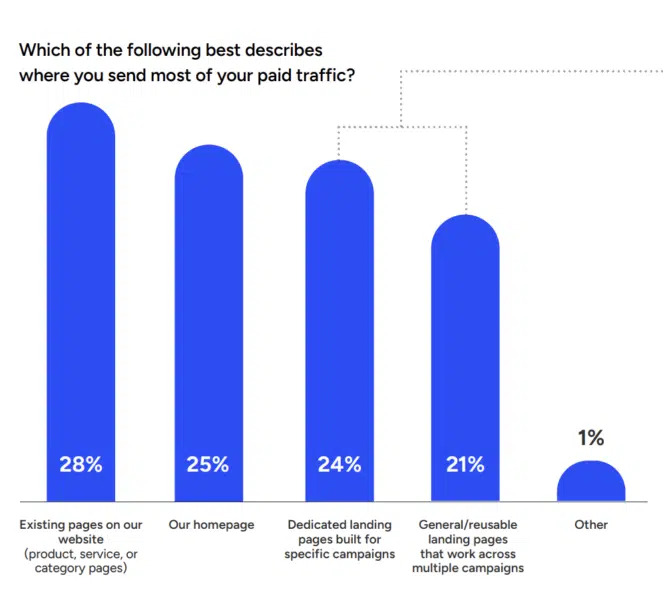
One of the most concerning revelations from the report is how frequently marketers undermine their own targeting efforts once a click has been earned. Despite investing heavily in precise audience segmentation and compelling ad creative, more than half of all respondents admitted to sending paid traffic to general website pages rather than dedicated, campaign-specific landing pages.
Specifically, 28% primarily direct visitors to existing product or category pages, while another 25% send them directly to the company homepage. A meager 24% consistently utilize dedicated landing pages meticulously crafted for individual campaigns. This practice represents a fundamental disconnect. The purpose of a paid ad is often to drive a specific action related to a specific offer, product, or service. When a user clicks on an ad promising a particular solution, they expect to land on a page that directly addresses that promise, without distraction or the need to navigate through a general website. Directing users to a generic homepage or a broad category page creates friction, dilutes the message match, and significantly increases the likelihood of bounce, effectively wasting the initial ad spend.

This mismatch is particularly stark when considering campaign objectives. For marketers focused on direct sales, 40% still direct traffic to general product or category pages instead of conversion-optimized destinations. Similarly, over a quarter of marketers running lead-generation campaigns continue to send prospects to their homepage. Such strategies inherently dilute the conversion intent cultivated by the ad, forcing users to search for the promised content or offer, which few will do.
The Performance Gap: Dedicated Pages Drive Results
The cost of this post-click neglect is quantifiable in terms of ROI. The research provides compelling evidence that this strategy carries a tangible performance penalty. Nearly two-thirds of marketers who primarily send paid traffic to their homepage reported not exceeding their ROI goals. Conversely, marketers who consistently outperformed their targets were significantly less reliant on homepages as a destination for paid traffic. Instead, they were more likely to employ reusable, templated landing pages or, ideally, unique, campaign-specific landing pages designed to perfectly match the ad’s message and the user’s intent.
This finding reinforces a fundamental principle of effective digital marketing: consistency and relevance throughout the customer journey. A dedicated landing page serves as a direct, focused extension of the ad, providing a seamless transition and reinforcing the value proposition. It eliminates distractions, streamlines the path to conversion, and allows for precise message matching, all of which contribute to higher conversion rates and, consequently, a superior ROI. The data clearly demonstrates that the effort invested in creating these tailored experiences pays dividends, separating top performers from those struggling to meet their targets.
Operational Hurdles: The True Barriers to Optimization
The Unbounce and Ascend2 report ultimately concludes that the widespread failure to prioritize post-click optimization is not born of ignorance, but rather of operational constraints. Marketers understand the intrinsic value of destination page optimization; it ranked second only to audience targeting as the most effective way to optimize paid media spend, even ahead of cutting underperforming channels, shifting platforms, or setting spending caps. Their day-to-day priorities, however, tell a different story.
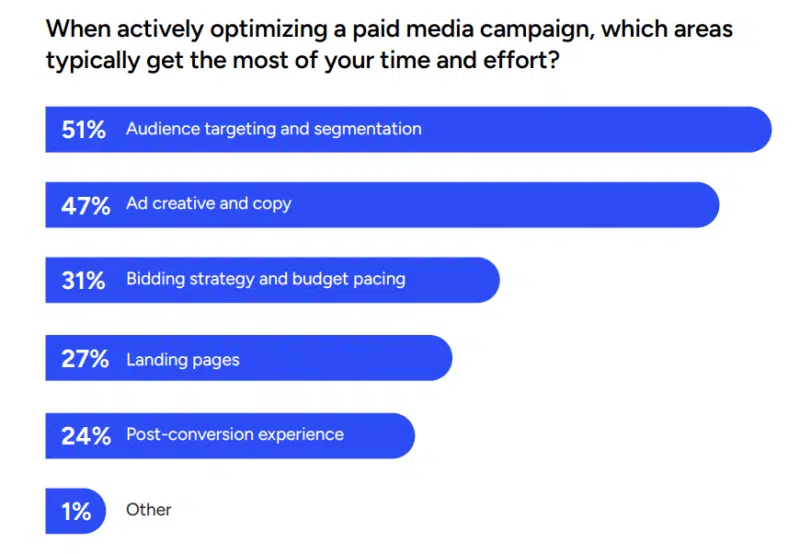
While over half of marketers dedicate most of their optimization efforts to audience targeting, followed by ad creative and bidding strategy, landing pages and the broader post-conversion experience consistently languish at the bottom of the priority list. This isn’t a strategic disagreement; it’s a practical roadblock. The report meticulously identifies the biggest obstacles preventing greater adoption and use of landing pages: team capacity, design and development resources, specialized expertise, ongoing maintenance, and insufficient software budgets. In essence, marketers recognize the importance of the post-click experience but often lack the necessary human capital, specialized skills, time, or technological tools to implement and sustain effective optimization efforts. This points to a deeper organizational challenge where the strategic vision for end-to-end customer journeys is often hampered by tactical resource limitations and a disproportionate allocation of investment.
A Holistic Path to ROI: Lessons from Top Performers
The most successful marketing teams, those consistently exceeding their ROI targets, appear to have circumvented these operational challenges by adopting a fundamentally different approach. They do not view paid media as a series of disconnected optimizations, but rather as an integrated, end-to-end system. Throughout the research, these high-performing marketers consistently demonstrated a more balanced investment profile. They committed resources not just to audience targeting, creative, and AI, but also significantly more to landing pages, robust attribution modeling, continuous testing, and post-conversion improvements.
This holistic perspective acknowledges that generating clicks is only half the battle. The true measure of success lies in the ability to convert those clicks efficiently and effectively into leads, sales, or other desired outcomes. By strengthening the entire customer journey, from the initial ad impression to the final conversion and beyond, these top performers realize compounding gains that isolated optimizations simply cannot deliver. They understand that a strong "front end" (targeting, creative) without an equally strong "back end" (landing pages, conversion experience) is akin to building a magnificent billboard on a deserted highway.

The implications for the broader marketing industry are clear. To truly unlock the full potential of paid media and achieve sustainable ROI in a budget-constrained environment, marketers must shift their focus. It is no longer sufficient to merely optimize for the click; the imperative is to optimize after the click. This requires a re-evaluation of resource allocation, a commitment to investing in the full funnel, and potentially, a strategic adoption of AI tools that can automate and personalize the post-click experience, thereby overcoming some of the operational hurdles that currently prevent marketers from realizing the immense value of dedicated landing pages and a seamless conversion journey. The full report, "The state of paid media ROI 2026," offers a detailed roadmap for this crucial re-prioritization and can be downloaded by interested parties for deeper insights.
Related posts: