In the high-stakes arena of corporate media planning, the terminology used to measure advertising effectiveness often masks profound financial vulnerabilities for brands. A recent examination of official platform guidance from major digital advertising giants, notably Google, has sparked rigorous debate among senior marketing analytics professionals regarding how statistical certainty is communicated to advertisers. At the center of the controversy is the wide gap between a platform’s definition of "useful insights" and a Chief Financial Officer’s requirement for verifiable, reproducible return on investment.
The Semantic Trap of Directional Results
For decades, digital marketing measurement tools have relied on incrementality testing, such as Google’s Brand Lift, Search Lift, and Conversion Lift studies. These analytical instruments are designed to isolate the impact of advertising campaigns by comparing exposed audiences with control groups. However, the interpretation of the resulting metrics has become a point of contention.
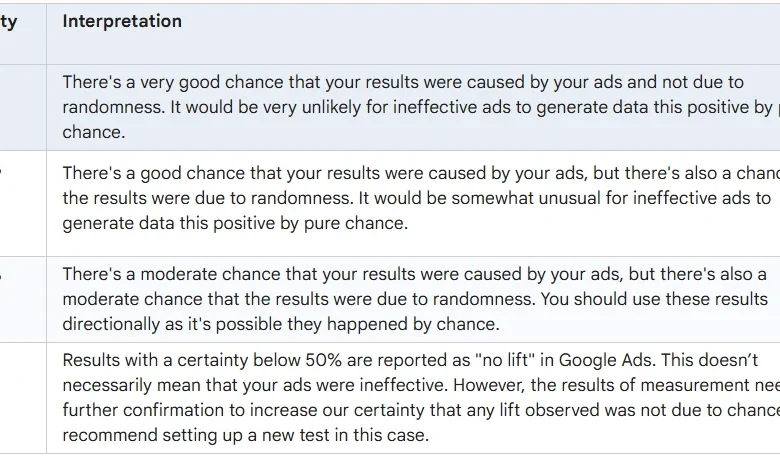
Industry veterans have increasingly criticized terms like "directional results"—a sophisticated-sounding phrase that often serves as a catch-all for ambiguous data. According to platform guidelines, certainty metrics are frequently categorized into intuitive bands: a statistical certainty of 90 percent or higher is described as a "very good chance" of success, 70 to 90 percent as a "good chance," 50 to 70 percent as a "moderate chance," and anything below 50 percent indicates "no lift."
While these linguistic categorizations sound reassuring to non-technical stakeholders, marketing analysts argue they systematically obscure underlying financial risks. By framing moderate-to-low statistical certainty as "directionally valuable," platforms encourage advertisers to treat ambiguous outcomes as a green light for continued spending.
Divergent Incentives: The Platform Versus the Brand Owner
To understand the friction in modern digital advertising, analysts point to the fundamental divergence of interests between media sellers and brand budget holders.
For an advertising platform such as Google, Meta, or TikTok, the economic incentive structure is clear. The platform functions as a marketplace for ad inventory. If an incrementality study yields weak or suggestive evidence that an ad campaign may have worked, the platform has minimal downside in encouraging the advertiser to explore the data further. The theoretical possibility of a positive outcome is enough to justify ongoing experimentation.
Conversely, the brand’s Senior Director of Brand Media, Chief Marketing Officer (CMO), and Chief Financial Officer (CFO) operate under an entirely different risk profile. Their responsibility is not to extract abstract insights from noisy datasets, but to determine whether historical performance justifies risking millions of dollars of corporate capital on a repeat campaign. When a platform labels a 70 percent certainty metric as a "good chance" of success, the platform bears none of the financial fallout if the subsequent campaign fails. The brand, however, absorbs 100 percent of the loss.
Translating Statistical Certainty into Replication Risk
To bridge the gap between abstract statistical modeling and corporate finance, independent analysts have begun applying advanced biostatistical concepts—such as the Bayesian replication models inspired by statistician Steven Goodman—to digital advertising metrics.
When a brand invests $5 million into a YouTube campaign and receives a reported metric with 70 percent certainty, the raw data represents a snapshot of that specific test. However, business leaders do not make budget decisions based on isolated past performance; they base decisions on replication risk: the mathematical probability that an identical repeat investment under the same market conditions will yield a result strong enough to justify future spending.
Applying replication math reveals stark realities that contrast sharply with platform labeling:
- A reported 70 percent certainty metric often translates to only a modest probability of achieving positive lift upon replication.
- The statistical odds of hitting high-certainty thresholds (such as 90 percent or above) in a second identical campaign drop significantly when factoring in cumulative measurement error.
- The risk of repeating a multi-million-dollar expenditure without securing definitive proof of success can easily exceed 50 percent.
Consequently, many seasoned analytics leaders advocate for a strict internal threshold of 90 to 95 percent statistical certainty before presenting a campaign success story to executive leadership. Setting a higher floor helps mitigate Type S (sign) and Type M (magnitude) errors, where weak evidence not only fails to replicate but also overstates the actual business impact of the initial spend.
Broader Industry Implications and the Path Forward
The debate over statistical interpretation extends far beyond any single advertising ecosystem. As digital ad spend shifts dynamically across major platforms including YouTube, Meta, TikTok, and emerging retail media networks, agency and vendor reporting practices face mounting scrutiny.
Industry experts emphasize that brand owners must stop outsourcing their risk tolerance to the entities selling them ad inventory or to agencies whose compensation is directly tied to the scale of media spending. While exploratory data analysis and low-certainty tests have valid exploratory uses in low-budget environments, committing multi-million-dollar budgets requires rigorous evidentiary standards.
As corporate governance tightens around marketing accountability, the demand for transparent, reproducible metrics will likely grow. For now, the consensus among independent analysts remains clear: corporate decision-makers must establish their own rigorous definitions of statistical evidence, ensuring that platform-friendly terminology is never mistaken for verifiable financial return.