In the high-stakes arena of corporate digital marketing, the interpretation of data analytics often dictates multimillion-dollar budgetary allocations. Recently, scrutiny has turned toward the statistical frameworks employed by dominant digital advertising platforms, specifically Google, regarding how they evaluate the efficacy of advertising investments. At the center of this debate is the divergence between statistical certainty as defined by platform providers and the practical replication risk faced by corporate chief financial officers (CFOs) and chief marketing officers (CMOs).
For years, brands executing campaigns across digital ecosystems—including Google Ads, YouTube, and secondary social channels—have relied on proprietary measurement tools such as Brand Lift, Search Lift, and Conversion Lift studies. These analytical instruments are designed to quantify the incremental impact of advertising expenditures on consumer behavior, brand perception, and conversion rates. However, a critical examination of official platform guidelines reveals a fundamental tension in how statistical probabilities are communicated to advertisers bearing the financial risk of campaign deployment.
Background and Context of Digital Lift Measurement
Digital advertising lift studies emerged as a response to the limitations of last-click attribution and correlation-based metrics. By utilizing randomized controlled trials (RCTs)—dividing audiences into exposed groups (those who see the ads) and control groups (those who do not)—platforms attempt to isolate and measure causality.
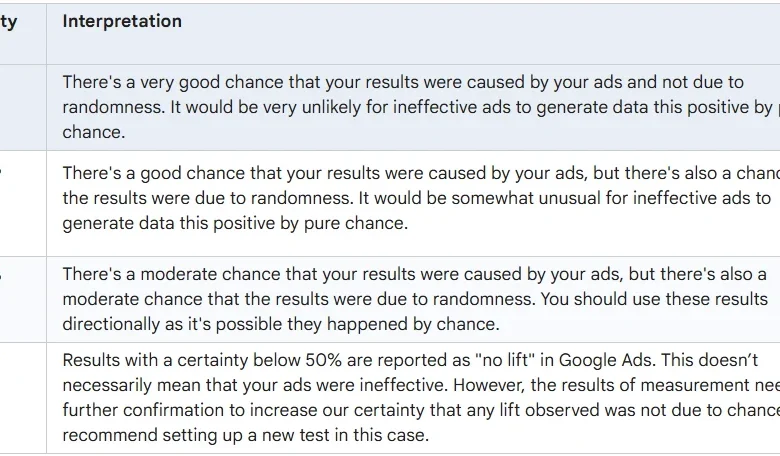
Yet, the statistical thresholds used by platforms to denote success have increasingly drawn criticism from enterprise analytics experts. According to official Google guidelines, statistical certainty ratings are categorized into distinct bands: certainty levels of 90% or higher are classified as a "very good chance" of success; ranges between 70% and 90% are deemed a "good chance"; 50% to 70% indicate a "moderate chance"; and metrics hovering near 50% are categorized as "no lift." Furthermore, platform guidance frequently advises that studies achieving a certainty threshold of 50% or greater can yield "valuable, directional insights," encouraging advertisers to interpret such results for strategic planning.
This terminology has ignited a debate within the analytics community regarding the operational definition of terms like "directional results." Critics argue that such phrasing creates an ambiguous safety net, allowing platforms to frame inconclusive or statistically weak data as actionable intelligence, thereby justifying ongoing or expanded media spending.
Two Parties, Two Different Risk Profiles
The core controversy lies in the asymmetrical distribution of risk between the platform providing the analytics and the enterprise funding the media campaign.
From the perspective of an advertising platform, the primary objective of a lift study is exploratory and optimization-oriented. If a study indicates even a modest, suggestive correlation between ad exposure and consumer lift, the platform retains a commercial incentive to interpret the data as a potential indicator of success. The platform incurs no direct financial penalty if the underlying campaign fails to deliver reproducible business value upon reinvestment.
Conversely, the corporate buyer—represented by senior brand media directors, CMOs, and CFOs—operates under strict financial accountability. For these stakeholders, the central business question is not whether a dataset contains an interesting statistical anomaly, but whether the evidence is robust enough to justify risking millions of dollars on the assumption that a subsequent campaign will yield identical results. When a platform characterizes a 70% certainty score as a "good chance," it places the burden of risk squarely on the advertiser, who must decide whether those odds meet corporate standards for capital allocation.
The Mathematics of Replication Risk
To bridge the gap between platform certainty and enterprise financial planning, analysts utilize probabilistic frameworks—such as Bayesian replication models inspired by biostatistical methodologies pioneered by researchers like Steven Goodman—to evaluate "replication risk." This metric calculates the mathematical probability that an identical campaign, executed with an equivalent budget under the same market conditions, will reproduce results strong enough to meet predefined corporate standards of statistical significance.
When applied to platform-reported metrics, the math often yields sobering conclusions for budget holders. For instance, if a YouTube Brand Lift study reports a +3-point lift in brand consideration at a 70% certainty level, a Bayesian replication analysis demonstrates that the actual probability of achieving a positive lift upon repeating the campaign is significantly lower than a casual interpretation of "good chance" implies. Specifically, the statistical probability of replicating a statistically significant result at or above a stringent enterprise threshold (such as 90% certainty) drops considerably, often revealing high exposure to capital loss.
Enterprise risk management models generally dictate that for high-consequence financial decisions—such as committing multimillion-dollar tranches of media spend—a statistical floor of 90% to 95% certainty is required before declaring a campaign a success and reinvesting capital. Relying on lower thresholds introduces substantial vulnerability to Type S (sign) and Type M (magnitude) errors, where the initial impact may be both statistically fragile and economically overstated.
Broader Impact and Implications for the Advertising Industry
The implications of these statistical divergences extend far beyond Google’s ecosystem, applying equally to major digital publishers and social media platforms including Meta, TikTok, and programmatic ad networks. As enterprise marketing budgets face heightened scrutiny in constrained macroeconomic environments, corporations are increasingly re-evaluating how they assess vendor-provided analytics.
Industry analysts emphasize the necessity for independent validation and standardized statistical reporting across marketing teams, media agencies, and external vendors. By establishing internal benchmarks that decouple corporate risk tolerance from platform-supplied terminology, organizations can avoid subsidizing exploratory platform research with core marketing capital.
Ultimately, the debate underscores a fundamental mandate for modern marketing analytics: enterprise decision-makers must distinguish between data that serves the commercial interests of advertising platforms and data that satisfies the rigorous evidentiary standards required for sustainable business growth.