Navigating the European Union AI Act: Comprehensive Guidelines for AI Content Labelling and Digital Transparency

The implementation of the European Union’s landmark artificial intelligence transparency regulations has sparked widespread discussions across the global tech industry, transitioning from abstract legislative frameworks into concrete operational requirements. Set to fully take effect on August 2, 2026, the European Commission’s updated guidelines under Article 50 of the AI Act establish definitive legal obligations for companies serving EU citizens. Contrary to initial industry panic regarding exorbitant fines and sweeping punitive measures, the regulatory landscape is remarkably targeted. Fundamentally, the legislation aims to enforce clear, unambiguous disclosures whenever artificially generated or manipulated content could reasonably be mistaken for human-created material.
As digital ecosystems flood with synthetic text, imagery, and video, organizations worldwide must adapt their user experience (UX) and interface design strategies to comply with these emerging standards. Understanding the nuances of what requires labelling, where the boundaries of editorial oversight lie, and why traditional UI conventions like the ubiquitous "AI sparkle" fall short is now a critical priority for product managers, legal teams, and software designers alike.
The Scope and Jurisdictional Reach of Article 50
The core objective of the EU AI transparency framework is simple yet demanding: to ensure that individuals interacting with digital media can instantly and unmistakably recognize when content has been generated or altered by an artificial intelligence system. Under Article 50(4) of the AI Act, these obligations are imposed upon both providers—those who develop or supply AI models—and deployers—organizations and enterprises that integrate these tools into public-facing products.

Crucially, the regulation operates on a jurisdictional model similar to the General Data Protection Regulation (GDPR) and the European Accessibility Act (EAA). Companies do not need to be physically headquartered within the European Union to fall under its purview. Any business globally that offers AI-driven products, services, or media consumed by individuals located inside the EU must adhere to these transparency mandates. This extraterritorial reach means that software-as-a-service (SaaS) providers, global marketing agencies, e-commerce platforms, and multinational media networks must systematically audit their digital interfaces to ensure compliance.
Failing to meet these standards risks substantial regulatory scrutiny and enforcement actions from member state authorities. However, legal experts emphasize that the mandate is not a blanket requirement to label every single instance of computer-assisted work. The vast majority of standard, behind-the-scenes AI optimizations remain entirely unregulated, provided they do not cross the threshold into autonomous generation of public-facing content.

Demarcating AI Generation from Human Editorial Control
One of the most pressing questions facing digital publishers and content creators involves the distinction between AI assistance and true AI generation. According to the European Commission’s detailed guidance and the associated Code of Practice, minor assistive edits do not trigger disclosure requirements. Routine software functions such as automated spellcheck, grammar correction, formatting adjustments, cropping, color balancing, and machine translation are classified as basic processing rather than artificial generation.
Conversely, heavier computational tasks cross the legal threshold into AI generation. Substantive content creation—such as AI-generated article summaries, composite imagery, automated text rewrites, or programmatic alterations that add or remove elements within digital photographs—demands explicit, visible labelling.

A frequent point of confusion among corporate communications teams is the role of human review. The Commission has explicitly clarified that a cursory glance or a nominal "human skim" immediately prior to publication does not constitute valid editorial control. To bypass the mandatory disclosure rule, a human editor must perform a substantive review, taking formal editorial responsibility for the material with their name or corporate entity clearly attached.
Furthermore, where AI-generated claims or media touch upon areas of public interest—defined broadly to include health, safety, the environment, the economy, financial markets, politics, science, and culture—the requirement for transparent labelling becomes absolute. Similarly, commercial entities deploying realistic AI-generated illustrations, marketing photos, or promotional posters that resemble actual people, places, or objects are legally advised to incorporate prominent disclosures to prevent consumer deception.

The Shortcomings of the Ubiquitous AI Sparkle Icon
For years, the technology sector has relied on informal visual shorthand to indicate artificial intelligence features, most notably the "sparkle" symbol or icon. However, recent usability research and regulatory updates indicate that sparkles are fundamentally insufficient for legal compliance under the new EU framework.
Studies from prominent UX research organizations, such as the Nielsen Norman Group, have repeatedly demonstrated that users interpret sparkle icons in wildly inconsistent ways. Frequently, a sparkle is used by product designers to signify a generalized "AI-powered feature"—such as a smart writing assistant or a predictive search bar—rather than explicitly identifying that a specific piece of content currently on the screen was entirely generated by an algorithm.

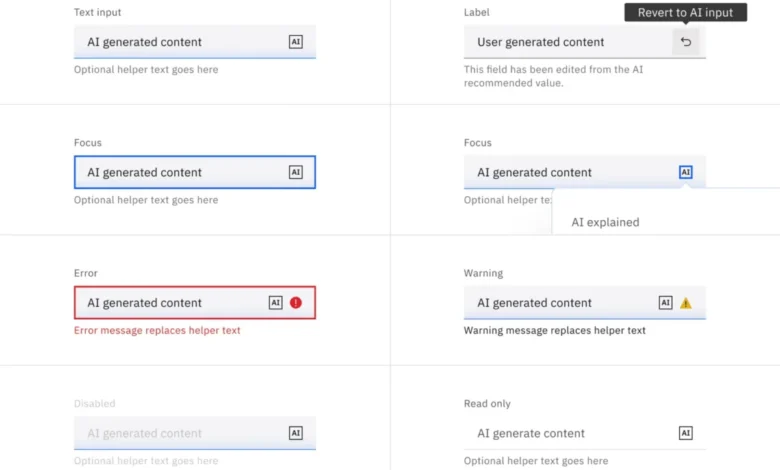
To resolve this ambiguity, the European Commission, alongside industry groups publishing design systems like IBM’s Carbon Design System, has introduced standardized visual languages. The official EU AI icon set provides distinct graphical markers to differentiate between basic AI integration, fully generated media, and partially modified content.
Crucially, the European Commission has formally stated that displaying an icon in isolation does not constitute legal compliance. Micro-icons tucked away in obscure corners, disclosures buried in a website’s footer, or transient labels that fade after a few seconds violate the core principle of accessibility and visibility. Regulators mandate that AI labels must be clear, easily distinguishable, accompanied by plain-language textual descriptions (such as "AI-generated"), and fully accessible to assistive technologies. Moreover, these digital markers must persist even when the underlying content is downloaded, shared, or republished across external platforms.

A Global Regulatory Pattern Emerging Beyond Europe
While the European Union’s regulatory framework is among the most comprehensive, it does not exist in a vacuum. Similar legislative initiatives are rapidly proliferating across international jurisdictions, signalling a broader global convergence toward mandatory AI transparency.
In the United States, a patchwork of state-level legislation has emerged to address specific facets of synthetic media. Several states have enacted laws requiring rigorous disclosures for synthetic human performers ("digital replicas" in the entertainment industry), AI-driven political advertising, and automated decision-making systems in consumer finance and employment. In Asia, regulatory bodies in countries like South Korea, China, and Japan have introduced parallel mandates requiring visible watermarking and explicit labelling for deepfakes and generative AI outputs.

This synchronized global shift indicates that AI transparency is evolving from a voluntary corporate best practice into an international compliance standard. Organizations planning product roadmaps for the coming years must view regulatory adaptation not as a temporary hurdle, but as a permanent structural component of product development.
Practical Implications for Product Design and Engineering Teams
For software architects, UX designers, and digital product teams, the arrival of these transparency rules requires immediate, cross-functional collaboration. Engineering teams must implement robust provenance tracking—such as cryptographic watermarking and metadata embedding—to ensure that AI-generated assets retain their disclosure tags throughout their digital lifecycle.

Concurrently, UX designers must rethink interface patterns to incorporate standardized AI labels seamlessly into user dashboards, e-commerce product listings, content management systems, and enterprise software. Balancing regulatory compliance with a clean, frictionless user experience will be one of the defining design challenges of the digital economy. Ultimately, these measures seek to empower consumers to effortlessly distinguish authentic human craftsmanship from automated synthetic media, fostering a more transparent, trustworthy digital environment for all participants.