Building Reliable Memory Systems for AI Agents: Architectural Strategies for Long-Term Intelligence

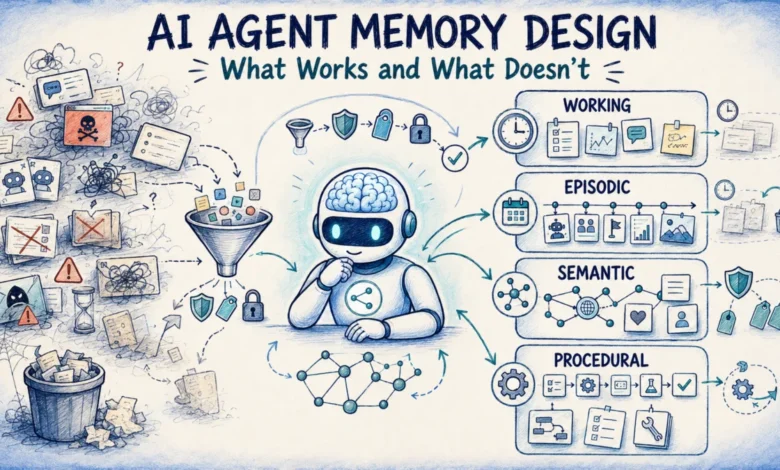
The shift from stateless language models to autonomous AI agents marks a fundamental transition in computing, moving from transient input-output tasks to persistent, goal-oriented reasoning. When an AI agent operates within a single, isolated prompt, its operational requirements are straightforward. However, once an agent must function across separate sessions, long-running workflows, or complex multi-agent environments, the necessity for robust, reliable memory becomes the primary determinant of system stability. Without a sophisticated memory architecture, agents suffer from "amnesia"—restarting from zero in every interaction—or, conversely, "context pollution," where stale or irrelevant data degrades performance. Designing memory systems that facilitate continuity without introducing persistent, hard-to-trace failures is the current frontier of AI engineering.
The Evolution of Agentic Memory
In the early stages of large language model (LLM) deployment, developers relied almost exclusively on "context windows"—the immediate, volatile buffer of tokens available to the model. While effective for simple chat interfaces, this approach fails in agentic systems where the agent must retain facts, preferences, and procedural knowledge over days or weeks.
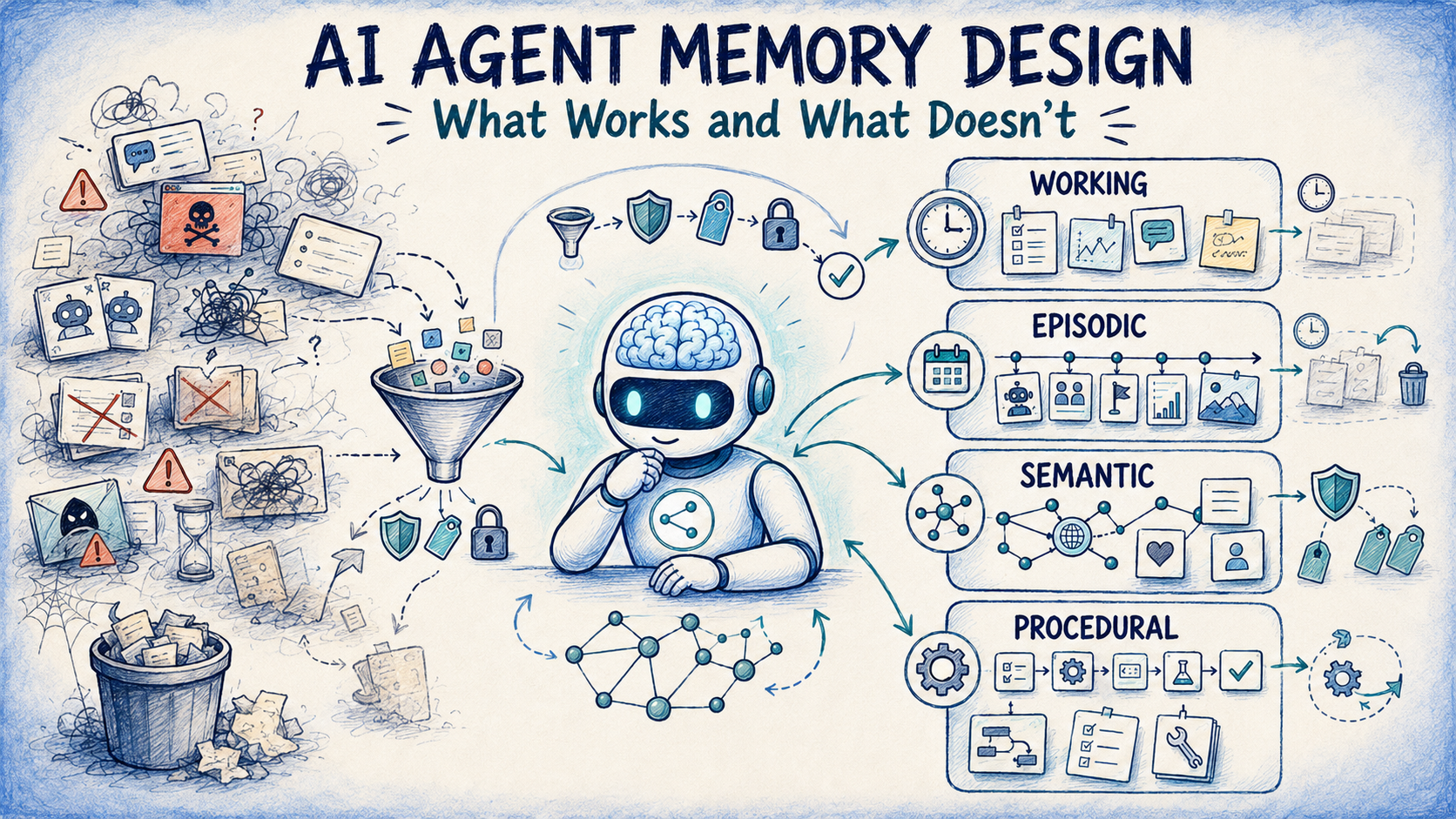
The industry has moved toward a taxonomy of memory that mimics cognitive science frameworks. The primary challenge currently facing developers is the "flattening" of these memory types into a single storage layer, such as a monolithic vector database. This architectural shortcut frequently leads to retrieval noise, where the agent retrieves a piece of semantic knowledge when it actually requires procedural instructions, or vice versa. By segregating memory into four distinct layers—Episodic, Semantic, Procedural, and Working—engineers can apply specific retrieval strategies to each, drastically reducing the rate of logic errors.
Taxonomy and Structural Requirements
Episodic memory, which stores the "what happened" of past interactions, is most effectively handled by vector stores, allowing for semantic similarity searches. In contrast, Semantic memory—the repository of static facts and user preferences—requires a hybrid approach, combining vector-based retrieval with exact key-value lookups to ensure precision. Procedural memory, representing the "how-to" of successful task execution, often functions best as a structured store or a series of injected prompt templates that guide the agent’s decision-making flow. Finally, Working memory serves as the "scratchpad," providing the immediate, short-lived state of an active task.
The critical failure point in many modern systems is the reliance on unstructured, free-form summarization. While compressing long conversation histories into summaries seems efficient, it introduces significant risks: the loss of critical, granular detail and the compounding of hallucinations. If an agent summarizes a conversation containing a subtle error, that error is then persisted as a "summary fact," effectively legitimizing the mistake. To mitigate this, high-reliability systems are transitioning toward structured extraction, where LLMs are constrained by Pydantic schemas to pull only verified, typed data points into memory.
The Problem of Memory Poisoning and Trust
A significant, often overlooked, challenge in long-term memory design is "Memory Grafting," or memory poisoning. This security vulnerability occurs when an agent processes external, untrusted content—such as a user-provided document or a web scrape—that contains hidden instructions or malicious prompt injections. If the agent stores this content in long-term memory without sanitization, it can retrieve these instructions during a future session, inadvertently changing its own behavior based on the poisoned entry.
Data from recent cybersecurity research into agentic systems suggests that as little as one or two poisoned entries can fundamentally alter the retrieval behavior of an agent, as similarity-based searches prioritize these entries over legitimate history. To combat this, architects are implementing rigorous provenance tracking. Every memory entry must now be tagged with metadata: which agent created it, which tool was used, the confidence score of the fact, and, crucially, a trust level. By filtering memory through a "trust-gated" lens, developers can ensure that only high-integrity data influences high-stakes decision-making.
Best Practices for System Scalability
Reliable memory systems are built on the principle of continuous maintenance. An unbounded, ever-growing database is a form of technical debt. Effective systems employ automated routines, such as:
- TTL (Time-To-Live) Policies: Short-term working memory should automatically expire if a task does not complete, preventing the accumulation of "zombie" state.
- Confidence Decay: For facts that are prone to changing—such as a user’s current project status—the system should programmatically degrade the confidence score over time, forcing a re-verification before the agent treats the data as absolute truth.
- Deduplication: Periodic batch processing to identify and merge redundant facts, reducing the noise floor of the vector database.
Multi-Agent Coordination and Scoping
In multi-agent systems, the most frequent failure is the implementation of a "flat namespace," where every agent in a swarm has read/write access to the entire memory store. This leads to chaotic behavior where a research agent might write a temporary, context-specific note that is then misinterpreted by a code-execution agent.
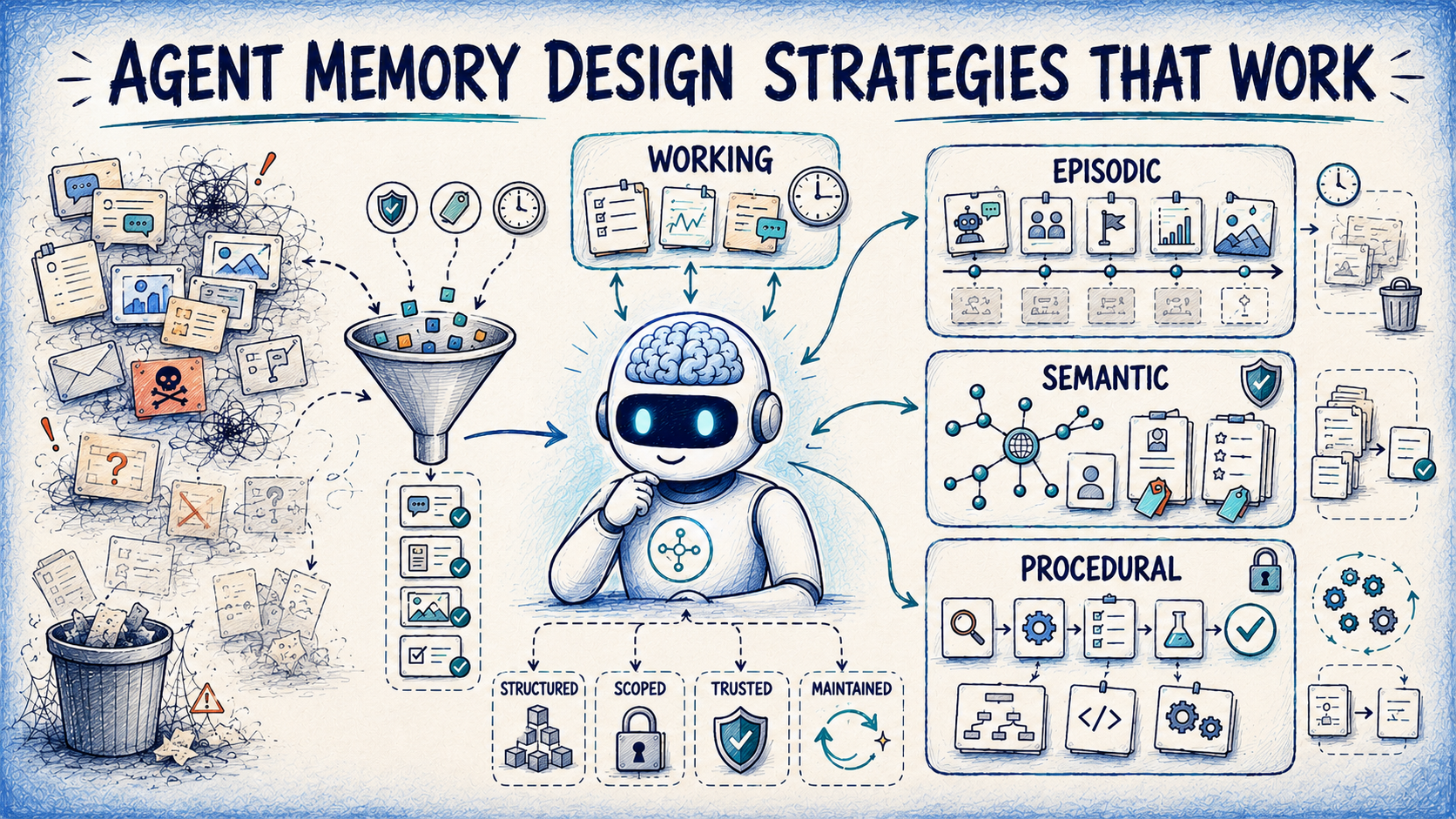
Modern architectural standards now dictate "Scoped Memory," where namespaces are strictly defined. An orchestrator agent holds global read/write privileges, while sub-agents are restricted to their own specific namespaces, plus a "shared facts" layer for essential, verified data. This scoping acts as a form of modular programming for AI agents, ensuring that errors in one subsystem do not propagate to the entire agentic architecture.
Analysis of Future Implications
The trajectory of AI memory design suggests a move away from generic, "one-size-fits-all" storage. As businesses move toward autonomous agents that manage customer service, financial analysis, or software development, the reliability of these systems will depend entirely on how they manage their "cognitive load."
Analysts observing the current development cycle in Silicon Valley note that the "intelligence" of an agent is increasingly becoming a secondary concern to its "stability." An agent that is 90% accurate but exhibits persistent, uncorrectable memory errors is ultimately less valuable in an enterprise environment than an agent that is 70% accurate but capable of self-correcting and maintaining a clear audit trail of its decisions.
Conclusion
Building a reliable memory system is not a task of storage, but a task of governance. By treating memory as a tiered, structured, and provenance-tracked asset rather than a simple database of text, developers can solve the most pressing issues of agentic instability. The shift from "writing everything" to "writing only the important" is the defining characteristic of the next generation of AI applications. As these systems become more integrated into critical infrastructure, the rigorous application of schemas, trust levels, and scope-based permissions will separate resilient, production-grade agents from experimental, failure-prone prototypes. The future of autonomous AI is not just about having more information, but about the intelligent management of what the machine chooses to remember.