Large language models (LLMs) are fundamentally designed to predict the next token in a sequence based on statistical probabilities derived from vast datasets. While this architecture allows for remarkable fluency, it creates a structural bottleneck when applied to complex, multi-step logical tasks. By default, these models prioritize the most probable immediate continuation, often bypassing the iterative deliberation required for genuine problem-solving. This phenomenon, frequently described by researchers as the "stochastic parrot" problem, often results in outputs that possess a veneer of coherence while masking underlying logical fallacies. As AI agents move from simple chatbots to autonomous systems capable of executing multi-stage workflows, the necessity for robust reasoning frameworks has transitioned from an academic interest to a critical engineering requirement. Two primary paradigms—Chain of Thought (CoT) and Tree of Thoughts (ToT)—have emerged as the leading solutions for mitigating these limitations, offering distinct approaches to how machines process information, evaluate risk, and reach conclusions.
The Evolution of Machine Reasoning: A Historical Context
The shift toward structured reasoning represents a significant milestone in the development of generative AI. In the early stages of LLM adoption, the focus was primarily on scale—increasing parameter counts and training data volume. However, by 2022, researchers at Google and elsewhere identified that simply scaling models did not solve the problem of systemic logical errors in fields like mathematics and symbolic logic.
The introduction of "Chain of Thought" prompting, formalized in research papers such as Chain-of-Thought Prompting Elicits Reasoning in Large Language Models, marked a departure from direct prompt-to-response generation. By 2023, the industry saw the emergence of "Tree of Thoughts," a more sophisticated framework designed to address the limitations of linear logic. This progression mirrors the history of classical artificial intelligence, where systems evolved from simple rule-based heuristics to complex search-tree algorithms like those used in IBM’s Deep Blue or AlphaGo.
Chain of Thought: The Linear Foundation
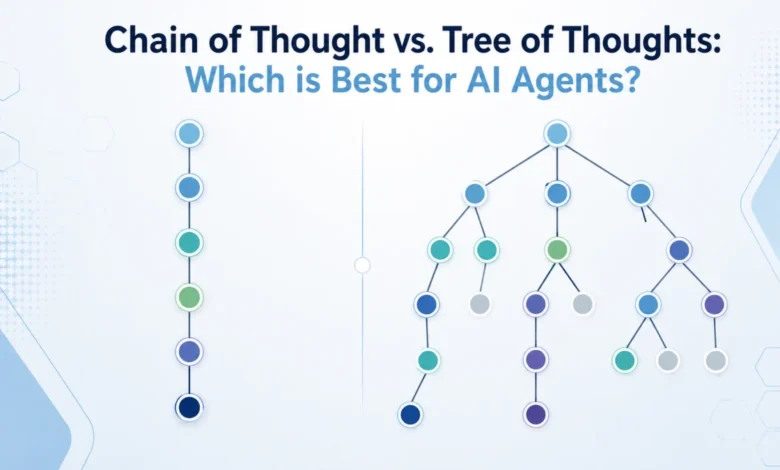
Chain of Thought is an intuitive prompting technique that forces an LLM to externalize its reasoning process. By inserting intermediate steps, the model is essentially encouraged to "think out loud." A prompt containing the phrase "Let’s think step by step" effectively shifts the model’s focus from predicting the final token to predicting a sequence of logical bridges that connect the initial query to the conclusion.
From a data perspective, CoT has demonstrated significant efficacy. Benchmarks on the GSM8K dataset, which tracks mathematical reasoning, have shown that CoT can improve model accuracy by over 30% compared to zero-shot, direct-answer prompting. Despite its simplicity, CoT remains the industry standard for most agentic tasks. Its primary advantage is its low computational overhead; because it generates a single path of reasoning, it requires minimal additional latency and cost, making it ideal for high-throughput, routine tasks like data extraction, sentiment analysis, and straightforward document summarization.
However, the linearity of CoT is a double-edged sword. Because the model operates on a "first-best-path" logic, it lacks an intrinsic mechanism for self-correction. If the model commits a minor arithmetic error or misinterprets a constraint in step two, that error is baked into the foundation of all subsequent steps. In a multi-step supply chain management agent, such an error could lead to a catastrophic miscalculation of inventory, as there is no mechanism for the model to "pause" and re-evaluate its previous logic.
Tree of Thoughts: Navigating Non-Linear Complexity
Tree of Thoughts represents a fundamental architectural pivot. Instead of a single, rigid sequence, ToT treats the reasoning process as a search problem. The model acts as a decision-maker at each node of a tree, generating multiple potential "thoughts" or next steps. These branches are then evaluated, either by the model itself or by a secondary heuristic, to determine which paths remain viable.
The implications for AI agents are profound. Consider a software development agent tasked with writing a complex API integration. Using ToT, the agent can draft three different code architectures simultaneously. It then evaluates each against specific unit tests or performance constraints. If one path leads to an impossible dependency, the agent can prune that branch and "backtrack" to a more promising alternative. This methodology effectively mirrors the human cognitive process of deliberation, where we consider multiple potential futures before selecting a course of action.
Quantitative Comparison and Computational Costs
The trade-off between these two approaches is largely dictated by the resource-intensity of the search process.
| Feature | Chain of Thought (CoT) | Tree of Thoughts (ToT) |
|---|---|---|
| Logic Structure | Linear/Sequential | Branching/Hierarchical |
| Self-Correction | None (Inherits errors) | High (Supports backtracking) |
| Latency | Low (Single-pass) | High (Multi-pass/Iterative) |
| Cost | Minimal | Significant (10x-100x increase) |
| Ideal Use Case | Routine/Standardized tasks | High-stakes/Strategic planning |
In professional settings, the cost of ToT is often the primary inhibitor. Because ToT requires the model to perform multiple inference calls—often generating scores and summaries for various branches—it can increase the token expenditure for a single query by orders of magnitude. For a real-time customer support agent, the latency induced by ToT would be unacceptable. Conversely, for an agent performing financial risk assessment or strategic market analysis, the cost of an error is far higher than the cost of increased compute, making ToT the only viable choice.
Strategic Implications for AI Agent Architecture
The current consensus among systems architects is to utilize a hybrid approach. Sophisticated agentic frameworks, such as those utilizing LangChain or AutoGPT, are increasingly implementing "Reasoning Orchestrators." These systems employ a classification layer at the start of a user request to determine the appropriate reasoning depth.
Routine tasks—such as updating a CRM record or scheduling a meeting—are routed through a CoT engine, ensuring speed and cost-efficiency. Complex tasks—such as debugging a production codebase or simulating an adversarial security threat—are escalated to a ToT framework. This tiered strategy allows organizations to optimize for both accuracy and operational expenditure.
The Future of Reasoning Frameworks
Looking ahead, the next generation of LLMs may integrate these reasoning structures natively into their training processes, rather than relying on prompt engineering alone. Research into "System 2" thinking for AI, a concept borrowed from behavioral economics, suggests that future models will be able to dynamically adjust their own reasoning depth based on the perceived complexity of the input.
As AI agents become more deeply integrated into enterprise workflows, the ability to select the right reasoning framework will become a core competency for developers. While CoT provides the reliable "workhorse" performance needed for daily operations, ToT offers the analytical depth required for the frontier of autonomous decision-making. Ultimately, the maturity of an AI system is not defined by its ability to answer, but by its ability to deliberate before it acts. In an era where AI-driven errors can have significant financial and operational consequences, the transition from simple linear prediction to complex, branching reasoning is not merely an improvement—it is a necessity for the safe and effective deployment of autonomous intelligence.