Measuring the True Business Impact of Sports Marketing: Moving Beyond Vanity Metrics to Proven Profitability

Live sports remain one of the last major bastions of collective, real-time television viewing in an increasingly fragmented media landscape. Recent viewership statistics underscore this phenomenon: nearly all of the top 50 telecasts in the United States are directly tied to sporting events, with rare exceptions such as major award ceremonies and high-profile news interviews. This enduring consumer appetite for live athletics has driven major streaming giants and global brands to fiercely compete for sports telecast rights and sponsorship inventories.
Marketers have responded by pouring vast sums into sports advertising, securing sponsorships for teams, apparel, equipment, vehicles, and stadium infrastructure. However, as corporate budgets face tighter scrutiny, senior leadership frequently challenges these multi-million-dollar outlays. When a company invests tens of millions of dollars into sports sponsorships, executives inevitably ask whether the hospitality suites and executive networking events translate into tangible business growth. Addressing this accountability gap requires a structured framework to evaluate sports marketing through rigorous analytics rather than superficial impressions.
The Fundamental Laws of Marketing Applied to Athletics
Before evaluating advanced analytical frameworks, practitioners must recognize that traditional marketing principles apply directly to the sports sector. Creative quality remains the primary driver of brand success, responsible for an estimated 60 to 70 percent of marketing outcomes. When a brand leases a team’s identity, athlete endorsement, or stadium real estate, it essentially borrows the emotional equity of the sport. However, if a brand’s creative strategy fails to cut through consumer noise in standard environments, it will perform even worse within the high-distraction setting of a live game where the primary focus is the athletic competition.
Furthermore, sporadic exposure—often described as the spike-and-silence phenomenon—proves lethal to sports marketing investments. Transferring the halo effect of an athlete or team to a corporate brand requires sustained frequency. Similar to standard digital or broadcast media, where a frequency threshold of three exposures per user weekly is often required to shift perceptions, sports sponsorships cannot rely solely on organic placements. Brands must integrate paid media strategies that feature sports personalities to achieve the necessary repetition for behavioral influence.
Similarly, boutique hospitality events, such as luxury boxes at major league stadiums or private suites at iconic racing events, effectively entertain key clients and facilitate executive networking, but they rarely scale to drive mass-market business impact. Consequently, establishing a sophisticated measurement methodology is essential to separate vanity metrics from genuine commercial return.
Level 5: The Opening Gambit of Vanity Metrics
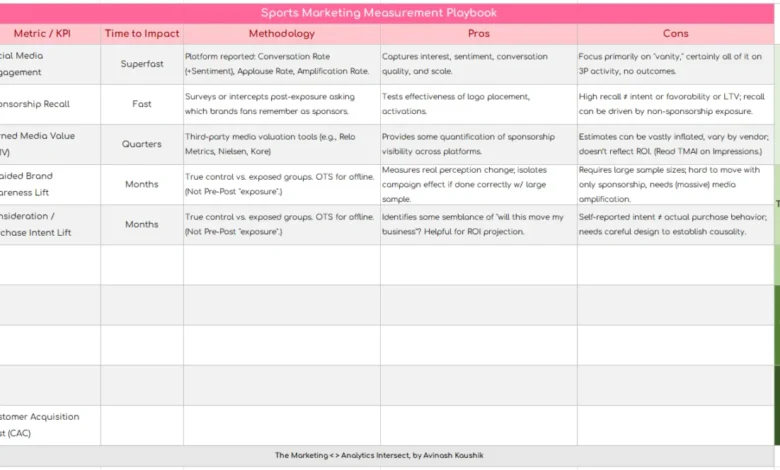
Most corporate sports sponsorships begin at Level 5, an entry point characterized by high-volume activity metrics that populate slide decks but fail to demonstrate financial causality. This tier focuses primarily on visibility rather than outcomes.
L5.1 tracks social media engagement, measuring conversation rates, applause rates, and amplification across organic brand channels and athlete profiles. While these metrics provide immediate feedback and low-cost data collection, they measure noise rather than business value.
L5.2 examines sponsorship recall through post-exposure surveys administered at stadium exits or via customer relationship management databases. Although aided recall questions often inflate positive responses by prompting participants, unaided recall and analysis segmented by exposure intensity offer more reliable signals.
L5.3 introduces Earned Media Value (EMV), also known as Ad Value Equivalency (AVE). This heavily criticized metric calculates the duration of a brand logo’s visibility during a broadcast and multiplies it by equivalent advertising rates. Major marketing associations widely discredit EMV because it assumes all exposure is positive, ignores audience relevance and clutter, and lacks a dedicated marketing message. Level 5 metrics ultimately yield an Impact Intelligence Score of 1 out of 10, offering immediate speed of impact but zero financial linkage.
Level 4: The Quest for Brand Impact and Perception Shifts
Transitioning from activity to human impact requires Level 4 measurement, which evaluates whether a sports sponsorship genuinely shifts consumer perceptions over a period of months. This tier employs test-versus-control methodologies to assess changes in core brand metrics.
L4.1 focuses on Unaided Brand Awareness (UBA), a long-term revenue driver that is notoriously difficult to influence. Effective sports marketing programs executed over multi-year agreements can successfully lift UBA, whereas short-term contracts typically fail to generate meaningful business results.
L4.2 measures lifts in consideration and purchase intent, metrics that capture the attention of corporate chief financial officers. Utilizing traditional brand tracker surveys, analysts compare exposed audiences—those who demonstrably viewed sponsored content, broadcasts, or paid amplification—against comparable control groups using propensity score matching.
By accounting for external variables such as concurrent product launches and competitor activity, Level 4 metrics achieve an Impact Intelligence Score of 4 out of 10. While self-reported purchase intent does not automatically equate to actual buying behavior, this tier introduces rigorous science to perception shifts and brand affinity.
Advanced Measurement: Toward Financial Incrementality
Beyond perception lies the upper echelon of sports marketing measurement, which connects brand affinity to actual financial outcomes. While introductory levels gauge visibility and intermediate tiers measure brand lift, advanced frameworks track direct digital traces and prove ultimate incrementality.
For Chief Marketing Officers and corporate boards, the transition from visibility-driven accounting to causal analytics transforms sports sponsorships from speculative hospitality expenses into predictable growth drivers. Organizations that implement multi-tiered evaluation frameworks can successfully isolate the revenue impact of their investments, ensuring that multi-million-dollar partnerships deliver measurable profitability rather than mere corporate prestige.
Related posts: