Fourthwall vs Spring: A Comprehensive Comparative Analysis of Creator Monetization Platforms

The landscape for digital creators has shifted dramatically over the past decade, moving from simple ad-revenue models to diversified ecosystems where creators act as their own retailers, publishers, and media houses. As the "creator economy" matures, the infrastructure supporting these entrepreneurs has become a critical point of competition. At the center of this are two primary platforms: Spring (formerly Teespring) and Fourthwall. While both offer mechanisms for creators to monetize their audiences through print-on-demand (POD) merchandise and digital assets, their underlying philosophies, technological capabilities, and long-term scalability offer fundamentally different value propositions.
Historical Context and Evolution of the Creator Marketplace
Spring was founded in 2011 as Teespring, originally functioning as a crowd-funding platform for custom apparel. Its model was revolutionary at the time, removing the financial risk of inventory management by utilizing a print-on-demand fulfillment chain. Over the years, the company rebranded to "Spring" to reflect a broader scope of services, including integrations with major social platforms like YouTube and Twitch.
Fourthwall entered the market significantly later, positioning itself as an "all-in-one" solution for the modern, professionalized creator. Recognizing that the top tier of content creators needed more than just a store—they required a brand architecture—Fourthwall developed a platform that integrates storefront customization, membership management, and diverse revenue streams into a single dashboard. This evolution represents a shift in industry expectations: creators are no longer just "influencers" but are now small businesses requiring sophisticated financial, logistical, and branding tools.
Comparative Infrastructure and Storefront Functionality
The technical disparity between the two platforms is perhaps the most significant factor for creators at different stages of their careers. Spring operates primarily as a hosted social storefront. Its design language is centered on simplicity and speed of deployment. A user can launch a campaign in minutes by uploading a design and selecting items from a pre-determined catalog. However, this accessibility comes at the cost of creative control. Users are largely confined to the platform’s templates, which, while functional, offer limited capacity for deep brand identity construction or custom site architecture.
Conversely, Fourthwall provides a comprehensive storefront builder that functions closer to dedicated e-commerce platforms like Shopify. It allows for custom domains, full CSS and HTML control, and the creation of multi-page websites that can house blogs, landing pages, and complex navigation structures. For a creator attempting to establish a standalone brand that exists independently of their social media following, this structural freedom is paramount. Furthermore, Fourthwall’s inclusion of a Storefront API enables developers to build custom experiences, a feature that distinguishes it as a tool for scaling businesses rather than just seasonal merchandise campaigns.
Product Catalog and Revenue Diversification
When evaluating what can be sold, the divergence in strategy becomes clear. Spring’s core revenue driver remains print-on-demand apparel and lifestyle accessories. While it has introduced a "Digital Launcher" to support the sale of eBooks and other digital downloads, the platform lacks native support for recurring revenue models. A creator on Spring generally relies on the "transactional" model: a follower buys an item, the transaction concludes, and the relationship enters a waiting period until the next product launch.
Fourthwall, by contrast, provides a diversified revenue engine. Its platform is architected to handle:
- Retail-grade POD: A curated catalog featuring premium blanks and higher-end printing techniques.
- Memberships: Native support for paid tiers, exclusive content feeds, and subscriber-only perks.
- Self-Fulfilled Inventory: Unlike Spring, Fourthwall allows creators to integrate their own stock, enabling a hybrid model where creators can sell curated items alongside POD goods.
- Donations and Gift Cards: Built-in tools for direct community support and long-term financial engagement.
This ability to bundle digital downloads, physical goods, and membership subscriptions into a single checkout flow allows creators to increase their Average Order Value (AOV) and lifetime customer value.
Financial Models and Fee Structures
The economic feasibility of these platforms hinges on their fee structures. Both companies offer "free" plans, which function as entry points. However, the "hidden" costs—base product prices and transaction fees—vary significantly.
Spring’s financial model is transparent but rigid. The platform sets a base cost for production, and the creator determines the retail price. The margin is the difference between the two. However, for digital products, Spring imposes a 20% commission plus a flat $1.70 fee per sale. For high-volume, low-cost digital items, these fees can significantly erode profitability.
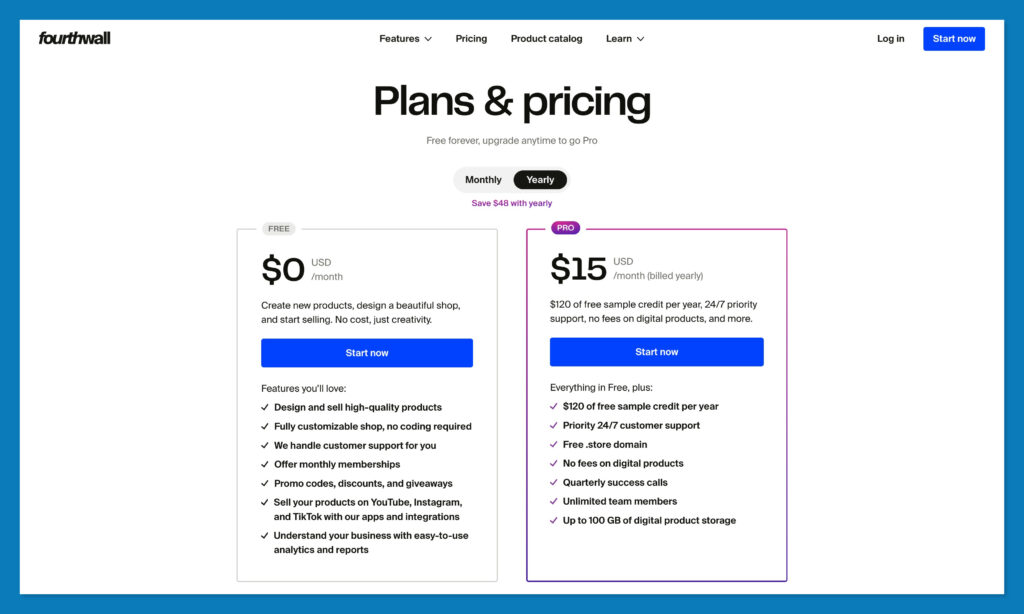
Fourthwall’s pricing is tiered. On its free plan, there are no fees for physical merchandise sales (beyond standard payment processing), but it levies a 5% fee on digital products and memberships. For creators generating significant revenue, Fourthwall offers a paid subscription ($19/month or $180/year) that eliminates digital product fees and unlocks advanced features like expanded product limits and priority support. This subscription model is often more cost-effective for creators who reach a specific scale, as the marginal cost of the subscription is frequently lower than the cumulative percentage fees incurred on higher-volume platforms.
Logistical Support and Merchant of Record Status
A critical aspect for creators who are not logistics experts is the "Merchant of Record" (MoR) status. Both Spring and Fourthwall act as the MoR, meaning they assume the burden of tax calculation, remittance, and compliance for transactions across various jurisdictions. This is an invaluable service for creators who would otherwise face complex legal and accounting challenges when selling globally.
However, the customer service experience differs in scope. Spring utilizes a "Make It Right" policy for defects, but generally limits its support obligations. Fourthwall offers a more integrated support experience, including an AI-driven shop assistant, "Eli," designed to help with catalog management, pricing optimization, and store maintenance. This AI integration marks a departure from the manual, labor-intensive management of older POD platforms, reflecting a broader trend toward automation in the creator economy.
Analytical Data and Integrations
The modern creator is data-driven. The ability to sync sales data with marketing tools like Klaviyo, Mailchimp, or Zapier is essential for retargeting and customer retention. Fourthwall provides a robust suite of integrations, including a recent partnership with "Kit" to synchronize subscriber data, which allows for sophisticated automated email marketing sequences based on purchase history.
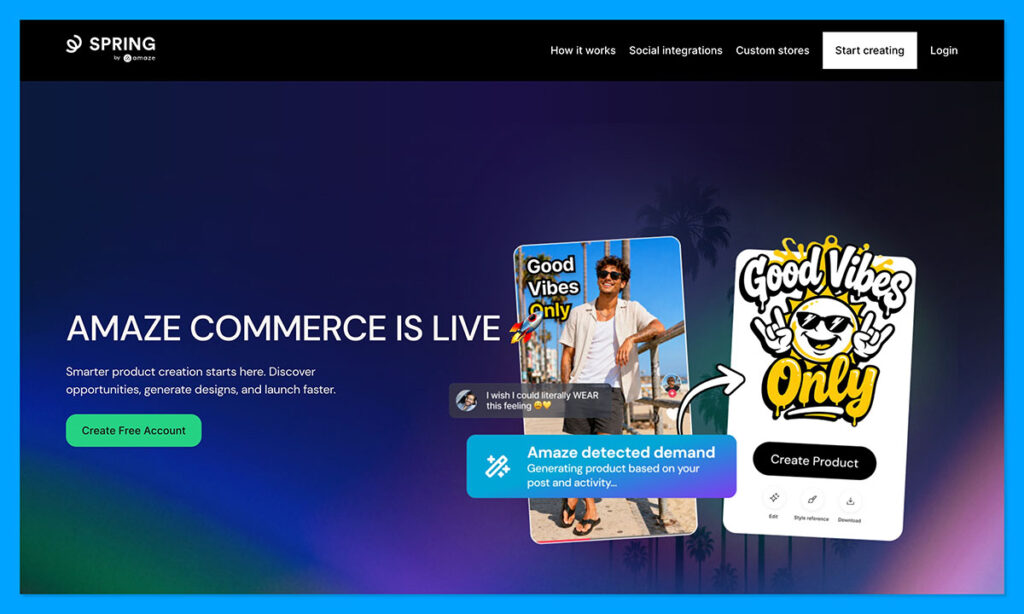
Spring maintains solid integrations with social platforms—essential for the "social commerce" aspect of its business—but it offers less in terms of deep-funnel marketing integration. The lack of built-in blogging or native email marketing tools within the Spring ecosystem forces creators to manage their marketing stack in silos, which can lead to data fragmentation.
Strategic Implications for Creators
The choice between Spring and Fourthwall ultimately depends on the creator’s current trajectory. If the goal is a low-friction, "set it and forget it" approach to launching a limited run of merchandise for an existing social media audience, Spring remains a viable, low-barrier-to-entry solution. It is a tool for the "merch drop" generation.
However, for creators looking to build a sustainable, multi-channel business that includes memberships, exclusive content, and a professional-grade web presence, Fourthwall offers a more robust foundation. It addresses the fundamental need for "ownership" in the creator economy—not just ownership of the brand, but ownership of the customer relationship.
As the industry moves away from the reliance on singular platform algorithms and toward direct-to-consumer relationships, the ability to collect first-party data, offer recurring memberships, and curate a premium shopping experience becomes a competitive advantage. In this context, Fourthwall represents the next generation of creator infrastructure, while Spring remains the standard-bearer for the initial wave of creator monetization. Creators must weigh the immediate convenience of the latter against the long-term scalability of the former.