Meta’s Quest for the Ultimate AI Assistant: Inside the Launch of Muse and the Decade-Long Struggle to Make Digital Companions Stick


The artificial intelligence landscape is witnessing a massive influx of generative tools designed to streamline daily life, yet one Silicon Valley giant remains tethered to a vision that consumers have repeatedly pushed back against. Meta Platforms, under the stewardship of Chief Executive Officer Mark Zuckerberg, has once again doubled down on the concept of the personal digital assistant with the launch of its new application and chatbot, Muse. Touted by the company as its most sophisticated artificial intelligence tool to date, Muse allows users to assign their bots custom names, delegate background tasks, and interact with an ever-present digital companion.
Zuckerberg envisions Muse not merely as a feature upgrade, but as a foundational stepping stone toward the broader realization of personal superintelligence for the masses. Yet, this ambition runs headfirst into a stubborn historical precedent. Despite billions of dollars in capital expenditure, decades of algorithmic progress, and aggressive promotional campaigns, Meta’s previous attempts to integrate AI-driven personal assistants into the daily routines of average users have largely sputtered out. As the tech industry watches Meta commit vast resources to its latest generative AI ecosystem, industry analysts and historians of consumer technology are left examining a fundamental disconnect between executive philosophy and consumer behavior.
A Decade of Repetitive Ambition: The Chronology of Meta’s AI Assistants
To understand the weight riding on the Muse application, one must examine Meta’s turbulent history with conversational agents and virtual assistants. The pursuit is not a novel pivot born of the recent generative AI boom; rather, it is the continuation of a strategic objective that dates back more than a decade.
In August 2015, Facebook—as the company was then known—unveiled "M," an ambitious artificial intelligence-powered personal assistant integrated directly into the Messenger platform. Designed to rival Apple’s Siri, Microsoft’s Cortana, and dedicated concierge services, M was built to handle complex, real-world requests. According to David Marcus, who headed the Messenger division at the time, M’s capabilities extended far beyond simple web searches. The assistant could purchase consumer goods, arrange deliveries of gifts to loved ones, secure restaurant reservations, coordinate travel itineraries, and manage personal schedules.
However, M faced severe technological limitations. In its early phases, the artificial intelligence required a significant safety net of human contractors—often referred to as "trainers"—to fulfill requests behind the scenes. As the computational limitations became clear and consumer adoption failed to materialize at scale, Meta quietly wound down the experiment, officially shelving the M project in January 2018, less than three years after its grand introduction.
Undaunted by the closure of M, Meta continued to experiment with automated interaction formats. In 2016, the company launched its Messenger bots platform, encouraging developers to build automated customer service and utility tools within the chat interface. Years later, in an effort to inject personality and pop-culture appeal into its conversational interfaces, Meta rolled out a series of celebrity-voiced AI chatbots across its messaging apps, enlisting high-profile cultural figures to endorse and voice the automated tools.
Despite these iterative redesigns and heavy marketing pushes, none of these features captured sustained public interest. Users consistently gravitated toward human-to-human communication on social platforms, treating automated bots as novelties rather than indispensable daily utilities. Now, with Muse, Meta is attempting a modern variation of the exact same conceptual framework, powered by advanced large language models rather than the brittle rule-based and hybrid systems of the past.
The Philosophical Divide: Optimization Versus Human Experience
The persistence of Meta’s assistant strategy points to a deeper philosophical divergence between the company’s executive leadership and its global user base. Where everyday consumers often view communication, shopping, and product research as organic, leisurely, or socially driven experiences, Zuckerberg approaches these domains through the lens of radical efficiency and personal optimization.
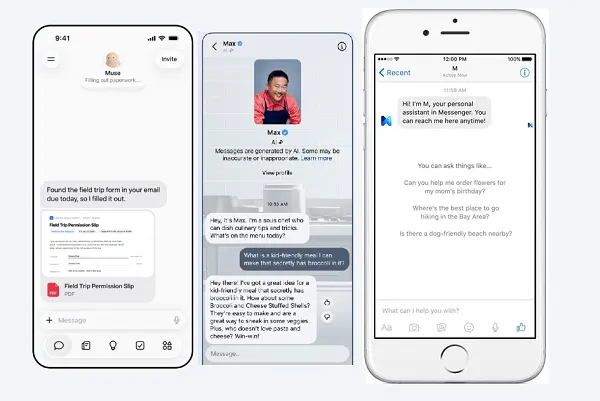
In recent interviews discussing the operational philosophy behind Muse, Zuckerberg articulated a deeply personal use case for the technology. Rather than focusing solely on corporate productivity or logistical tasks, he noted that his primary aspiration for his personal AI agent is to help him become a better father, a better husband, and a more attentive friend. This perspective highlights an internal corporate ethos that seeks to apply computational optimization to interpersonal relationships and emotional availability.
For Zuckerberg, every minute spent navigating logistics, researching products, or managing daily friction is viewed as time that could be streamlined or eliminated. He has famously demonstrated this commitment by engineering custom smart-home systems that manage household operations in a manner reminiscent of science fiction narratives.
However, market data and sociological trends suggest that this hunger for hyper-optimization is not a universal human desire. The broader public frequently demonstrates a preference for organic discovery, serendipitous browsing, and authentic human interaction. Activities like selecting a gift, researching a major purchase, or chatting with a friend are often valued precisely because they require active human participation and emotional investment, rather than because they can be outsourced to an automated algorithm running quietly in the background.
Broader Implications for Meta’s AI Strategy
The launch of Muse arrives at a critical juncture for Meta. The company has staked its financial and strategic future on artificial intelligence, pouring staggering amounts of capital into data centers, hardware infrastructure, and top-tier engineering talent. Wall Street and industry stakeholders are closely monitoring these expenditures, looking for clear paths to monetization and long-term user engagement that justify the immense capital outlays.
If Muse fails to capture the public imagination—much like its predecessor M and the subsequent celebrity-themed chatbots—it could signal a systemic vulnerability in Meta’s consumer-facing AI product strategy. While Meta boasts immense technical prowess and commands vast troves of data regarding global human behavior, critics argue that the company frequently misinterprets this behavioral data. Rather than recognizing user habits as an expression of a preference for genuine social connection and independent exploration, the corporate apparatus often frames these habits as inefficiencies waiting to be corrected by software.
Furthermore, the competitive landscape for AI assistants is fiercer than ever. Consumers are already navigating a crowded ecosystem of conversational tools from tech giants including OpenAI, Google, Microsoft, and Apple. Introducing a dedicated personal assistant that requires users to rename, retrain, and reintegrate a new bot into their daily workflows presents a steep adoption barrier, particularly when previous iterations of the same concept failed to deliver lasting value.
Conclusion: Will Consumers Embrace the Muse?
As Meta rolls out Muse to the global market, the platform faces an uphill battle against historical precedent and shifting consumer sentiments. The fundamental technology powering the application has undoubtedly advanced by leaps and bounds since the days of the 2015 M assistant, offering far superior contextual awareness, natural language processing, and task execution capabilities.
Yet, technological sophistication alone may not be enough to overcome the core strategic hurdle. Unless Meta can convince a skeptical public that delegating intimate aspects of daily life to a customizable digital agent provides a tangible improvement over traditional human agency and organic routines, Muse risks becoming the latest chapter in a long history of well-funded, yet ultimately unwanted, digital assistants. For Mark Zuckerberg and his engineering teams, the true challenge moving forward is not just building an AI smart enough to manage a household or organize a schedule, but convincing a world that largely prefers to experience life on its own terms that it actually needs a machine to live it for them.