The Evolution of Search Marketing and the Implementation of AI-Driven Maturity Models in Global Advertising Platforms

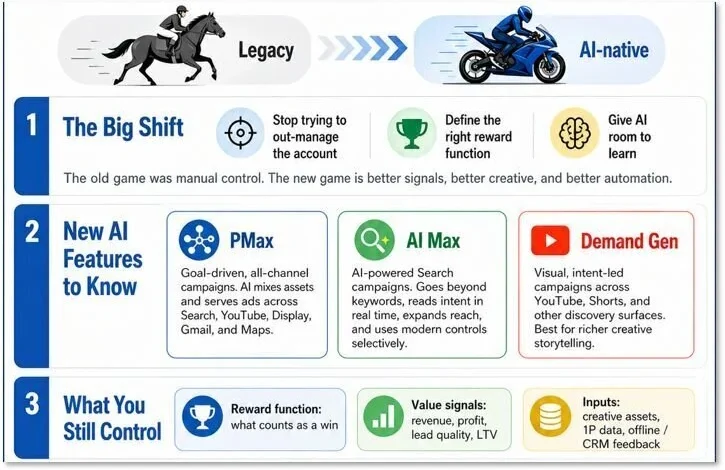
The global digital advertising landscape is currently undergoing a fundamental transformation as major platforms, led by Google and Meta, transition from manual, keyword-centric management to fully automated, artificial intelligence-driven ecosystems. This shift represents a departure from traditional "search marketing" methodologies, which relied heavily on manual adjustments of match types, geographic targeting, and audience bidding. In its place, a new paradigm has emerged where machine learning algorithms assess user intent in real-time to optimize for business outcomes. For modern enterprises, the transition is no longer a matter of preference but a strategic necessity, as manual intervention increasingly yields diminishing returns compared to the scale and speed of AI-integrated systems.
The Chronological Shift: From AdWords to AI-Native Ecosystems
The evolution of Google’s advertising platform provides a clear timeline of this technological progression. Launched in 2000, Google AdWords was built on the principle of manual control, where advertisers bid on specific keywords and managed every facet of their campaigns. For nearly two decades, the industry standard was defined by granular control—specifically, the use of "Single Keyword Ad Groups" (SKAGs) and manual Cost-Per-Click (CPC) bidding.
The pivot toward automation began in earnest around 2016 with the introduction of "Smart Bidding," which utilized machine learning to set bids at the time of the auction. This was followed by the sunsetting of Expanded Text Ads in favor of Responsive Search Ads (RSAs) and, most significantly, the 2021 launch of Performance Max (PMax). PMax represented the first "black box" campaign type, where the platform took control over creative assembly, channel distribution, and bidding based solely on provided assets and conversion goals. By 2024, the integration of generative AI into the Google Ads interface has further solidified the "AIfication" of the platform, making manual "sculpting" of accounts an increasingly obsolete practice.
Current AI Offerings and Campaign Architectures
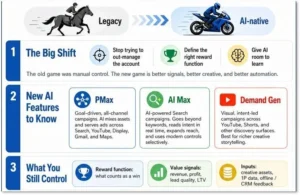
The contemporary Google Ads environment is defined by three primary AI-driven campaign types, each designed to minimize human micromanagement and maximize cross-channel reach.
Performance Max (PMax)
PMax is an all-in-one campaign type that serves ads across the entirety of the Google ecosystem, including Search, YouTube, Display, Gmail, and Maps. Advertisers provide a budget, conversion goals, and a library of assets (text, images, and video). The AI then dynamically mixes these elements to find the highest-value users across all touchpoints.
AI Max (AI-Powered Search)
Formerly categorized under broad-match search strategies, AI Max focuses exclusively on the Search Network. It moves beyond the literal interpretation of keywords, instead utilizing large language models (LLMs) to analyze the underlying intent of a search query. This allows the system to capture relevant traffic that traditional exact-match or phrase-match keywords would overlook.
Demand Gen
Replacing the previous "Discovery" ad format, Demand Gen is a visually focused campaign type. It leverages AI to deliver high-impact video and image ads across YouTube Shorts, Discover, and Gmail. Its primary function is to stimulate interest and intent among audiences who may not yet be actively searching for a specific product but exhibit behaviors consistent with a target customer profile.
The Maturity Model: A Framework for Assessment
To navigate this transition, industry experts have developed maturity models to help organizations assess their level of integration with modern AI tools. These models typically measure two specific dimensions: Capability and Depth.
Dimension 1: Capability Scoring
Capability measures the technical sophistication of an advertising setup on a scale from 0 to 4.
- Level 0 (Legacy): Manual bidding, exact-match obsession, and optimization for surface-level metrics like pageviews.
- Level 2 (Hybrid): A mix of manual controls and some automated bidding, though the account still reflects a "control-first" mindset.
- Level 4 (AI-Native): Full reliance on value-based bidding, where the system is optimized for profit, lifetime value (LTV), or closed-won revenue.
Dimension 2: Depth Scoring
Depth measures how widespread these sophisticated practices are across an organization’s total ad spend.
- Level 0: No automation in place.
- Level 2 (Partial): Between 10% and 39% of the budget is allocated to AI-driven campaigns.
- Level 4 (Execution Default): Between 75% and 100% of the budget is managed through AI-native structures.
According to this framework, a "Modern Google Ads Advertiser" should aim for a combined maturity score of 85 or higher to maintain a competitive advantage in high-cost auctions.
Measurement and Value Architecture: The "Reward Function"
The most critical component of a modern advertising strategy is the "Measurement and Value Architecture." Because AI systems optimize based on the data they receive, the quality of that data—often referred to as the "reward function"—determines the success of the campaign.
In a journalistic analysis of current performance data, it is evident that companies optimizing for "lame proxies" (such as clicks or generic leads) are seeing a decline in Return on Ad Spend (ROAS). Conversely, organizations that feed the AI "truth signals"—such as offline conversion imports from a CRM or profit-margin data—allow the machine learning model to distinguish between a low-value browser and a high-value purchaser.
Key technical requirements for a mature measurement architecture include:
- Enhanced Conversions: Using first-party data to improve the accuracy of conversion tracking in a cookieless environment.
- Data-Driven Attribution (DDA): Moving away from "last-click" models to give credit to all touchpoints in a customer journey.
- Value-Based Bidding (VBB): Instructing the AI to maximize "conversion value" rather than just "conversion volume."
The Search Operating Model: Moving Beyond Manual Control
The second pillar of the maturity model is the Search Operating Model. For years, digital marketers believed that performance was the result of "sculpting" an account through manual bid modifiers for devices, hours of the day, and specific geographies. However, Google’s AI now assesses millions of signals in real-time—signals that are invisible to human managers.
A mature search model abandons manual CPC in favor of Smart Bidding and utilizes "Broad Match" keywords paired with "Brand Controls." This allows the AI to find new, profitable search queries while the human manager provides the "guardrails" to ensure brand safety. Data suggests that accounts utilizing this simplified structure see significantly higher scale because they are not artificially limited by a human’s pre-conceived notion of which keywords will perform.
Supporting Data and Market Reaction
The shift toward AI in advertising is reflected in broader market trends. According to a 2023 report by McKinsey & Company, generative AI could add the equivalent of $2.6 trillion to $4.4 trillion annually across various use cases, with marketing and sales seeing the most significant impact. Within the Google ecosystem, the company reported during its recent earnings calls that an increasing percentage of its multi-billion dollar ad revenue is now flowing through AI-powered formats like PMax.
However, the transition has not been without friction. Many advertising agencies, whose business models were historically built on the billable hours required for manual account "monkeying," have expressed skepticism. Critics argue that the "black box" nature of AI campaigns reduces transparency. In response, Google has introduced new reporting features, such as "Search Term Insights" and "Asset Reporting," to provide a window into how the AI is making decisions.
Broader Impact and Strategic Implications
The implications of this shift extend beyond simple campaign management. It fundamentally changes the role of the "Search Marketer." The profession is moving away from tactical execution—adjusting bids and match types—toward strategic orchestration. The modern marketer’s job is to provide the "machine" with better creative assets, better customer data, and a more accurate definition of business value.
For businesses, the "choice to stay in the past" is effectively being removed. As the cost-per-click in manual auctions rises due to the efficiency of AI-driven competitors, legacy operators find their profit margins "pulverized." The pragmatic perspective for the coming years is one of "embrace and extend": embracing the AI’s ability to learn and optimize, and extending that advantage by feeding the system unique, first-party data that competitors cannot replicate.
In conclusion, the transition from the "AdWords era" to the "AI Max era" represents a maturation of the digital economy. While the cultural pain of giving up manual control is real for many practitioners, the potential for 3x to 20x increases in revenue and profit—driven by the scale and precision of machine learning—makes the transition an inevitability for any enterprise seeking to survive in the modern digital marketplace. The "new game" of advertising is not about who can work the hardest on an account, but who can feed the machine the best truth.
Related posts: