Symphony by Wix Review: Evaluating the Impact of AI Orchestration on Small Business Operations

Small business owners frequently face the operational paradox of needing to manage diverse, high-stakes tasks—ranging from lead generation and client outreach to complex marketing campaigns and design workflows—often with limited human resources. In an increasingly digital economy, the inability to maintain these various operational "plates" can result in missed deadlines, lost revenue, and reduced competitive agility. The recent launch of Symphony by Wix, an AI-powered orchestration platform, attempts to address these systemic inefficiencies by deploying a suite of specialized AI agents managed by a central engine known as "Maestro."

The Evolution of Agentic AI in Small Business
The release of Symphony arrives at a pivotal moment in the evolution of business automation. While earlier generations of AI focused primarily on content generation or basic chatbots, the current "agentic" era represents a shift toward autonomous task execution. By leveraging a foundational knowledge base derived from millions of businesses across diverse sectors, Wix has positioned Symphony not merely as a productivity tool, but as a virtual operations team.
The platform functions as a middleware layer, connecting to critical business infrastructure, including email clients, customer relationship management (CRM) systems, and calendar applications. Unlike traditional software-as-a-service (SaaS) products that require manual configuration for every process, Symphony utilizes natural language processing to allow users to articulate business goals. Maestro, the orchestrator, then decomposes these goals into actionable tasks, assigning them to specific, specialized AI agents designed to execute those functions.

Chronology and Operational Integration
Symphony’s deployment strategy emphasizes platform neutrality. Despite being developed by Wix, the service operates independently of the user’s primary website builder. For those operating within the WordPress ecosystem, integration is facilitated through the Model Context Protocol (MCP) server, often utilizing the Jetpack plugin to bridge the communication gap between the AI agents and the self-hosted content management system.
The setup process requires users to provide foundational business context, which acts as the initial training data for the Maestro engine. Following this, users are prompted to authorize "connectors"—the vital links between the Symphony dashboard and external business tools. This phase is technically optional but essential for the system to function effectively; without access to a user’s calendar or CRM, the agents lack the necessary data to perform meaningful outreach or scheduling.

In early testing environments, the dashboard provides a centralized view of ongoing "chats" or active projects. These workspaces act as project management hubs, where the history of interactions with Maestro is preserved. A notable feature observed during the rollout is the system’s proactive alerting mechanism, which can scan connected platforms for security vulnerabilities—such as outdated plugins or pending patches on a WordPress site—demonstrating a dual focus on productivity and site maintenance.
Data-Driven Pricing and Resource Allocation
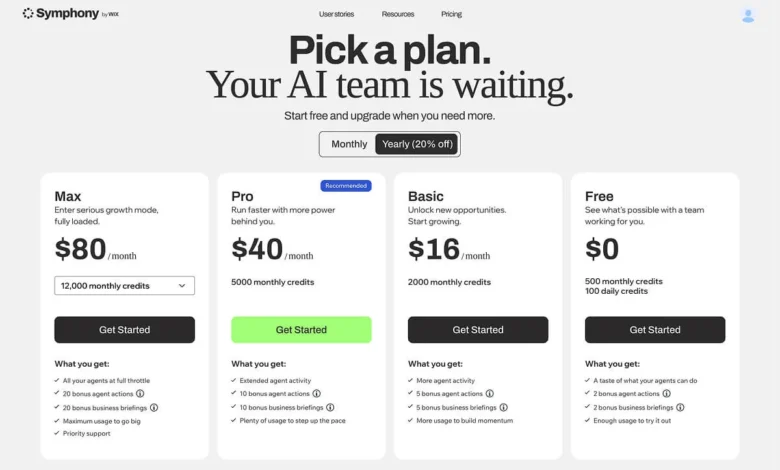
Symphony operates on a tiered subscription model, with pricing structured to accommodate varying scales of business activity. Each tier includes core access to the Maestro orchestrator and a defined allotment of "AI credits," which are consumed as agents execute tasks.

- The Free Tier: Designed as a discovery tool, this tier provides 500 monthly credits and a daily limit of 100 credits. It supports two concurrent agent actions, offering a restricted but functional baseline for micro-businesses.
- Premium Tiers: These levels scale based on the complexity and volume of tasks. While specific thresholds for "activity levels" are not publicly quantified in absolute terms, Wix indicates that higher-tier subscriptions provide increased capacity for simultaneous agent operations and higher usage ceilings.
A critical design choice is the system’s behavior upon exhaustion of credits. Rather than allowing a service interruption or incurring hidden overage fees, the platform initiates a "pause" state. This ensures that workflows remain in a stable, predictable state until the next billing cycle or credit refresh, mitigating the risk of fragmented data or unfinished automated tasks.
Analysis of Technical Capabilities
The functionality of Symphony is categorized into four primary domains: marketing and outreach, scheduling, research, and financial oversight. By utilizing human-language prompts, users bypass the need for traditional software configuration. This "no-code" approach to complex business automation is a significant departure from legacy workflow automation tools, which often required advanced knowledge of APIs or logic-based "if-this-then-that" programming.

The platform’s "knowledge cycle" is perhaps its most compelling feature. As Maestro accumulates data from the user’s specific business context, the agents are intended to become increasingly efficient. However, this creates a reliance on the user to provide accurate initial briefings. The system maintains "human-in-the-loop" guardrails, requiring manual approval for significant actions. This design addresses common concerns regarding the autonomy of AI, ensuring that users retain oversight of their brand voice and operational decisions.
Implications for the Digital Marketplace
The introduction of Symphony reflects a broader industry trend toward the commoditization of specialized AI labor. By providing a low-barrier, platform-agnostic entry point, Wix is targeting the "solopreneur" and small agency markets, where the cost of human administrative support is often prohibitive.

From a market analysis perspective, the success of such tools will depend on the reliability of the underlying agentic models. While the integration with existing CRMs and email systems reduces friction, the reliance on third-party APIs introduces potential points of failure. Furthermore, as these tools proliferate, business owners will face the "orchestration challenge"—deciding which tasks are appropriate for AI and which require the nuance of human judgment.
The current documentation and support structure, while functional, highlights a nascent stage of development. The reliance on Maestro to troubleshoot its own errors represents a potential frustration point for users accustomed to traditional, human-led customer support. Although the ability to escalate requests to human representatives is available, the preference for AI-first support reflects the company’s commitment to a fully automated operational philosophy.

Broader Impact and Future Outlook
The implications for small businesses are significant. If AI agents can effectively manage the "busywork" that plagues daily operations, the resulting time savings could fundamentally alter the growth trajectory of independent ventures. By lowering the administrative burden, Symphony allows business owners to pivot their focus toward strategy, product development, and customer relationship management—areas where human intuition remains the primary driver of success.
However, the efficacy of this transition depends on the user’s ability to effectively "manage" their digital team. The platform is not a "set-and-forget" solution; it requires a disciplined approach to briefing and reviewing agent output. As the technology matures, it is expected that the integration of more sophisticated third-party tools and the expansion of the agent knowledge base will further reduce the manual oversight required.

For now, Symphony stands as a robust experiment in AI-driven management. It provides a tangible, user-friendly interface for what has previously been a high-level technical concept. Whether it achieves broad adoption will likely depend on its ability to maintain high levels of accuracy and security while navigating the complex, often messy reality of real-world business environments. As the digital landscape continues to favor those who can iterate quickly, the adoption of tools that harmonize disparate operational tasks into a unified, AI-managed flow may shift from being a competitive advantage to a baseline operational requirement for small business survival.