Why Modern Enterprises Must Abandon Legacy Digital Marketing and Embrace AI-Driven Advertising

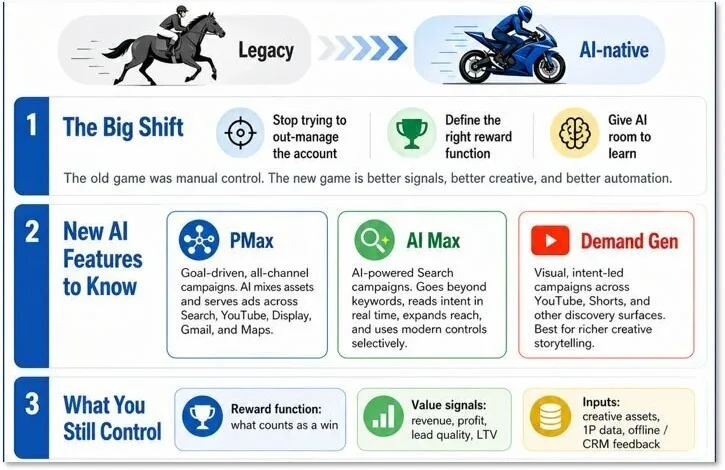
The evolution of digital advertising platforms has reached an inflection point where traditional manual management techniques are no longer just inefficient—they are actively detrimental to corporate profitability. In the current media landscape, continuing to rely on granular, manual campaign adjustments is analogous to choosing horseback riding over fuel-efficient motorcycles for long-range transportation. This paradigm shift centers on platforms like Google Ads and Meta, which have systematically integrated artificial intelligence into their core architectures to handle complex optimization tasks far exceeding human capability.
Industry experts and analysts emphasize that the fundamental mechanics of search and performance marketing have permanently changed. Yet, despite clear signals from major ad platforms, many corporate marketing departments and external agencies remain entrenched in legacy operational habits. They continue to spend countless hours micromanaging match types, geographic parameters, dayparting schedules, negative keyword lists, and minor audience segments. This persistent resistance to automation represents a strategic misstep, sacrificing potential revenue and operational efficiency in favor of outdated control frameworks.
The Historical Shift Toward Platform Automation
Over the past decade, Google and other major publishers have steadily transitioned their advertising ecosystems from human-managed keyword bidding systems to machine-learning-driven intent engines. This technological transformation reflects a broader industry trend toward narrow artificial intelligence applications capable of processing billions of real-time signals.
Historically, digital marketers proved their value through constant iteration—adjusting bids multiple times a day, building complex single-keyword ad groups (SKAGs), and manually sculpting account structures. However, as search queries have diversified and consumer behavior has become increasingly non-linear, the sheer volume of data points has outstripped human processing capacity. Platforms responded by introducing automated solutions designed to interpret user intent across expansive digital surfaces.
Despite these advancements, organizational inertia remains a primary barrier to adoption. Many enterprise marketing teams operate under the assumption that human oversight can consistently outperform algorithmic bidding models on an auction-by-auction basis. Industry veterans note that this mindset ignores the core architectural design of modern ad servers, which are built to ingest millions of implicit and explicit signals—ranging from device context and browsing history to real-time location and micro-intent indicators—that are entirely invisible to human analysts.
Current AI Offerings and Ecosystem Capabilities
Modern advertising suites now rely on automated campaign types designed to capture demand across multiple channels simultaneously. Understanding these offerings is essential for assessing true organizational readiness.
Performance Max (PMax) serves as Google’s flagship automated campaign structure. By ingesting a combination of budgetary parameters, conversion goals, and creative assets—including text variations, high-resolution imagery, video content, and brand logos—PMax utilizes machine learning to dynamically assemble and serve advertisements across Search, YouTube, Display networks, Gmail, and Google Maps.
Similarly, AI Max targets search-only environments by bypassing traditional brand and non-brand keyword segmentation. Instead of relying strictly on exact or phrase match parameters, AI Max evaluates real-time user intent to deliver relevant ads to audiences whose search behavior indicates high conversion potential, even when the exact search terms diverge from historical keyword lists. Furthermore, Demand Gen campaigns leverage advanced visual AI models to place video assets across YouTube Shorts and other discovery feeds by accurately predicting user engagement patterns.
Across all these advanced frameworks, two core operational principles apply: advertisers control the reward function—defining what constitutes a successful business outcome—while the underlying AI evaluates intent across a data set far broader than any human team could manually analyze. While these narrow AI systems are not infallible, empirical data suggests that their optimization accuracy significantly outperforms manual intervention over aggregate campaign lifecycles.
The Google Ads Maturity Model and Evaluation Framework
To help organizations objectively evaluate their transition from legacy practices to AI-native execution, structured maturity models have been developed. These frameworks assess enterprise capabilities across two primary dimensions: capability sophistication and deployment depth.
Capability scoring typically utilizes a five-tier scale, ranging from level zero (legacy manual operations) to level four (fully AI-native execution). To prevent organizations from overestimating their technological sophistication based on isolated pilot projects, deployment depth is measured across actual budget allocation, conversion volume, or campaign coverage. This dual-axis evaluation ensures that an enterprise cannot claim advanced status if automation is restricted to a negligible fraction of its overall media spend.
The comprehensive evaluation model prioritizes six core operational dimensions, each weighted according to its strategic impact on overall business outcomes:
- Measurement and Value Architecture (30 Points): Evaluates how effectively an organization transmits genuine business value—such as profit margins, customer lifetime value, and offline CRM conversion data—back to the advertising platform’s algorithmic core.
- Search Operating Model (20 Points): Measures the extent to which manual keyword constraints and bid modifiers have been replaced by smart bidding, broad match strategies, and AI Max deployments.
- First-Party Data and Audience Intelligence: Assesses the integration and activation of proprietary customer data within platform intelligence layers.
- Surface Breadth and Campaign Mix: Analyzes whether media distribution spans the full suite of available digital surfaces based on consumer intent rather than siloed channel habits.
- Creative and Landing Page Adaptability: Measures the diversity and quality of creative assets provided to machine-learning systems to match varied consumer intents.
- Operating Cadence and Governance: Evaluates the shift from constant tactical intervention to strategic oversight, guardrail implementation, and outcome governance.
Scores are calculated by multiplying capability and depth ratios across weighted dimensions, establishing benchmarks that distinguish between legacy operators, modern advertisers, and fully optimized industry leaders.
Strategic Implications and Organizational Change Management
The broader implications of this technological shift extend far beyond media buying efficiency; they touch upon fundamental questions of corporate governance and resource allocation. Organizations that cling to legacy advertising methodologies face severe financial opportunity costs. When internal marketing teams spend their hours adjusting granular bid modifiers rather than refining core business metrics and creative inputs, capital is inefficiently deployed.
Conversely, enterprises that successfully transition to an embrace-and-extend strategy experience measurable improvements in return on ad spend (ROAS) and customer acquisition cost (CAC). By shifting human capital away from mechanical optimization tasks and toward strategic oversight, brand safety governance, and first-party data collection, companies unlock significant competitive advantages.
Industry analysts stress that avoiding self-deception during maturity assessments is critical. Organizations must evaluate their top-tier media investments objectively rather than allowing edge cases or successful minor campaigns to distort overall performance metrics. True progress requires acknowledging that human analysts can no longer out-manage automated auction systems at scale.
Ultimately, the transition to AI-driven advertising redefines the role of the modern marketing professional. The primary objective is no longer micro-managing account structures, but rather feeding automated systems higher-quality truth signals, superior creative assets, and precise definitions of customer value. Enterprises that successfully navigate this cultural and operational transformation position themselves to capture substantial market share, achieving exponential gains in revenue and profitability while eliminating the soul-numbing administrative burdens of the legacy digital advertising era.