As artificial intelligence capabilities advance across the enterprise software sector, product development teams frequently encounter a paradox: features designed to save users time often end up consuming more of it as workers are forced to meticulously verify automated outputs. While executive leadership and competitive pressures drive organizations to rapidly deploy generative AI tools, the operational reality on the ground often reveals a mismatch between technological capacity and workflow efficiency.
To address this friction, product strategy frameworks are increasingly incorporating practical audits to determine precisely where automated systems add genuine value and where they inadvertently introduce cognitive burdens. By analyzing the net effort required to operate an AI tool against the productivity gains it yields, organizations can avoid costly deployment failures and re-scope features before development resources are committed.
The Anatomy of an Enterprise Deployment Failure
The risks of misapplied automation were recently highlighted in a case study involving a large health insurer. The organization’s product team sought to integrate an AI feature capable of drafting comprehensive written determinations for benefits appeals specialists. From a technical standpoint, the model performed flawlessly, producing coherent, grammatically correct text matching the insurer’s formal guidelines.
However, the operational outcome was counterproductive. Specialists quickly abandoned the tool. Those who attempted to use it actually took longer to process each case compared to colleagues who ignored the feature entirely.
A rapid evaluation revealed the root cause: reading an AI-generated determination closely enough to legally and professionally sign off on it required roughly the same amount of time as writing it from scratch. Moreover, the specialists were forced to actively search for subtle, machine-made errors that would never have appeared in their own work. Instead of streamlining a routine duty, the software converted an established, highly competent workflow into an error-checking exercise.
By restructuring the release, the product team resolved the issue. In the second iteration, the AI was restricted to surfacing relevant policy provisions and historical precedent cases pertinent to each appeal, while leaving the actual drafting process to the human specialist. This modification eliminated the manual search phase, sharply reduced review times, and preserved the core professional responsibilities of the workforce. Notably, the underlying technology remained identical in both versions; the critical variable was simply which component of the task the AI handled.
Establishing the Break-Even Line in Product Design
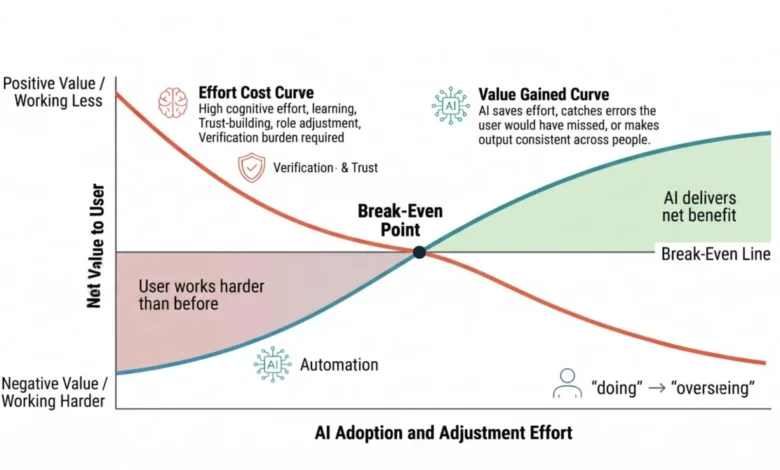
Every interface modification imposes an initial cost on the user before delivering a return on investment. Operators must recalibrate their mental models of how the system functions, locate new interface elements, and establish a baseline of trust regarding automated outputs. Human cognitive architecture imposes strict limits on multitasking and information retention; historical research into working memory, such as cognitive psychologist Nelson Cowan’s 2001 reviews, underscores that humans can hold only a severely limited number of items in active mental storage simultaneously. Enterprise AI features draw directly from this same finite cognitive pool.
When an organization introduces an AI tool that alters core daily workflows, the demands on the user escalate significantly. Handing synthesis tasks over to an algorithm transforms the user into an auditor. Delegating recommendations as well reduces the job to mere sign-off procedures.
These shifts carry psychological implications. For professionals whose status and identity are tied to specialized training, heavy reliance on automated systems can feel like a demotion. Research published by Sophia Ackerhans and colleagues in 2025 demonstrated that physicians tasked with signing off on AI-assisted clinical decisions reported heightened threats to their professional identity, noting that explanations of algorithmic reasoning simultaneously increased both their trust in the system and their sense of professional displacement.
To ensure a positive return, an AI feature must surpass what is termed the break-even line—the threshold where the net value delivered to the user outweighs the adjustment effort required to operate the tool. User returns generally manifest in three ways: catching errors that would otherwise be missed, accelerating repetitive processing, or scaling analytical capacity across complex datasets. For instance, automated fraud-screening tools cross this threshold because the volume of hidden anomalies they catch outweighs the cognitive cost of reviewing false positives.
Four Critical Diagnostic Questions for Product Teams
To locate the break-even line prior to committing engineering resources, product teams can evaluate proposed features through a structured framework of four core questions. This audit should be conducted collaboratively during the initial scoping phase, ideally incorporating feedback from frontline operators such as loan officers, data analysts, or customer service agents.

1. Does this reduce the total effort the task takes for this user?
Product metrics often focus misleadingly on reducing click counts. However, eliminating clicks does not automatically reduce total effort if the user must invest heavy cognitive focus into verifying the resulting output. For example, pre-filling a standard tracking field in a database removes physical keystrokes but shifts the burden to validation, frequently increasing total effort. Conversely, AI that synthesizes dozens of conflicting financial disclosures for a loan officer directly reduces deep cognitive demand. Evaluating teams must account for verification labor on the "after" side of the equation and recognize that user demographics matter; a feature that benefits a junior analyst may merely add friction for a senior practitioner.
2. Does this beat the way the user does the task now?
Product developers must compare proposed AI interventions against existing user workarounds, such as custom spreadsheets or established manual routines. AI generally succeeds when tasks involve genuine ambiguity, high data scale, speed requirements, strict consistency across teams, or error-catch rates that manual methods miss. If users already possess a fast, highly practiced route to a reliable answer—such as drafting a familiar email notification—layering an AI interaction on top introduces unnecessary complexity.
3. Can the user catch the errors?
Every machine learning model produces errors. Teams must evaluate whether those mistakes will be visible to the operator and what the consequences are if an error goes unnoticed. Invisible errors—such as a travel planning AI recommending a museum on its scheduled closure day—carry high risks, particularly when compounded by automation bias, a well-documented psychological tendency for humans to defer to automated systems even when incorrect, as reviewed by researchers Raja Parasuraman and Dietrich Manzey. Mitigating this requires robust provenance displays, showing users precisely where data originated and when it was retrieved.
4. After a year of using this, can the user still tell when the AI is wrong?
While automating routine clerical tasks is beneficial, core human judgment must be preserved to prevent skill degradation. Radiologial studies, such as 2023 research by Thomas Dratsch and colleagues, have shown that exposure to incorrect AI suggestions significantly degrades diagnostic accuracy across all experience levels over time. If a system entirely replaces human evaluation without providing feedback loops, users lose their baseline proficiency. Long-term deployment strategies must incorporate mechanisms—such as periodic blind reviews or rotational manual processing—to keep verification skills active.
Implications and Industry Outlook
As enterprise software matures, the integration of artificial intelligence is shifting from a speculative feature race to a disciplined exercise in workflow engineering. Organizations that bypass rigorous pre-development audits risk deploying tools that alienate skilled professionals, degrade operational accuracy, and ultimately fail to achieve sustainable adoption.
By applying structured evaluative criteria—mapping total user effort, comparing current operational baselines, assessing error visibility, and protecting long-term human expertise—product teams can align technological capabilities with human realities. Ultimately, successful AI integration is not measured by the autonomy of the algorithm, but by the empowered efficiency of the human operator utilizing it.