Social Media Presence Proves Essential for Brand Visibility in AI-Generated Search Results, New Study Finds

The digital marketing landscape is undergoing its most profound transformation since the widespread adoption of traditional search engines, as artificial intelligence chatbots and generative search features fundamentally alter how consumers discover brands, products, and services. A comprehensive new industry study conducted by SE Ranking sheds light on this shifting paradigm, revealing that maintaining an active, robust presence on social media platforms is no longer merely a branding exercise for engagement; it has become a critical engine for driving visibility within AI-generated search responses.
As search behavior pivots away from traditional blue links toward conversational, AI-driven summaries and synthesized answers, brands are scrambling to understand the underlying mechanics of Generative Engine Optimization (GEO). The findings from SE Ranking offer some of the clearest empirical evidence to date regarding which digital assets AI algorithms favor when constructing responses to user queries across major platforms like Google and OpenAI’s ChatGPT.
Unpacking the Methodology and Scope of the Research
To arrive at these conclusions, the data science and research teams at SE Ranking undertook a massive analytical undertaking. They analyzed an expansive dataset comprising 100,000 distinct keywords across a wide spectrum of brand niches, industries, and consumer verticals. The primary objective was to map out the exact digital architecture powering modern search, comparing traditional search engine results pages with the dynamic outputs generated by AI chatbots and AI-powered overview tools.
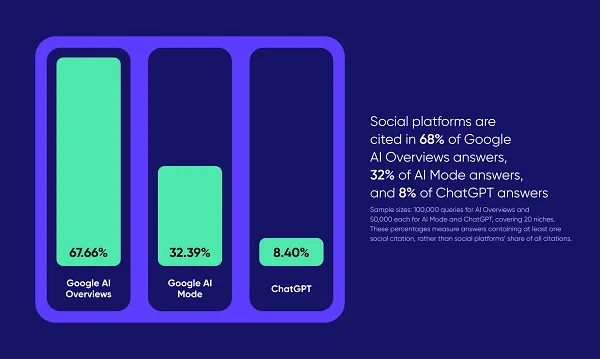
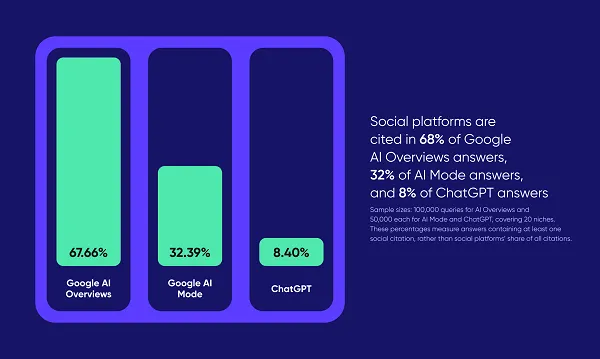
By evaluating which domains, platforms, and content types were most frequently cited, referenced, or linked to within AI-generated outputs, the researchers were able to quantify the direct influence of social media assets on machine learning algorithms. The results indicate that social platforms are deeply integrated into the data retrieval pipelines of modern large language models (LLMs). Specifically, social media links appeared in 67.66% of Google AI Overviews, 32.39% of Google AI Mode replies, and 8.4% of ChatGPT responses.
These staggering percentages underscore a vital strategic imperative for modern marketers: ignoring social media ecosystems severely hampers a brand’s discoverability in AI-first discovery channels. While traditional search engine optimization (SEO) has historically focused on optimizing corporate websites and earning high-authority backlinks, GEO requires a sprawling, multi-channel footprint that heavily leverages user-generated content, community discussions, and social video platforms.
Platform-Specific Nuances: Where AI Looks for Information
A closer examination of the SE Ranking data reveals that a one-size-fits-all approach is ineffective when attempting to optimize for AI visibility. Different AI models and search ecosystems exhibit distinct preferences for which platforms they crawl, trust, and ultimately cite in their synthesized answers.
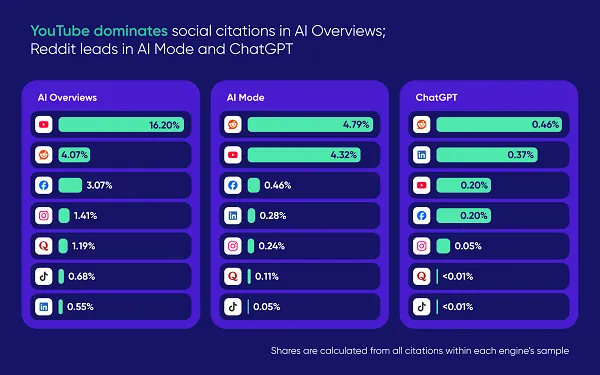
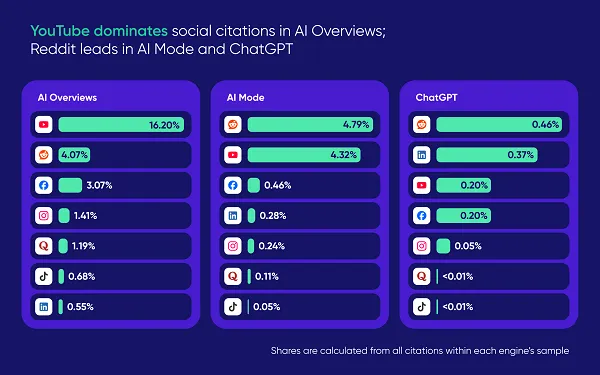
For Google’s ecosystem, video content reigns supreme. Google-owned YouTube emerges as the single most commonly cited source within Google’s AI Overviews, reinforcing the tech giant’s preference for its proprietary video platform. This is hardly surprising given Google’s deep institutional integration of YouTube transcripts and metadata into its broader search indexing infrastructure.
Conversely, OpenAI’s ChatGPT demonstrates a strong affinity for community-driven text platforms and professional networks. Across general queries, Reddit and LinkedIn stand out as the top social platforms referenced by ChatGPT. However, the data also highlights the granular nature of these citations; references to platforms like Reddit, LinkedIn, and Facebook appear in fewer than 1% of ChatGPT answers for highly specific, common consumer queries. This indicates that while social citations are present, their volume varies dramatically depending on whether the user is searching for broad industry insights, technical troubleshooting, or direct product recommendations.
When researchers narrowed their focus to the top 100,000 branded and non-branded queries within Google’s AI Mode, the influence of social media became even more pronounced. The analysis revealed that social media sources were referenced in 39.34% of branded query responses and an impressive 48.58% of non-branded searches. Among these, Facebook, YouTube, and Reddit emerged as the dominant platforms driving visibility, proving that consumers seeking out product information and brand validation are routinely served content hosted on social networks by AI tools.
The Volatility of AI Citations: The Reddit Case Study
While the data firmly establishes social media as a gateway to AI visibility, the underlying partnerships and algorithmic behaviors governing these platforms are subject to sudden, dramatic shifts. Nothing illustrates this volatility more clearly than the turbulent relationship between Reddit and major AI developers over the past year.
In August, industry publication Search Engine Land reported a shocking development: Reddit’s share of ChatGPT search citations plummeted by a staggering 86.4% over the course of just four days. While OpenAI representatives and technical analysts offered few definitive explanations for the sudden drop, the incident sent shockwaves through the digital marketing community. It served as a stark reminder that relying on AI referral pathways can be inherently risky, as large language model providers frequently update their underlying ranking algorithms, training data preferences, and partnership agreements without public warning.
In sharp contrast to its standing with ChatGPT, Reddit’s presence in Google’s AI responses has remained remarkably stable. This stability is largely underpinned by a high-profile commercial data-sharing deal established between Google and Reddit. Announced earlier in the year, the multimillion-dollar partnership grants Google real-time access to Reddit’s vast repository of user-generated content to train its AI models and improve search features.
This symbiotic relationship ensures that Reddit content maintains a privileged position within Google’s AI Overviews. However, industry observers note that the dynamic nature of these corporate alliances introduces long-term strategic complications. As the balance of value shifts between search engines and content platforms, the rules governing AI citations could change overnight, forcing brands to remain agile in their digital visibility strategies.
Branded Versus Non-Branded Search Dynamics in AI Mode
Understanding how AI algorithms treat branded versus non-branded queries is essential for modern enterprises seeking to capture market share through generative search. SE Ranking’s deep dive into Google’s AI Mode illuminated clear behavioral differences in how algorithms source information depending on the user’s intent.
For branded queries—searches where the user specifically names a company, product, or trademark—AI systems heavily favor authoritative brand touchpoints, official social media channels, and verified customer feedback communities. Brands that maintain active, highly engaged profiles on platforms like Facebook and YouTube are far more likely to see their social assets featured prominently alongside or within the AI-generated summary box. This reinforces brand trust and provides users with immediate, verified social proof.
On the other hand, non-branded queries—broader searches where users look for solutions, product categories, or recommendations without naming a specific brand (e.g., "best project management software for remote teams")—exhibit an even higher reliance on social media and community forums. Registering at nearly 48.58% in SE Ranking’s non-branded dataset, social citations act as the primary grease for discovery. Because AI models are designed to synthesize consensus opinions and peer reviews, they frequently pull recommendations from Reddit threads, LinkedIn discussions, and YouTube reviews to answer general consumer queries authentically.
Implications for Digital Marketers and Brand Strategists
The implications of these research findings are profound for Chief Marketing Officers, SEO professionals, and social media managers alike. For over two decades, search engine optimization was largely synonymous with technical website audits, keyword stuffing mitigation, and backlink acquisition from high-DA blogs and news outlets. Today, that playbook is obsolete.
Optimizing for AI discovery—frequently termed Generative Engine Optimization (GEO) or Artificial Intelligence Optimization (AIO)—requires a holistic, omnichannel strategy that treats social media profiles not as isolated marketing silos, but as primary indexing targets for machine learning models.
First, brands must recognize that AI chatbots do not just read corporate homepages; they harvest the collective conversational web. Consequently, cultivating positive customer sentiment, active discussions, and authentic brand mentions across platforms like Reddit, LinkedIn, YouTube, and Facebook directly feeds the algorithmic appetite of LLMs. If a brand is absent from these community-driven spaces, it risks becoming invisible in the conversational search era.
Second, marketing budgets must adapt to reflect the fragmentation of search. Unlike traditional SEO, which was universally dominated by Google’s desktop and mobile web crawlers, optimizing for AI tools demands a variable, platform-agnostic approach. A brand might dominate Google AI Overviews through robust YouTube video optimization, while simultaneously missing out on ChatGPT recommendations due to a weak footprint on professional networking or community discussion sites.
Finally, organizations must prepare for ongoing algorithmic volatility. As demonstrated by the sudden fluctuations in ChatGPT’s citation of Reddit, AI models are continuously evolving, retraining, and fine-tuning their information retrieval processes. Brand visibility strategies must therefore diversify across multiple social and digital ecosystems to insulate against sudden algorithmic shifts.
Looking Ahead: The Future of AI Search Discovery
As artificial intelligence continues to permeate every facet of digital commerce, the boundary lines separating social media marketing, public relations, public community management, and search engine optimization will continue to blur. The SE Ranking study provides a vital roadmap for this new era, proving conclusively that social media presence is no longer a peripheral nice-to-have, but a core foundational pillar of modern brand discoverability.
Brands that successfully adapt to this new paradigm—treating their social ecosystems as vital data feeds for artificial intelligence—will secure a definitive competitive advantage in the conversational search economy. Those that fail to integrate their social strategies with the realities of AI-generated search risk relegation to the digital shadows, hidden away from the modern consumer’s primary path of discovery.