Choosing the Right Agentic AI Framework for Production Systems in 2026

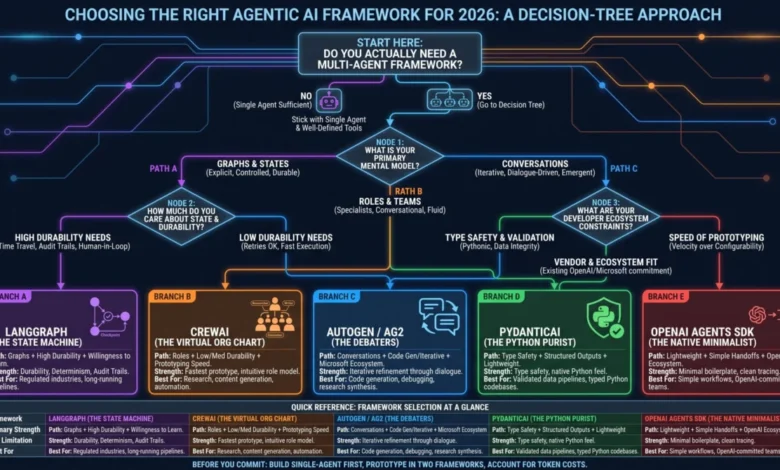
The landscape of artificial intelligence development has undergone a seismic shift, transitioning from the experimental, proof-of-concept era of 2023 to a mature, industrial-grade software ecosystem. As of 2026, developers are no longer merely testing the capabilities of Large Language Models (LLMs); they are tasked with building complex, agentic production systems that operate within the constraints of real-world enterprise environments. This transition has necessitated a move away from "toy" implementations toward robust, scalable orchestration frameworks capable of handling high-stakes workflows. Choosing the correct framework is now a critical architectural decision that carries long-term implications for system reliability, observability, and cost-efficiency.
The Evolution of Agentic Orchestration: A Brief Chronology
The trajectory of agentic AI can be traced back to the early adoption of LangChain in late 2022 and early 2023. At that time, the industry was focused on "chains"—linear sequences of prompts and tool calls. By mid-2024, the focus shifted toward "agents"—autonomous systems capable of selecting their own tools and reasoning through tasks.
By 2025, the market saw the emergence of domain-specific orchestration layers, such as the OpenAI Agents SDK and specialized frameworks like LangGraph, which introduced state management to what were previously stateless, conversational loops. Today, in 2026, we have arrived at an era of "opinionated frameworks." Each major contender—LangGraph, CrewAI, AG2, PydanticAI, and the OpenAI Agents SDK—now reflects a distinct philosophy on how software should interact with non-deterministic model outputs.
Assessing the Requirement for Multi-Agent Complexity
A common pitfall for engineering teams in 2026 is the premature adoption of multi-agent architectures. Data from internal system performance audits suggests that over 60% of tasks currently handled by multi-agent "crews" could be executed more efficiently by a single, well-optimized agent.
Before committing to a multi-agent framework, developers must identify clear triggers for complexity. These include:
- Task Decomposition: When a single prompt or context window is insufficient to hold the complexity of the required reasoning steps.
- Tool Specialization: When the system requires disparate toolsets (e.g., a SQL database interface and a web scraper) that create conflicting system prompts.
- Accountability and Auditability: When a regulatory requirement demands a clear, step-by-step record of which agent performed which action.
- Error Correction Loops: When the task requires a "critic" or "verifier" agent to iterate upon the output of a "generator" agent.
If a project does not meet these criteria, the added latency and token costs associated with multi-agent coordination often yield a negative return on investment.
A Structured Decision-Tree for Framework Selection
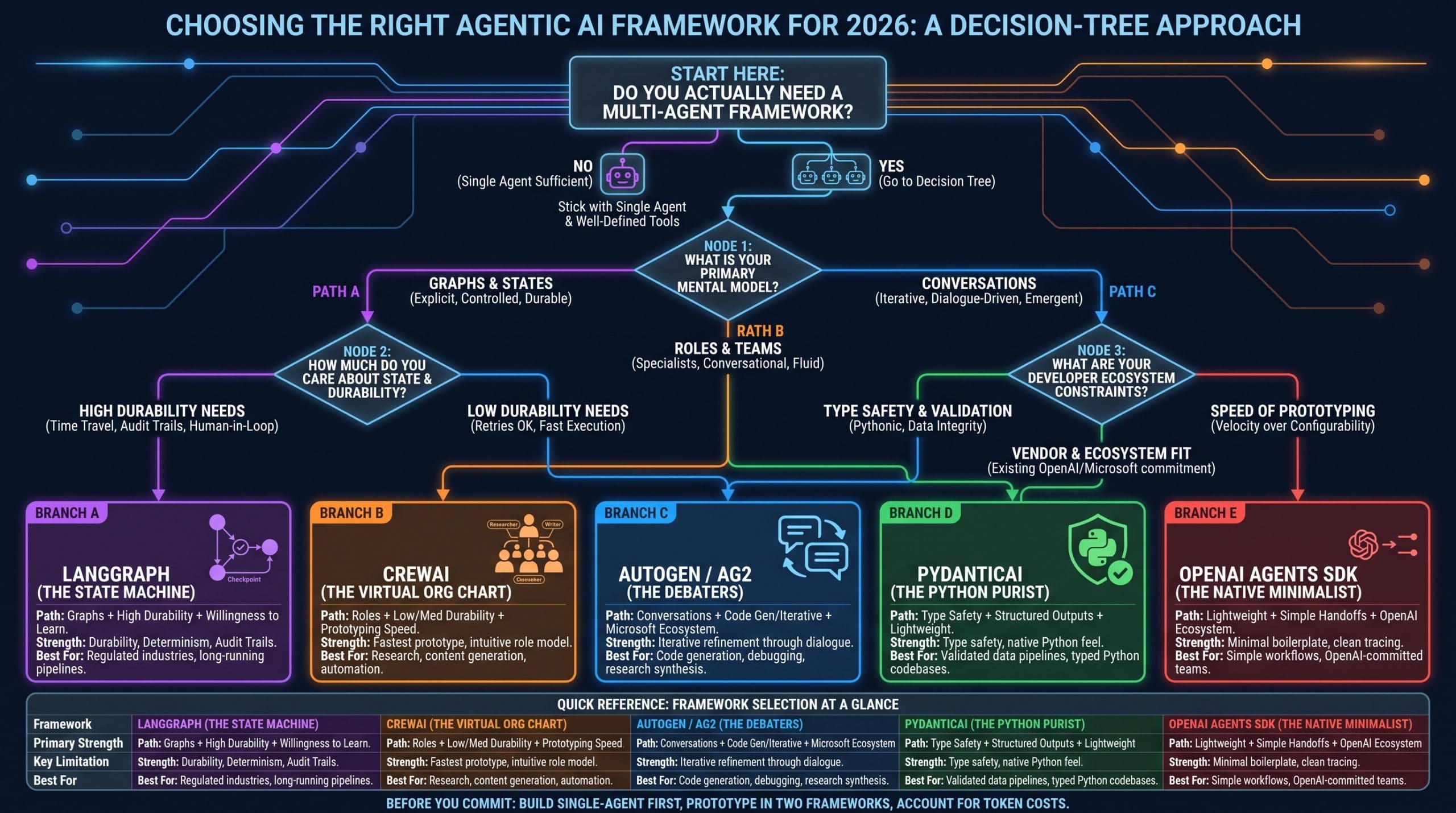
To navigate the current ecosystem, developers should categorize their projects based on three fundamental nodes: architectural mental model, durability requirements, and developer ecosystem alignment.
1. Architectural Mental Models
How a team visualizes the "flow" of intelligence determines which framework will feel intuitive.
- The Graph/State Approach: Systems requiring rigid, deterministic flows benefit from a state-machine model. Here, every transition is explicitly defined, and the system state is a mutable, inspectable object.
- The Role-Based Approach: Projects that mirror human organizations—assigning roles like "Researcher" or "Editor"—thrive in systems that emphasize peer-to-peer collaboration and delegation.
- The Conversational Approach: For iterative tasks like code generation or creative writing, a "debater" model, where agents communicate until they reach a consensus, is the most natural fit.
2. Durability and State Management
In high-stakes industries—such as banking, healthcare, and legal services—a system must be able to pause, checkpoint, and resume tasks. Frameworks that prioritize "High Durability" allow for human-in-the-loop interventions, where a human administrator can approve or reject a step before the system proceeds. Systems with low durability requirements, conversely, favor speed and iterative performance over auditability.
3. Ecosystem Constraints
The choice of framework is often dictated by the existing stack. Teams heavily invested in the Microsoft Azure ecosystem often find the native integration of AG2 (formerly AutoGen) to be the path of least resistance. Conversely, Python-centric teams that prioritize strict type checking and data validation typically align with PydanticAI, which treats agents as extensions of standard, type-safe Python code.
Comparative Analysis of Leading Frameworks
| Framework | Core Philosophy | Primary Use Case | Trade-offs |
|---|---|---|---|
| LangGraph | Graph-based state machine | Regulated, long-running pipelines | Verbose, high learning curve |
| CrewAI | Role-based virtual org chart | Rapid prototyping, research | Difficult to constrain in production |
| AG2 (AutoGen) | Conversational dialogue | Code generation, data analysis | Potential for conversational drift |
| PydanticAI | Type-safe, minimalist | Data-heavy, validated workflows | Lacks native, complex orchestration |
| OpenAI Agents | Native vendor SDK | Simple, OpenAI-centric workflows | Significant vendor lock-in |
Strategic Implications for Engineering Management
The selection of a framework involves more than just technical fit; it involves operational cost management. Multi-agent systems, by their nature, multiply the number of tokens consumed per task. A system with four agents engaged in a recursive loop can easily consume 4x to 10x the tokens of a single-agent implementation.
Furthermore, "conversational drift" remains a significant risk in agentic systems. In frameworks like AG2, where agents communicate in natural language, there is a non-zero risk of agents entering "hallucination loops" or recursive debates that consume massive compute resources without converging on a solution. To mitigate this, enterprise-grade systems must implement "hard" termination conditions and token budgets for each agent cycle.
Best Practices for Implementation
Industry leaders recommend a three-stage rollout for any agentic system:
- The Single-Agent Baseline: Start by automating the core task with one agent. Establish a benchmark for success and cost.
- Comparative Prototyping: If the architecture seems to sit between two frameworks—for example, deciding between the control of LangGraph and the speed of CrewAI—build a limited vertical slice of the project in both. The limitations of each will become apparent within a few hours of development.
- Operational Monitoring: Implement comprehensive logging from day one. In multi-agent systems, observability is not a luxury; it is a necessity for debugging the complex, non-linear paths that agents take when resolving ambiguous inputs.
As of 2026, the "best" framework is not the one with the most GitHub stars or the most active marketing. The best framework is the one that allows a team to build the most "guardrails" around their specific business logic, ensuring that the system is not only intelligent but also predictable, auditable, and economically sustainable.
Related posts: