Bridging the Gap: How Agentic Reasoning Transforms Traditional Machine Learning Systems

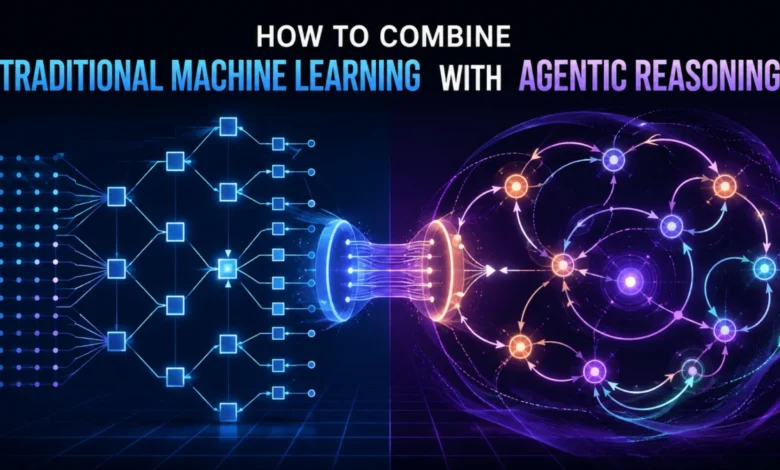
The landscape of artificial intelligence is currently undergoing a structural shift, moving from static predictive models toward dynamic, goal-oriented architectures. For over a decade, traditional machine learning (ML) has served as the backbone of enterprise automation, excelling at discrete tasks such as pattern recognition, classification, and regression. However, as the limitations of these "input-output" models become increasingly apparent in complex business environments, a new paradigm—agentic reasoning—has emerged. By combining the precision of traditional ML with the adaptive, multi-step orchestration of agentic systems, developers are creating AI architectures capable of executing complex, real-world workflows that were previously impossible to automate.
The Foundation of Traditional Machine Learning
To understand the necessity of this transition, one must first recognize the architecture of the systems that have defined the AI era since the 2010s. Traditional machine learning models, such as Random Forests, XGBoost, or specialized neural networks, operate on a deterministic functional mapping. In this framework, a model is trained on a static dataset to identify correlations between features and a target variable.
Data from industry benchmarks indicates that these models remain the gold standard for speed and scalability. For instance, a high-performance fraud detection model can process thousands of transactions per second, providing a probability score with sub-millisecond latency. Because these models are static, they offer high auditability—a requirement for sectors like finance and healthcare—where the logic behind a decision must be explainable and consistent. However, the rigidity that grants these models their reliability also serves as their primary constraint. Once deployed, a traditional model is locked into its training distribution. It cannot query external databases for new information, it cannot ask for clarification, and it cannot modify its behavior based on the shifting context of a multi-stage business process.
The Limits of Static Inference
The failure of traditional models in high-value applications typically occurs when the problem scope exceeds the capabilities of a single inference step. Analysts have identified three critical friction points in the current generation of AI deployments.
First, there is the "multi-step bottleneck." Many enterprise tasks, such as insurance claims processing or supply chain logistics, require a sequence of operations. While an ML model can calculate the probability of a fraudulent claim, it cannot perform the subsequent actions of validating documentation, cross-referencing external databases, or flagging inconsistencies for human review.
Second, the assumption of static context often fails in dynamic environments. Traditional models assume that all necessary information for a decision is present in the input vector. In contrast, real-world investigations—such as cybersecurity incident response—require a discovery phase where the analyst must adapt their search strategy based on initial findings.
Third, the "action gap" persists. Traditional ML produces an output—usually a numeric or categorical prediction—but it lacks the interface to execute the decision. The transition from "identifying a problem" to "solving a problem" currently requires human intervention, creating a latency bottleneck that reduces the overall efficiency of the system.
The Rise of Agentic Reasoning
The emergence of Large Language Models (LLMs) has provided the missing component: a "reasoning engine" capable of managing complex, iterative processes. Agentic reasoning refers to an AI architecture that perceives its environment, formulates a plan, utilizes external tools, and iterates based on feedback.
Unlike traditional models, which function as static calculators, agentic systems operate as autonomous orchestrators. The transition to this architecture began in earnest around 2023, as developers moved beyond basic chatbot implementations toward "agentic loops." These systems are designed to decompose high-level objectives into sub-tasks. For example, rather than simply predicting a value, an agent can determine that it needs to query a SQL database, parse the output, pass that data to a specialized regression model, and then format a report based on the combined findings.
This shift marks a departure from the "black box" prediction model toward a transparent "execution chain." By integrating these agents with existing tools, organizations are moving from simple automation to full-cycle workflow management.
Hybrid Architecture: The Best of Both Worlds
Industry leaders are increasingly adopting a hybrid approach, which is currently the most robust architecture for enterprise AI. In this model, the agent acts as the "manager" or "orchestrator," while the traditional machine learning models serve as "specialized experts."
This division of labor is mathematically and operationally sound. It acknowledges that LLMs, while excellent at reasoning, can be prone to "hallucinations" or calculation errors when handling raw, large-scale numeric data. Conversely, traditional ML models are superior at identifying subtle patterns in structured data.
In a modern insurance claim pipeline, the hybrid architecture operates as follows:
- Orchestration: An agent receives the claim and breaks the task into logical components.
- Specialized Inference: The agent invokes a legacy fraud-detection model to score the claim based on historical patterns.
- Data Retrieval: The agent queries an internal database to retrieve policyholder history and medical documentation.
- Synthesis: The agent combines the fraud score with the retrieved data, evaluates if the information is sufficient, and determines if further verification is required.
- Action: The agent routes the file to the appropriate queue or triggers an automated payment workflow, providing a documented trail of its logic.
Economic and Operational Implications
The broader implication of this shift is the closing of the "value gap" between AI capability and business utility. Research suggests that while organizations have invested heavily in ML models, the return on investment (ROI) has often been hampered by the manual labor required to manage the output of these models. By embedding these models into agentic systems, companies can automate the "connective tissue" of their workflows.
According to recent industry analysis, this transition is expected to reduce the "human-in-the-loop" requirement for routine business processes by an estimated 40% to 60% over the next three years. This does not necessarily signal a reduction in human staff, but rather a reallocation of human capital toward high-level decision-making and oversight, rather than data entry and routine validation.
Looking Ahead: The Future of AI Integration
The path forward for enterprise AI lies in the seamless integration of these technologies. The future architecture will likely move toward "multi-agent systems," where specialized agents manage different segments of a workflow, communicating with one another through standardized protocols.
As these systems mature, the primary challenge for developers will be ensuring the security and stability of these autonomous agents. Unlike static models, which are predictable and easily tested, agents that utilize tools and adapt their behavior require more sophisticated monitoring, logging, and "guardrailing" to ensure they operate within safety parameters.
The convergence of traditional machine learning and agentic reasoning represents a maturation of the field. By treating ML models as specialized tools within a broader, agent-driven architecture, organizations are finally bridging the gap between raw predictive power and true operational autonomy. The transition from "predictive AI" to "active, reasoning AI" is not merely an incremental improvement; it is the foundation upon which the next generation of industrial-scale automation will be built.