Sandboxing AI Agent Code Execution in Python: Containers, MicroVMs and Beyond

The rapid integration of Large Language Models (LLMs) into autonomous agent frameworks has introduced a critical security paradigm: the necessity of executing untrusted code generated by AI. As agents are granted the capability to write and execute scripts to perform data analysis, system automation, and software development, the infrastructure hosting these processes becomes the primary defense against malicious actors. Failing to properly isolate these environments can lead to data exfiltration, system compromise, and unauthorized resource consumption. Security researchers have increasingly focused on three distinct tiers of isolation—limited subprocesses, hardened Docker containers, and Firecracker microVMs—to mitigate these risks while balancing the latency requirements of real-time AI responses.
The Evolution of Agentic Security
Historically, sandboxing was a concern reserved for web browsers and cloud multi-tenancy. Today, the rise of agentic workflows has shifted the focus to "ephemeral code execution." In 2025, the industry witnessed a significant surge in vulnerabilities related to container breakouts, most notably the November 2025 series of runc exploits. These vulnerabilities underscored the limitations of shared-kernel architectures, where a flaw in the container runtime or the host kernel can allow a process to bypass namespaces and cgroups, potentially granting the AI agent access to the host’s underlying file system and network.
The current security landscape is dictated by the principle of "least privilege." Infrastructure teams are no longer relying solely on application-level filters; they are moving toward hardware-backed virtualization to ensure that even if an AI agent is prompted to execute malicious code, the damage remains contained within a restricted, short-lived environment.
Tiered Isolation: From Subprocesses to Hypervisors
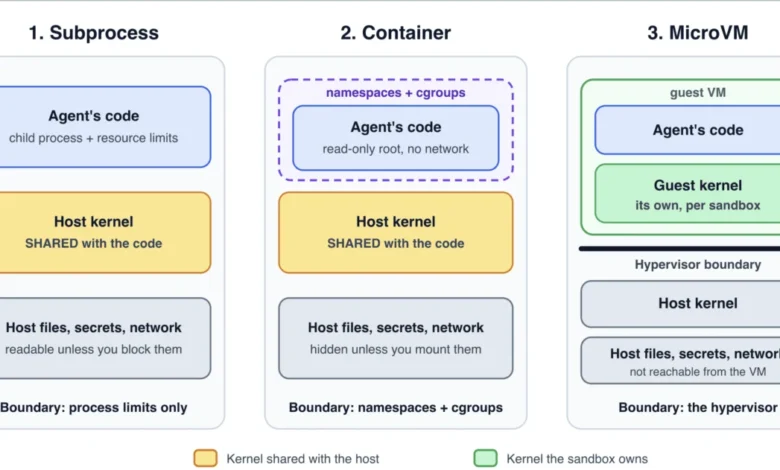
The hierarchy of isolation is defined by the depth of the boundary between the agent’s code and the host operating system.
-
Limited Subprocesses: This is the most lightweight method, utilizing Linux-native features like
resourcelimits andunshare. By spawning a child process that operates under the identity of an unprivileged user (such as "nobody"), developers can limit CPU usage, memory allocation, and file system visibility. However, this tier shares the host kernel. A kernel exploit remains a viable vector for a breakout, making this approach suitable only for environments where the code being executed is considered low-risk or is pre-vetted. -
Hardened Docker Containers: Containers utilize namespaces and control groups (cgroups) to provide a degree of isolation. By implementing strict security profiles—such as
no-new-privileges, read-only root filesystems, and the dropping of all Linux capabilities—developers can significantly shrink the attack surface. Despite these measures, containers remain "processes on the host kernel." The industry consensus, supported by findings from organizations like the Cloud Native Computing Foundation (CNCF), is that containers should not be the sole security barrier for highly sensitive or truly untrusted third-party code.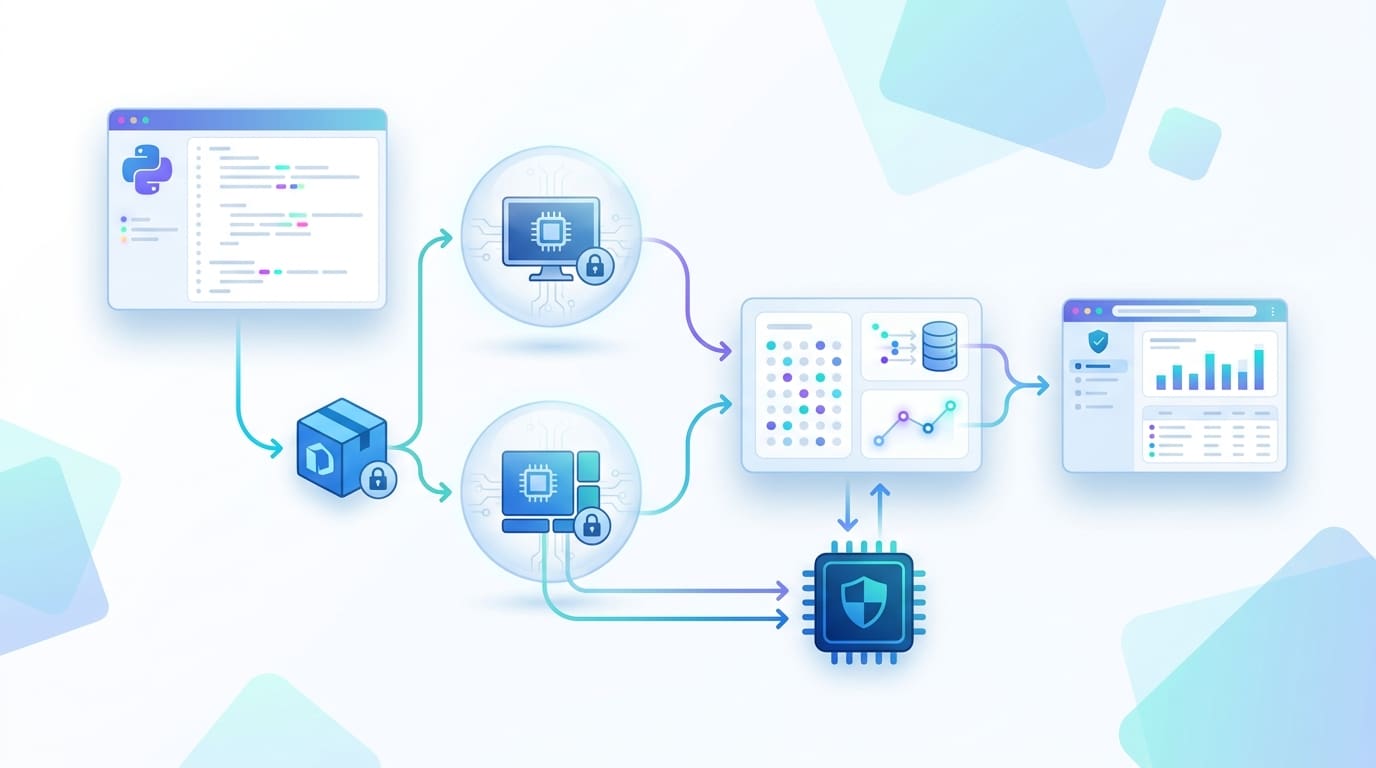
-
Firecracker MicroVMs: Representing the gold standard in current serverless architecture, microVMs utilize a hypervisor to provide each sandbox with its own kernel. Pioneered by AWS for Lambda and Fargate, and adopted by platforms like E2B, this architecture ensures that sessions are completely siloed. Because there is no shared kernel between the host and the VM, the breakout risk is drastically reduced to the hypervisor level, which is a significantly smaller and more secure interface.
Performance Benchmarking and Latency Trade-offs
A critical factor in choosing an isolation tier is the "latency tax." In production-grade AI agents, latency is the difference between a seamless user experience and a timeout error.
- Subprocess Execution: Demonstrates near-zero latency, as the process is initialized by the host OS. Median response times are typically under 50 milliseconds, making this ideal for high-frequency internal data analysis tasks.
- Container Initialization: Introduces overhead related to image pulling and namespace setup. While "warm" containers are fast, cold starts can range from 200 to 500 milliseconds.
- MicroVM Bootstrapping: Despite being the most secure, these systems must boot a lightweight Linux kernel for every request. Recent optimizations have reduced this to approximately 100-150 milliseconds. While slower than a simple subprocess, this delay is often negligible compared to the time required for an LLM to generate the code in the first place.
Strategic Implementation and Best Practices
To implement these safeguards effectively, developers must decouple the "Agent" from the "Executor." The agent should interact with an abstraction layer that treats the execution environment as a black box. Whether using a local Docker daemon or a managed service like E2B, the API should remain consistent.
Infrastructure-as-Code (IaC) plays a pivotal role here. Network policies, secret management, and file system permissions should be defined by the infrastructure team, not the AI agent. For instance, the agent should never have access to environment variables containing production API keys. Instead, the sandbox environment should be injected with specific, short-lived tokens, or no credentials at all, if the task does not strictly require them.
Future Implications
The trajectory of AI agent deployment is clearly leaning toward the "MicroVM-as-a-Service" model. As highlighted by the adoption of microVMs in major cloud providers like AWS and the recent evolution of Docker Sandboxes, the industry is moving away from the assumption that the host kernel can be safely shared with untrusted AI output.
Looking forward, we expect to see "Kernel-as-a-Service" become a standard component in the agentic tech stack. As LLMs become more capable of complex system-level operations, the barrier to entry for malicious code execution will rise, forcing developers to prioritize architectural isolation over simple runtime monitoring. By adopting a tiered approach—reserving subprocesses for trusted internal tasks and microVMs for open-ended or public-facing agents—organizations can harness the power of autonomous AI while maintaining a robust security posture. The shift from software-defined boundaries to hardware-virtualized boundaries marks a mature step in the lifecycle of agentic computing, ensuring that the next generation of intelligent tools remains a benefit rather than a liability.