Google Ads Introduces Channel Prioritization and Budget Allocation Controls


The landscape of automated advertising is undergoing a significant shift as Google rolls out new Channel Prioritization and Budget Allocation controls for its advertising platform. This update represents a departure from the "black box" approach that has defined Google’s automated campaigns, such as Performance Max, for years. By providing PPC managers with granular levers to influence where and how their budgets are deployed, Google is acknowledging a long-standing demand from advertisers for greater transparency and control over their automated spending.
For years, the rise of machine-learning-driven campaigns has stripped away many of the manual settings that managers once relied upon to guide their strategy. While automation has undoubtedly improved efficiency for many, it has also led to frustration among advertisers who find their budgets being funneled into inventory they deem suboptimal. These new controls are designed to strike a balance, allowing for human oversight without completely dismantling the algorithmic benefits that define modern Google Ads.
A Chronology of Control: From Manual Bidding to Automation
The evolution of Google Ads can be categorized into distinct eras. In the early 2010s, manual bidding and granular placement targeting were the industry standards. As the platform matured, Google transitioned toward Smart Bidding—a suite of auction-time bidding strategies that use machine learning to optimize for conversions or conversion value.
The launch of Performance Max (PMax) in 2021 signaled a major pivot toward "all-in-one" campaigns. PMax automatically distributes budgets across all Google channels, including Search, YouTube, Display, Discover, Gmail, and Maps. While this removed the need for manual cross-channel management, it also created a lack of visibility. Advertisers could see where their ads were appearing but had little ability to steer the ship if a particular channel underperformed.
The introduction of these new controls in late 2026 marks the first major corrective measure. It follows a period of intense feedback from agencies and enterprise advertisers who required, at minimum, the ability to restrict spend on specific "lower-priority" inventories that did not align with their broader marketing objectives.
How the New Controls Function
The new settings allow advertisers to classify channels into priority tiers. By assigning a higher priority to preferred channels, managers can signal to Google’s algorithm that they prefer their budget to be utilized there first. However, the system does not act as a hard switch. Instead, it works in tandem with the campaign’s existing bidding target—whether that be Target CPA (Cost Per Acquisition) or Target ROAS (Return on Ad Spend).

When a campaign is constrained by a strict budget, the prioritization settings become particularly relevant. If a Search campaign is consistently hitting its budget ceiling, assigning "High" priority to Google Search and "Low" priority to Search Partners ensures that the algorithm exhausts the high-value inventory before allocating the remaining funds to secondary sources.
Crucially, this is not an invitation to ignore bidding targets. If the algorithm determines that spending more on a high-priority channel would result in a violation of the defined CPA or ROAS goal, it will refrain from doing so, regardless of the priority setting. This creates a dual-layer decision-making process: the advertiser sets the priorities, but the machine learning still enforces the fiscal boundaries.
The Nuance of Budget Allocation
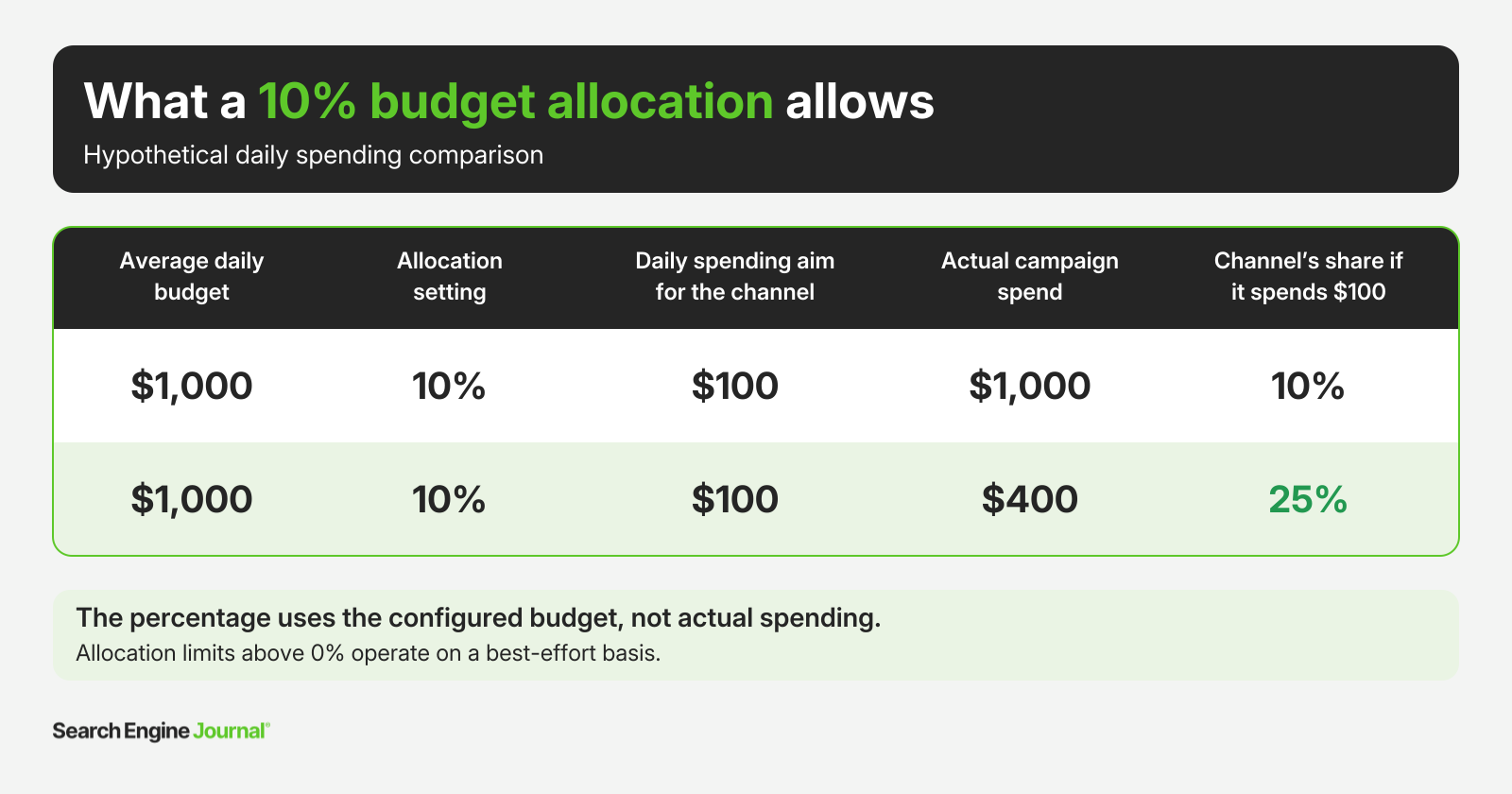
One of the most complex aspects of this update is the relationship between allocation percentages and actual daily spend. Advertisers can set a specific percentage of their budget to be allocated to lower-priority channels. It is vital to note that this percentage is calculated against the total daily budget, not the actual daily spend.
For example, if an advertiser sets a 10% allocation limit for Search Partners within a $1,000 daily budget, the system permits up to $100 for that channel. If, due to market fluctuations, the campaign only spends $500 total on a given day, the $100 allowance for Search Partners remains. Consequently, the percentage of total actual spend allocated to the partner network could jump from 10% to 20%. Understanding this math is essential for preventing accidental overspending or unintended exposure in lower-quality inventory.
Implications for Performance Max and Search Campaigns
For Performance Max users, these settings provide a moderate degree of relief, though they do not solve every architectural concern. Google continues to group Search, YouTube, Discover, Gmail, and Maps into a singular "Google Channels" bucket. While advertisers can prioritize this group against Search Partners and the Google Display Network, they still lack the ability to differentiate between YouTube and Search internally.
If a business relies on a strict budgetary split between video-based brand awareness and search-based lead generation, these new controls will not replace the need for separate campaign structures. The update is best viewed as a optimization tool rather than a restructuring panacea.
Strategic Review: The "Before You Act" Checklist
Before implementing these changes, PPC managers should adopt a data-driven approach to avoid unintended performance drops. The following steps are recommended for any professional auditing their account:
- Conduct a Network Performance Audit: Before restricting any channel, analyze existing data. Use the "Network (with search partners)" segment in Search campaigns or the "Channel performance" report in Performance Max. Look specifically for "Qualified Lead" metrics rather than simple "Form Submission" counts. If Search Partners are bringing in cheap but unqualified leads, restriction is warranted. If they are contributing to the overall conversion funnel, cutting them off may harm the campaign’s long-term health.
- Isolate the Variable: When testing these new controls, do not modify bidding strategies or audience targeting simultaneously. By keeping all other variables constant, managers can attribute changes in performance directly to the new channel prioritization settings.
- Plan for February 2027: Google is retiring the current Display Expansion allocation setup by February 2027. Advertisers currently utilizing this must prepare for the migration. The recommended path is to set Display to "Low" priority with a 50% budget allocation to maintain parity with current operations while moving to the new framework.
Broader Economic and Operational Impact
The push for these controls reflects a wider trend in the digital advertising industry: the return of "control-conscious" advertising. As economic conditions tighten, CFOs and marketing directors are increasingly skeptical of purely automated black-box performance metrics. There is a renewed emphasis on "incrementality"—the measure of whether a sale would have happened anyway, or if it was truly driven by the ad.
By providing these controls, Google is effectively offering a compromise. They are protecting the integrity of their automated bidding systems—which rely on large data sets—while granting human managers the ability to prune the "wasted spend" that often characterizes broad-reach campaigns.
The long-term implication for PPC managers is a shift in skill set. The role is evolving away from manual keyword bidding toward a role of "algorithmic oversight." Success will be defined by how well a manager can interpret data, set logical priorities for the AI to follow, and monitor the results of those instructions over time.
Conclusion
These new Channel Prioritization and Budget Allocation tools are a significant step toward a more transparent, user-led advertising experience within the Google ecosystem. They provide the necessary levers to refine budget distribution, particularly in instances where business requirements mandate stricter control than what an autonomous system might provide.
However, the efficacy of these tools is tied directly to the manager’s understanding of the underlying math and the specific business outcomes being pursued. As the industry moves toward February 2027 and the complete integration of these controls, advertisers who master the balance between machine-learning efficiency and manual strategic oversight will likely see the most consistent results. For now, the best strategy remains a cautious, experiment-based implementation, starting with individual campaigns before applying changes at scale.