Navigating the Automated Web: Managing AI and Bot Traffic Surges in Modern Website Administration


The modern digital landscape is undergoing a profound structural shift as automated scripts, software agents, and artificial intelligence crawlers claim an increasingly massive share of global web traffic. This phenomenon has transformed from a minor technical footnote into a critical operational consideration for website managers, system administrators, and enterprise hosting providers alike. Recent telemetry highlights the scale of this expansion: a comprehensive annual analysis of more than 10 billion web requests conducted by managed WordPress hosting provider Kinsta revealed a staggering 300% year-over-year surge in AI-driven bot traffic alone.
This exponential growth underscores a new reality for digital infrastructure. Automated agents are no longer confined to traditional search engine indexing and basic link-checking utilities. Today, they encompass sophisticated large language model (LLM) scrapers, automated e-commerce data collectors, credential-stuffing security threats, and benign monitoring utilities. Consequently, webmasters can no longer afford a passive stance toward traffic curation. Effective bot management requires proactive oversight, precise categorization, and nuanced response strategies designed to protect system resources without inadvertently severing valuable channels of automated engagement.
The Evolving Anatomy of Web Traffic
To understand the current challenges of web management, it is necessary to examine the historical trajectory of automated traffic. In the early days of the commercial internet, bots were relatively straightforward entities. Search engine spiders—most notably Googlebot and Bingbot—accounted for the vast majority of non-human traffic, quietly indexing pages to facilitate organic discovery. While security threats like DDoS scripts and basic comment-spam bots existed, the overall ecosystem was predictable and manageable through basic firewall rules and robots.txt files.
The proliferation of generative artificial intelligence and large language models over the past several years shattered this equilibrium. Enterprises, startups, and independent researchers are deploying thousands of proprietary web scrapers to harvest training data, monitor market pricing, and aggregate content in real time. Unlike traditional search engines that drive referral traffic back to source websites, many AI agents consume vast server resources to ingest content while offering little to no reciprocal visitor traffic.

According to industry data released through recent web infrastructure audits, automated requests now frequently outnumber human visitors on medium-to-large enterprise platforms. This imbalance places severe strain on database servers, dynamic endpoints, and content delivery networks (CDNs). When unmanaged, unchecked bot swarms can degrade site performance, inflate bandwidth expenses, and compromise the user experience for genuine human visitors.
The Diagnostic Imperative: Separating Malicious Attacks from Routine Traffic
When faced with a sudden spike in automated requests, website managers frequently fall into the trap of panic-driven overcorrection—either blocking all non-human traffic indiscriminately or ignoring the anomaly until server failure occurs. Cybersecurity and web hosting experts advocate instead for a methodical, data-driven diagnostic framework.
The first critical step in addressing a suspected bot surge is determining whether the platform is experiencing a deliberate, malicious attack or simply a high volume of heavy, non-malicious automated traffic. This distinction dictates the appropriate operational response. If a site is actively under pressure—manifested through spiking central processing unit (CPU) utilization, exhausted database connection pools, prolonged server response times, or sudden increases in error rates—immediate stabilization takes precedence over deep forensic analysis.
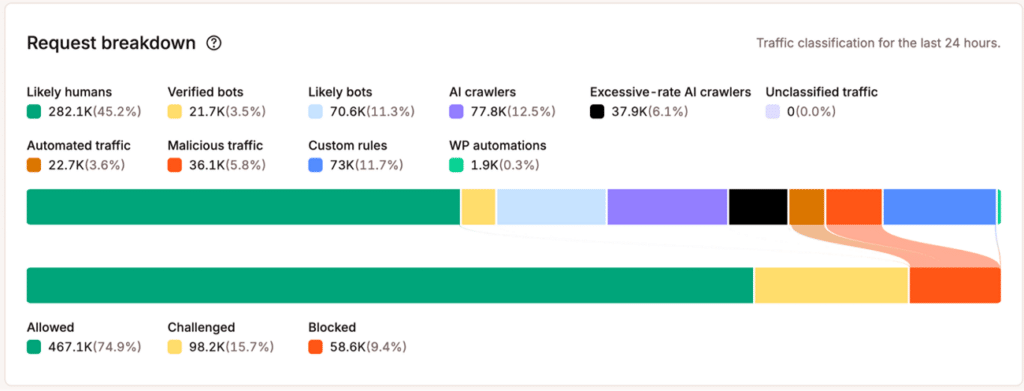
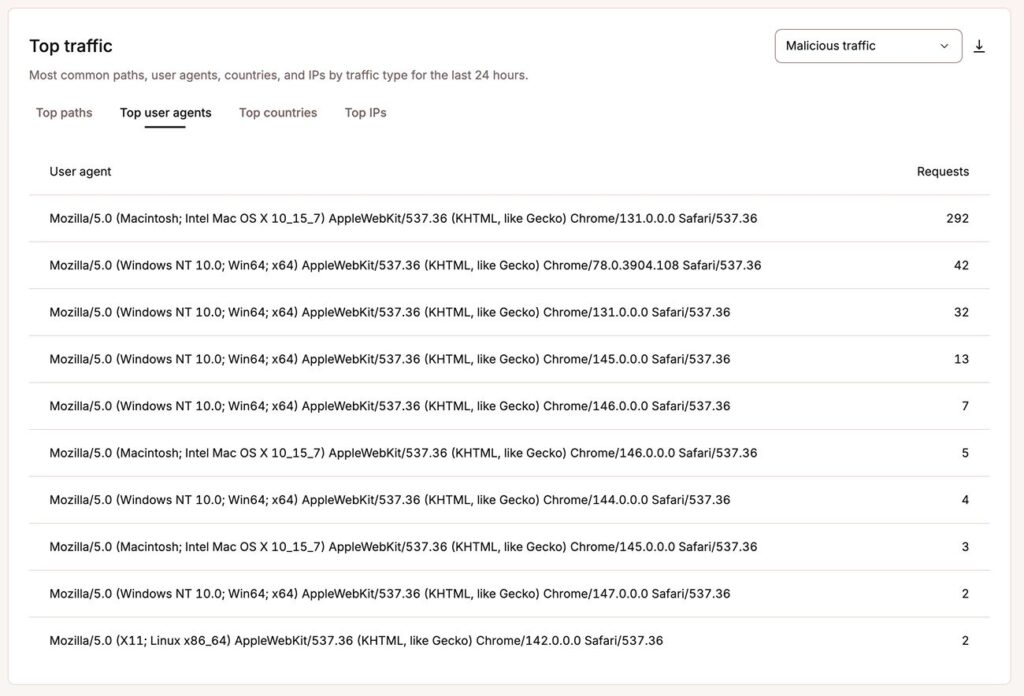
Modern hosting environments now provide advanced analytics dashboards to assist administrators in this diagnostic phase. For instance, Kinsta’s integrated bot protection analytics offer granular visibility into incoming traffic by breaking requests down into distinct operational categories. Administrators can inspect top traffic paths, user agents, geographic origins, and offending Internet Protocol (IP) addresses. By examining these metrics, technical teams can pinpoint precisely which areas of a website are drawing the heaviest automated attention and identify the specific software signatures driving the load.
Rapid Stabilization Protocols Under Pressure
When a website is actively buckling under the weight of automated requests, immediate triage is required to restore functionality for legitimate human users. Waiting to complete a full forensic investigation while a server crashes is counterproductive.
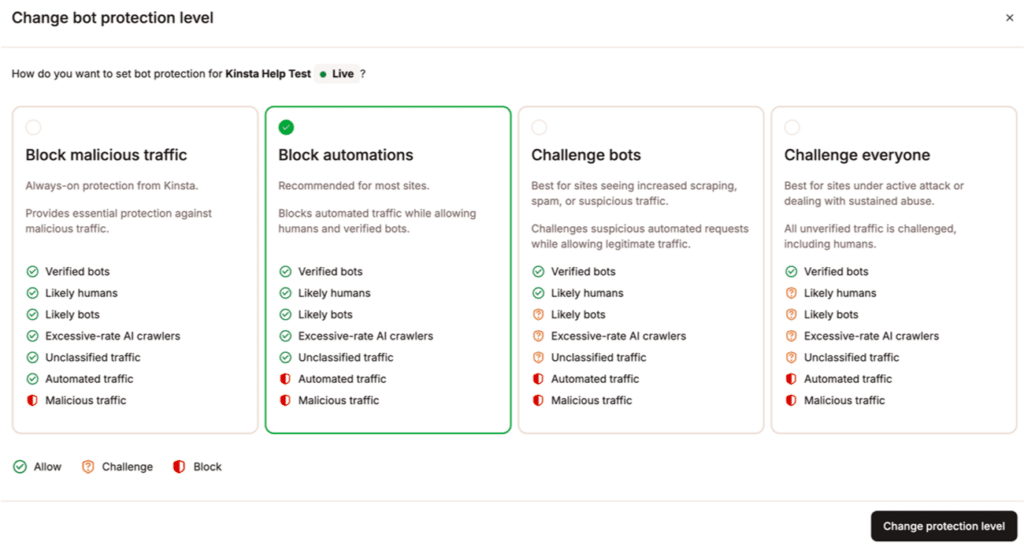
During acute incidents, administrators should deploy rapid mitigation measures. These often include elevating security postures to challenge unverified visitors, implementing temporary rate-limiting rules, or activating stricter Web Application Firewall (WAF) profiles. For example, platform-specific security layers like Kinsta Bot Protection allow administrators to rapidly shift their defensive posture from baseline threat-blocking to more aggressive stances, such as challenging all unverified bots or enforcing JavaScript challenges across the entire domain.
While these broad, aggressive measures are generally too restrictive for permanent, long-term deployment—as they risk creating friction for legitimate users and specialized crawlers—they serve as an invaluable emergency brake. Once stability is restored and server resource metrics return to baseline operating ranges, administrators can transition from emergency response to a refined, granular bot management strategy.
Formulating a Long-Term Strategy: Allow, Challenge, or Block
Developing a sustainable, long-term bot management policy requires moving away from binary assumptions and adopting a triage framework based on three primary actions: allowing, challenging, or blocking.
- Allow: Essential utilities that contribute tangible value to the website—such as major search engine crawlers, uptime monitoring systems, and verified analytics tools—should be granted unhindered access. Facilitating these bots ensures proper search engine indexing and site health tracking.
- Challenge: When automated traffic originates from unknown, unverified, or ambiguous sources, employing an intermediate challenge mechanism is often prudent. Methods such as JavaScript evaluations, CAPTCHAs, or interactive browser checks allow human users and compliant agents to pass while turning away simplistic automated scripts.
- Block: Traffic identified as malicious, aggressive, or utterly devoid of value—such as credential-stuffing botnets, aggressive content scrapers, and abusive vulnerability scanners—should be blocked outright at the server or edge network level.
Crucially, these rules do not need to be applied uniformly across an entire web property. A sophisticated bot management strategy recognizes that different sections of a website serve different business functions. For instance, a site owner might choose to fully allow AI crawlers to access public-facing informational blog posts to maximize brand visibility, while strictly blocking or challenging those same crawlers on expensive dynamic endpoints, such as user login portals, shopping carts, and checkout funnels.
Case Studies in Modern Bot Management
To illustrate how these theoretical frameworks apply in practice, industry specialists point to several recurring scenarios commonly encountered by website administrators, particularly those operating content management systems and e-commerce platforms.
High-Volume Search Crawlers
When a legitimate search engine crawler begins generating an unexpectedly high volume of requests, the immediate concern is server load. Rather than blocking the crawler outright—which could severely damage search engine optimization (SEO) and organic visibility—administrators should evaluate whether the crawler respects crawl-delay directives, whether it is indexing outdated or low-value pages, and whether the traffic is arriving during peak human visiting hours. Adjusting robots.txt parameters, optimizing server-side caching, or communicating directly with search engine webmaster tools often resolves the load issues without sacrificing search presence.
Resource-Intensive AI Scrapers
The monetization and utility of AI scraping traffic remain subjects of intense debate among digital publishers. While some platforms welcome AI citations as a new form of referral traffic, others find that LLM crawlers consume vast computing resources without returning adequate value. Administrators utilizing modern bot protection toolsets can isolate AI-specific user agents and apply tailored rules. This may involve rate-limiting specific AI bots, forcing them through verification challenges, or blocking specific autonomous agents that fail to provide reciprocal value or adhere to standard web etiquette.
Dynamic Endpoints and E-Commerce Vulnerabilities
Dynamic endpoints—such as e-commerce checkouts, account dashboards, search bars, and membership login pages—are particularly vulnerable to automated resource exhaustion. Because these pages cannot be easily cached by standard static mechanisms, every bot request directly invokes PHP execution and database queries. On platforms running WooCommerce or custom database-driven applications, unmitigated bot traffic on these endpoints can quickly exhaust database connections. Effective remediation involves applying aggressive rate limits specifically to POST requests, login pathways, and search parameters, shielding critical business infrastructure from non-human abuse.
Ongoing Monitoring and Continuous Adjustment
Implementing a bot management policy is not a one-time administrative task, but rather an ongoing operational discipline. Because automated actors constantly evolve their techniques—rotating IP addresses, spoofing user-agent strings, and adopting distributed scraping topologies—website managers must continuously monitor the efficacy of their defenses.
Post-implementation monitoring should focus on a synthesis of technical and business metrics. Key performance indicators include server resource utilization (CPU, memory, and database load), organic search visibility, referral traffic patterns, and conversion rates. Regular audits of bot analytics reports will reveal whether newly introduced rules are successfully repelling malicious agents or if they are inadvertently impeding legitimate users and partner integrations.
If monitoring indicates that legitimate visitors are encountering friction, rules can be fine-tuned by adding specific exceptions for trusted IP ranges, verified autonomous systems, or specific URL paths. Conversely, if resource consumption remains abnormally high, administrators can incrementally tighten their security postures.
Broader Implications for the Digital Ecosystem
The growing prevalence of automated web traffic highlights a fundamental evolution in how the internet functions. As artificial intelligence continues to mature, the boundary between human and machine interaction will blur further, necessitating increasingly sophisticated infrastructure management tools.
The era of treating all web traffic as either purely human or purely malicious is officially over. Modern website administration demands a proactive, highly calibrated approach that balances the necessity of open access with the imperative of resource preservation. By leveraging advanced analytics, deploying granular traffic-routing rules, and adopting a structured methodology of allowing, challenging, and blocking, digital managers can successfully navigate the complexities of the automated web and ensure long-term platform resilience.