Combating the Deluge: A Comprehensive Guide to WordPress Spam Protection in 2026


The pervasive issue of spam continues to plague the digital landscape, with WordPress sites, in particular, facing a relentless onslaught across contact forms, comment sections, and user registrations. This persistent annoyance, far from being a mere inconvenience, poses significant operational and security challenges for website administrators worldwide. Despite its formidable nature, effectively neutralising spam in the WordPress ecosystem is often more straightforward and less costly than many anticipate, leveraging a combination of built-in features, advanced artificial intelligence, and strategic deployment of protective measures.

For over sixteen years, leading digital publishers, including WPBeginner, have been at the forefront of testing and refining anti-spam plugins, tools, and comprehensive strategies. This extensive experience underscores the critical need for robust defense mechanisms against daily spam attacks that threaten the integrity and functionality of business websites. This comprehensive guide outlines a step-by-step approach to blocking every type of WordPress spam, moving from fundamental configurations to advanced, modern automated protection techniques – methods actively deployed to safeguard high-traffic online platforms.
The Pervasive Threat of WordPress Spam

WordPress powers over 43% of all websites on the internet, making it an exceptionally attractive target for spammers. This vast market share means that any vulnerability or common entry point becomes a high-value target for automated bots designed to inject malicious links, unsolicited advertisements, or fake user registrations. The sheer volume of spam is staggering; industry reports frequently indicate that spam constitutes over 85% of all email traffic, and a significant portion of web form submissions and comments suffer a similar fate. The financial implications for businesses are substantial, encompassing wasted administrative time, compromised data integrity, and potential damage to brand reputation and search engine rankings.
The evolution of spam has mirrored advancements in technology. Early spam efforts were rudimentary, easily detectable by simple keyword filters. However, the advent of sophisticated bot networks and, more recently, AI-powered content generation has elevated the threat. These modern bots can mimic human behaviour, generate contextually relevant (though still ultimately spammy) comments, and bypass basic security checks, making traditional defenses less effective in isolation. This necessitates a multi-layered, adaptive approach to WordPress spam protection.
Layered Defenses: A Strategic Approach to Spam Mitigation
Effective spam protection on WordPress is not a single solution but a combination of strategic layers, each addressing different vectors of attack.
1. Foundation: Leveraging WordPress’s Built-in Controls
The first line of defense often lies within WordPress’s native settings, which offer several free and effective anti-spam options. These configurations, while not foolproof against every sophisticated bot, are crucial for eliminating the easiest targets and establishing a baseline of security. Implementing these settings requires minimal effort and no financial outlay.
-
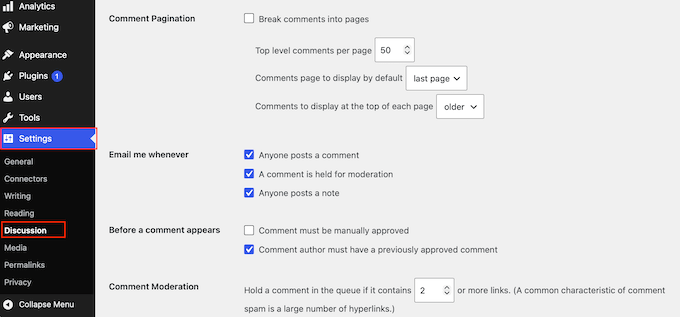
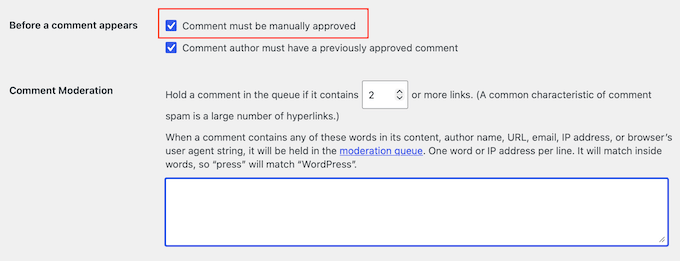
Tightening WordPress Discussion Settings: Comment spam is a prevalent issue. WordPress’s built-in discussion settings provide granular control over who can post, the types of links permitted, and overall moderation. Accessible via Settings » Discussion in the WordPress dashboard, these controls are instrumental. The most vital tool here is the comment moderation queue. By activating "Comment must be manually approved," all submissions are held for review before public display, ensuring that spam never reaches visitors, even if it circumvents other filters. Further, enabling "Comment author must have a previously approved comment" allows trusted returning users to bypass moderation, though regular review of published comments remains prudent.
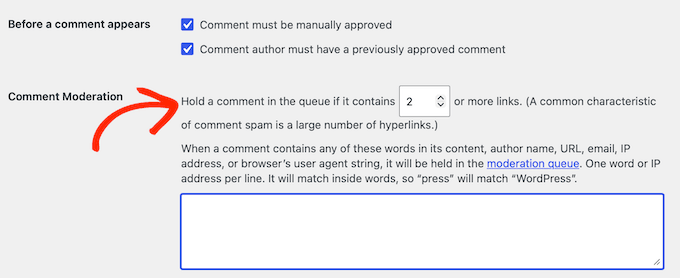
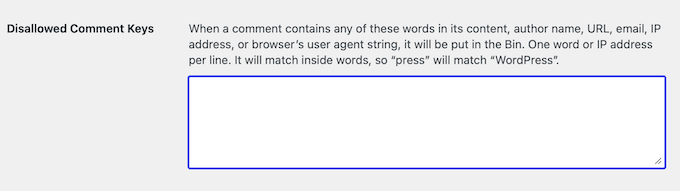
A significant percentage of spam comments are characterised by excessive links. The "Comment Moderation" box allows administrators to set a limit on the number of links in a comment. The default of two can be lowered to one, dramatically increasing the catch rate for junk submissions. Additionally, the "Disallowed Comment Keys" feature acts as a robust blocklist, automatically trashing comments containing specified words, names, email addresses, or web addresses. This allows for proactive filtering based on known spam patterns.
-
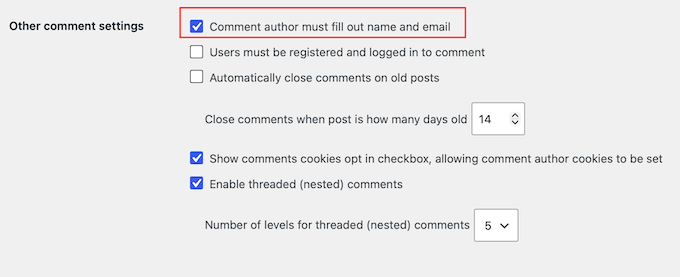
Requiring Name and Email for Comments: Promoting authentic engagement, requiring commenters to provide a name and email address helps foster thoughtful discussions and deters anonymous, drive-by spam. Most legitimate visitors are willing to provide these details. This setting is found under "Other comment settings" in the Discussion panel by checking "Comment author must fill out name and email."
-
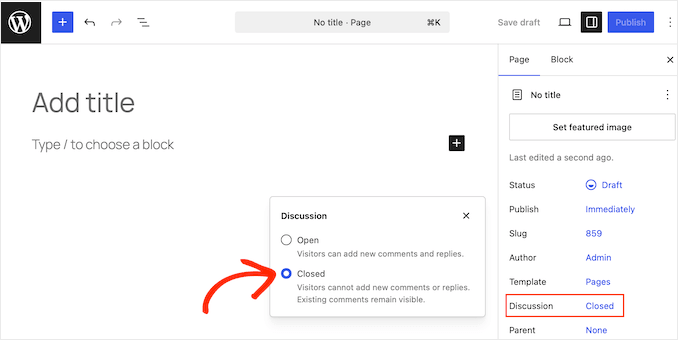
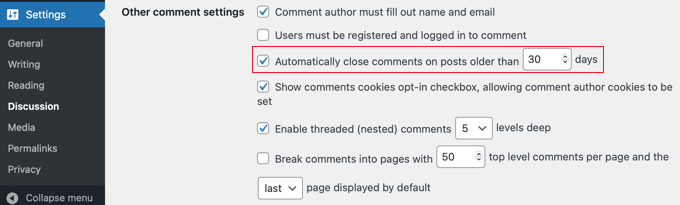
Disabling Comments Entirely: For websites where interactive comment sections are not essential, the most definitive solution is to disable comments altogether. This eliminates comment spam as a concern. A code-based method, safely implemented via a plugin like WPCode, can disable comment support across the entire site. Alternatively, comments can be disabled on individual pages (e.g., Contact or About pages) or automatically closed on posts older than a specified number of days (e.g., 30 or 90 days), reducing the attack surface on archived content.
-
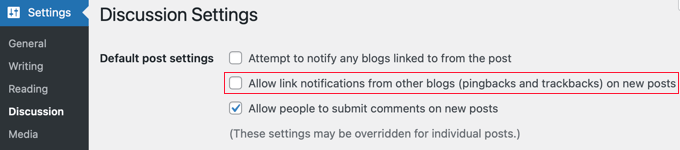
Disabling Trackbacks and Pingbacks: Originally designed to facilitate inter-blog communication, trackbacks and pingbacks have become notorious spam vectors. They generate fake link notifications, cluttering the dashboard. Disabling these notifications under Settings » Discussion by unchecking "Allow link notifications from other blogs (pingbacks and trackbacks) on new posts" effectively removes an entire category of junk. For existing posts, a specific cleanup process is required.
2. Modern Warfare: AI-Powered Spam Filtering
In an era increasingly dominated by AI-driven automation, especially in spam generation, the most advanced defense comes from AI-powered spam protection solutions. These systems automatically detect and block spam across comments, contact forms, and user registrations, crucially doing so without relying on CAPTCHAs, which can negatively impact user experience and conversion rates.
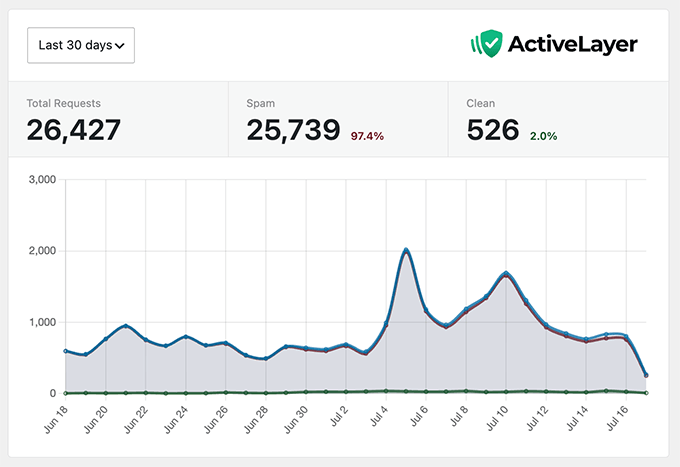
WPBeginner, for instance, employs ActiveLayer, an AI-powered, server-side plugin known for its invisible operation and GDPR compliance. This solution has demonstrated remarkable efficacy, blocking over 25,000 spam comments and form submissions in a single month on their platforms. ActiveLayer offers detailed logs, including confidence scores and reasons for flagging, providing transparency into its operations. While a free tier is available, paid plans offer scalable protection. Alternatives like Akismet and CleanTalk are also popular. Akismet, a long-standing solution, remains suitable for personal blogs, often offering a free "name your price" option for non-commercial use. However, its commercial pricing has become steep for businesses, making ActiveLayer or CleanTalk more competitive options for commercial sites. It is critical to use only one primary spam filtering plugin to avoid conflicts that could inadvertently block legitimate users. These plugins typically integrate seamlessly with popular contact form solutions.
3. User Verification: The Role of CAPTCHA and Registration Controls
While AI-powered filters work invisibly, some scenarios or persistent threats may necessitate user-facing verification methods.
-
Deploying CAPTCHA Solutions: CAPTCHA (Completely Automated Public Turing test to tell Computers and Humans Apart) presents a simple test that humans can pass but automated scripts cannot. Cloudflare Turnstile CAPTCHA is increasingly recommended for WordPress comments due to its free availability, ease of setup, and user-friendly, often invisible, background checks. By installing the Simple Cloudflare Turnstile plugin and connecting it to a free Cloudflare account, administrators can protect all WordPress forms. While Google reCAPTCHA is another option, its free tier limitations and data handling practices make Cloudflare Turnstile a more favourable choice for many.
-
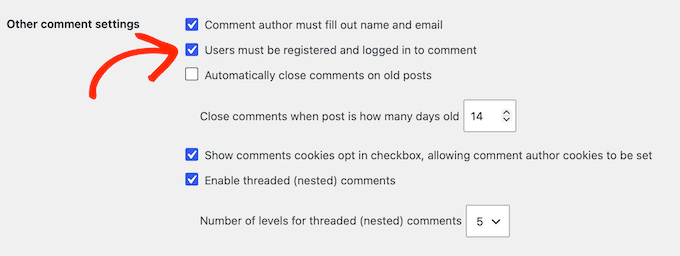
Restricting Comments to Registered Users: For membership sites, online forums, or private communities, controlling participation by requiring users to be registered and logged in significantly curtails spam. This adds a layer of accountability that deters most bots. This setting is enabled under Settings » Discussion by checking "Users must be registered and logged in to comment." However, this approach introduces friction and may not be suitable for public blogs aiming for broad engagement.
-
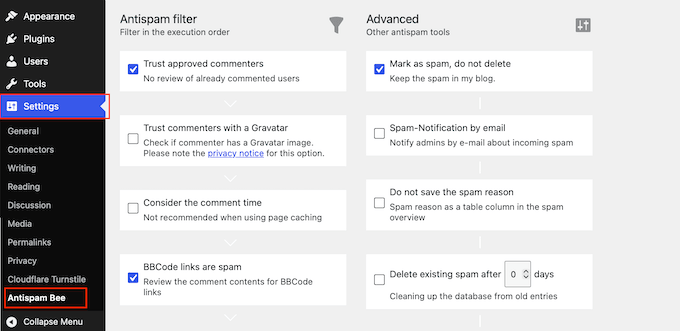
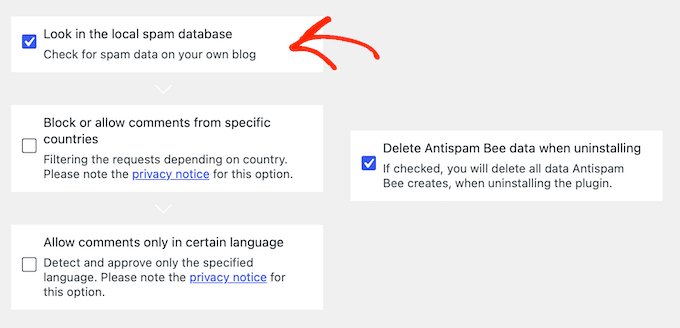
Free Keyword and Pattern Filtering with Antispam Bee: When some spam manages to mimic human writing, a dedicated filtering plugin like Antispam Bee can provide additional defense. This free, privacy-friendly plugin operates without requiring an API key, offering a powerful set of local rules to analyze comment data before it enters the database. Recommended settings include validating IP addresses, trusting approved commenters, blocking comments from specific countries or containing specific languages, and checking against a local spam database. Antispam Bee also allows for automatic deletion of old spam, maintaining database hygiene. A significant tweak to consider is removing the website address field from comment forms, as this field is a primary target for spammers.
4. Fortifying Contact and Lead Forms
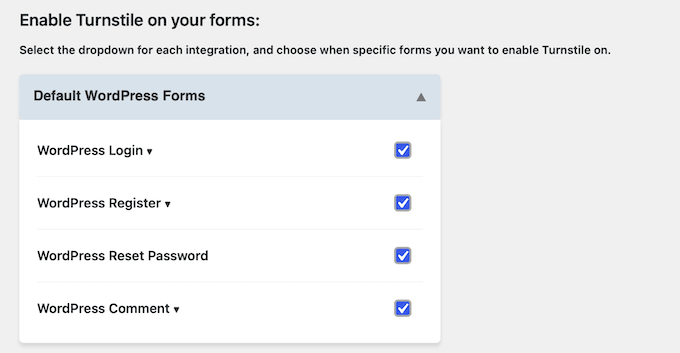
Contact and lead generation forms are particularly vulnerable to spam attacks, often experiencing thousands of malicious submissions. Form builder plugins like WPForms, widely used across millions of websites, integrate advanced anti-spam features. Other popular builders like Gravity Forms and Fluent Forms offer similar capabilities.
-
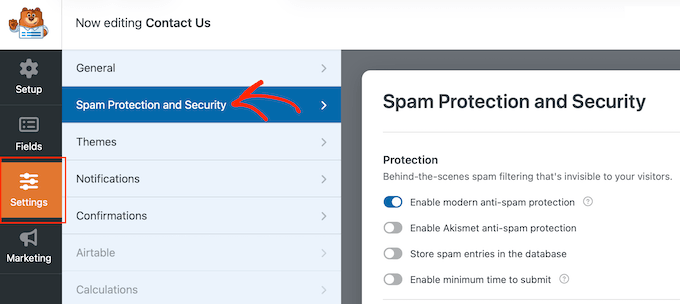
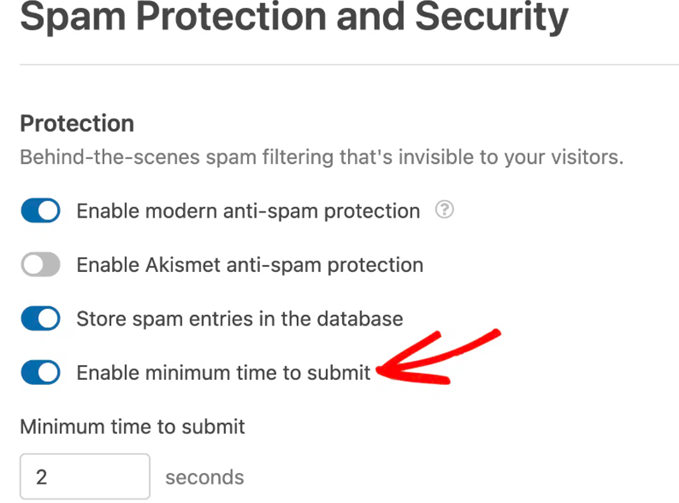
Enabling Default Anti-Spam Token (Honeypot): Modern form builders silently incorporate unique, time-sensitive tokens (a form of honeypot technology) into forms. This mechanism blocks automated scripts by detecting suspicious interactions, preventing spam entries from reaching the inbox. For WPForms, this is "Enable modern anti-spam protection" under Settings » Spam Protection and Security.
-
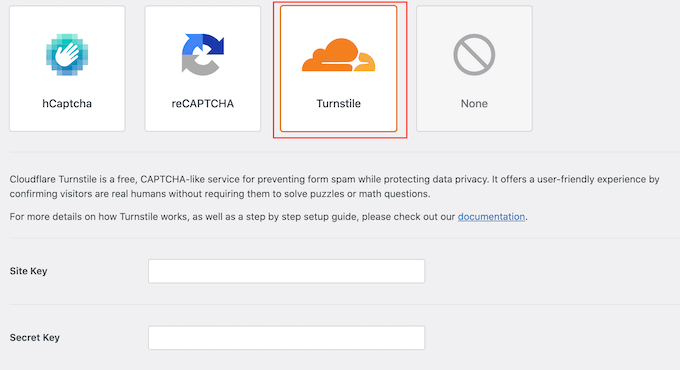
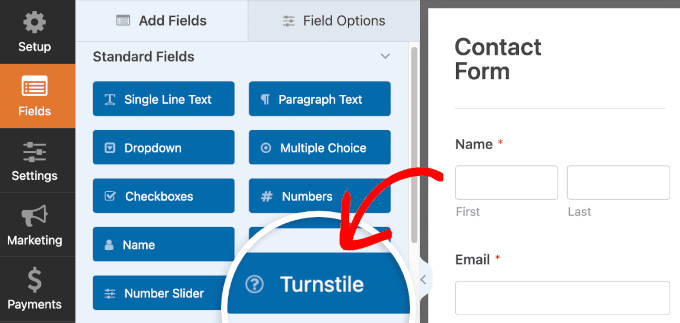
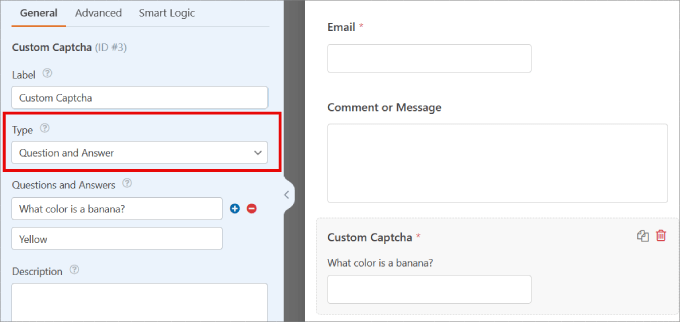
Integrating CAPTCHA on Contact Forms: For more aggressive bots that bypass honeypots, a visible CAPTCHA field is crucial. WPForms, for instance, offers both Cloudflare Turnstile and Google reCAPTCHA integration. Cloudflare Turnstile is generally preferred due to its cost-free and less intrusive background checks. For those wary of third-party data sharing, WPForms’ Custom Captcha field allows for server-side challenges (e.g., math problems or custom Q&A).
-
Time-Based Behavioral Checks: Human users naturally take several seconds to read and complete a form, whereas bots submit almost instantaneously. Time-based checks flag impossibly fast submissions without altering the user experience. WPForms includes an "Enable minimum time to submit" option, typically set to 2 seconds, which can be adjusted as needed.
-
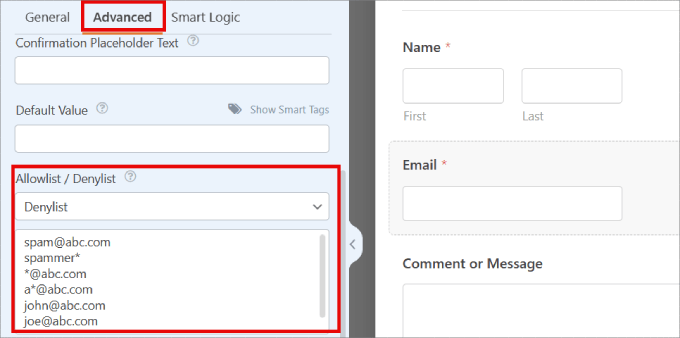
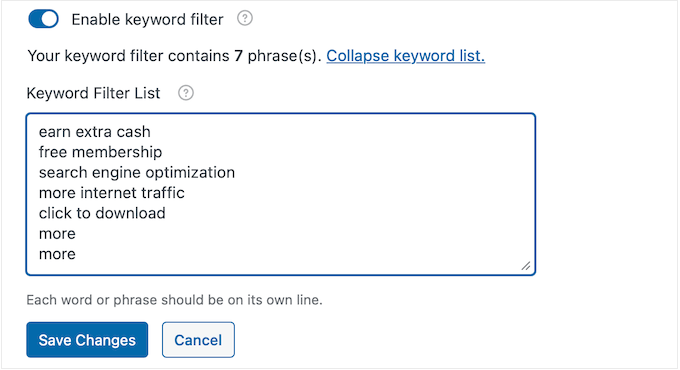
Advanced Filtering by Country, IP, Email, and Keyword: Pro versions of form builders offer advanced content screening. WPForms, for example, allows blocking entries by specific email addresses (with wildcard support), keywords (to filter spammy phrases), and even by country or IP address. This geo-fencing can be highly effective for businesses serving specific regions. Alternatively, IP addresses can be blocked directly within WordPress if the form solution lacks this feature.
5. Securing User Registrations
On membership sites or e-commerce platforms, spam registrations are more than a nuisance; they pollute user databases, skew analytics, and can pose security risks.
-
Disabling Registration When Unnecessary: The simplest solution for sites not requiring user accounts (e.g., most blogs without memberships or e-commerce) is to disable registration entirely. This is done in Settings » General by unchecking "Anyone can register."
-
Requiring Email Confirmation or Manual Review: When open registration is necessary, the goal is to admit legitimate users while excluding bots. Requiring a confirmed email address or manual administrative review before account activation is highly effective. The location of this control varies by platform:
- WooCommerce: While WooCommerce core doesn’t include a native email confirmation, extensions are available. Guest checkout can also be forced.
- Membership/Course Platforms: Dedicated platforms like MemberPress, LearnDash, or BuddyPress manage account verification within their own settings.
- Custom Forms: Plugins like WPForms User Registration addon offer email activation or manual admin approval for custom registration forms.
-
Adding CAPTCHA and Honeypot to Signup Forms: Similar to contact forms, CAPTCHA and honeypot mechanisms are vital for registration forms. Cloudflare Turnstile can be enabled for registration forms. For default WordPress registration pages, plugins like WP Armour can add hidden honeypot fields, logging and blocking bot attempts.
-
AI-Powered Detection for Registrations: Honeypots and CAPTCHAs prevent obvious bots, but AI-powered tools like ActiveLayer and CleanTalk screen new signups against live reputation data, identifying and blocking fraudulent accounts based on known bad IP addresses or throwaway email patterns.
6. Perimeter Protection: The Importance of a Site-Wide Firewall
A Web Application Firewall (WAF) acts as a crucial perimeter defense, screening all incoming traffic and blocking malicious requests before they even reach the WordPress server. A DNS-level firewall, which filters traffic at the provider’s network level, is highly recommended. Cloudflare, for instance, offers a free plan with basic firewall protection, configured by pointing the domain’s nameservers to Cloudflare. This robust layer can significantly reduce the volume of spam reaching the website.
7. Post-Defense: Cleanup and Ongoing Vigilance
Implementing preventative measures is only half the battle; existing spam requires cleanup, and ongoing monitoring is essential to maintain a clean and secure environment.
-
The Importance of Backups: Before undertaking any bulk deletion, a complete WordPress backup is paramount. These actions are permanent, and a backup ensures recovery in case of accidental data loss.
-
Clearing Spam Comments: WordPress flags junk comments, moving them to a spam folder rather than deleting them immediately. These can accumulate, consuming database space. Regular clearing via the Comments » Spam filter, followed by "Empty Spam," permanently removes them. For large backlogs, plugins like WP Bulk Delete offer a faster, more reliable solution.
-
Cleaning Out Existing Fake User Accounts: Bot-created user profiles are a security risk and distort analytics. Administrators should regularly review Users » All Users, filter by the "Subscriber" role (commonly used by bots), and bulk delete fake accounts. Extreme caution is advised to avoid deleting legitimate users or, critically, administrative accounts. For thousands of accounts, WP Bulk Delete can efficiently remove users based on role, inactivity, or registration date.
-
Handling False Positives: No filtering system is infallible. It is vital to periodically review the spam folder for legitimate comments that may have been incorrectly flagged. Marking these as "Not Spam" (under Comments » Spam) helps train the filter to recognise similar legitimate content in the future.
-
Establishing a Monthly Anti-Spam Review Routine: A consistent maintenance routine is key. This should include:
- Reviewing and emptying the spam queue.
- Checking for and deleting fake user registrations.
- Reviewing anti-spam plugin logs and statistics to identify new patterns or persistent threats.
Implications and Future Outlook
The fight against WordPress spam is an ongoing arms race. Published spam, particularly malicious links in comments, can indeed harm SEO and potentially lead to a site being blacklisted, even if WordPress typically tags comment links as nofollow. While the added friction of CAPTCHAs can slightly reduce form conversion rates, the security and data integrity benefits often outweigh this minor drawback, especially when opting for invisible CAPTCHAs like Cloudflare Turnstile. The core challenge remains the need for adaptive strategies, as spammers continuously evolve their tactics. A layered approach, combining built-in WordPress settings, intelligent AI-powered filtering, robust form and registration controls, and a site-wide firewall, forms the most comprehensive defense against the ever-present threat of spam in the digital landscape. Regular monitoring and maintenance ensure that these defenses remain effective against emerging threats.