PressMeGPT Emerges as a Pivotal Solution Bridging AI-Driven Design with Robust WordPress Functionality

The rapid evolution of web design tools has ushered in an era where visually compelling websites can be generated with unprecedented speed, often powered by artificial intelligence. Platforms like Lovable, Bolt.new, and Base44, alongside user-friendly builders, empower individuals and clients to create impressive frontends with minimal technical expertise. However, a significant chasm has historically existed between these swift, AI-driven design capabilities and the need for a robust, scalable content management system (CMS) like WordPress. This critical disconnect has often forced developers and agencies into the laborious process of manually rebuilding these aesthetically pleasing designs from scratch within the WordPress ecosystem, a task that negates the initial efficiency gains. PressMeGPT now steps into this void, offering a streamlined solution to transform existing websites, AI-generated projects, or even simple text prompts into production-ready WordPress themes or Elementor templates, fundamentally reshaping the migration and development workflow.
Contextualizing the Digital Landscape: The Rise of AI and WordPress’s Enduring Dominance
The past few years have witnessed an explosion in AI-powered tools designed to democratize web creation. These platforms excel at generating beautiful, responsive layouts quickly, allowing users to visualize their online presence almost instantly. This accessibility has been a game-changer for entrepreneurs, small businesses, and designers looking for rapid prototyping. However, the allure of speed often comes with inherent limitations. Many AI builders lack the comprehensive backend functionalities vital for long-term site management, such as integrated blogging capabilities, user role management, SEO optimization features, and the vast ecosystem of plugins that extend functionality. Crucially, they frequently lock users into proprietary platforms, restricting data portability and ownership.
In stark contrast, WordPress continues to reign supreme as the world’s most popular CMS, powering over 43% of all websites on the internet. Its open-source nature, extensive plugin and theme directories, unparalleled flexibility, and robust community support make it the preferred choice for everything from personal blogs to enterprise-level sites. The platform offers unparalleled control over content, SEO, and functionality, allowing site owners to scale and adapt their digital presence as needed. Yet, migrating a design from a non-WordPress environment or an AI builder to WordPress has traditionally been a manual, time-intensive undertaking, demanding a complete reconstruction of layouts section by section. This friction point has been a significant bottleneck, particularly for agencies and freelancers managing multiple client projects.
The Genesis of a Solution: PressMeGPT’s Transformative Approach
PressMeGPT is engineered specifically to bridge this efficiency gap. Its core innovation lies in its versatile conversion engine, capable of accepting a wide array of inputs and translating them into native WordPress assets. Users can initiate the conversion process from:

- Existing Website URLs: Simply provide the URL of any live website, regardless of its original platform, and PressMeGPT analyzes its structure and design.
- HTML, CSS, and JavaScript Code: For those with design files or code snippets, direct input of these foundational web languages allows for precise conversion.
- Plain Text Prompts: Leveraging natural language processing, users can describe their desired website, and the AI generates a design draft based on these instructions.
- Design Files (Upcoming): Soon, PressMeGPT plans to integrate directly with popular design tools like Canva and Figma, allowing for seamless import of design mockups and prototypes across all its plans. This forthcoming feature underscores its commitment to comprehensive design integration.
Upon receiving an input, PressMeGPT’s AI processes the information and, critically, generates three distinct design variations. This provides users with immediate options, accelerating the decision-making and refinement stages. The output is not merely a static image or a collection of isolated components; it is either a fully functional, native WordPress theme or an Elementor template. This distinction is paramount, as it means the generated assets are immediately editable and manageable within the familiar WordPress environment, ready for further customization using preferred builders. This capability marks a significant departure from many "prompt-only" AI website builders that focus solely on initial creation, positioning PressMeGPT as a powerful tool for migration and accelerating existing workflows.
Bridging the Gap: Why PressMeGPT Matters for Modern Web Development
The problem PressMeGPT addresses stems from a fundamental mismatch between the speed of modern design creation and the demands of long-term website management. AI builders and rapid prototyping tools excel at producing visually appealing frontends quickly, but they often fall short in providing a robust CMS, offering limited scalability, or trapping users in proprietary ecosystems. When the need arises for essential functionalities like publishing blog posts, managing user accounts, installing critical plugins for SEO or e-commerce, or simply ensuring complete data ownership, WordPress invariably emerges as the superior destination. Historically, this transition has necessitated a tedious, manual recreation of the entire site layout within WordPress, section by section.
This friction isn’t limited to AI-generated sites. Even in traditional web development, assembling complex layouts using page builders like Elementor or WordPress’s native block editor can consume countless hours. Developers and designers who have purchased pre-built themes from marketplaces like ThemeForest often find that the attractive demo sites rarely translate cleanly to their specific content requirements, requiring extensive modifications. PressMeGPT bypasses this laborious initial build phase by providing a generated draft that already closely resembles the intended design. This allows developers, agencies, and individual site owners to allocate their valuable time and expertise to refinement, branding, and implementing unique functionalities – the aspects that truly require human ingenuity – rather than expending effort on repetitive structural reconstruction. The platform promises to deliver approximately 80% of a finished design in minutes, transforming the initial setup from a hurdle into a head start.
Seamless Integration with Existing Workflows: Elementor, Gutenberg, and Beyond
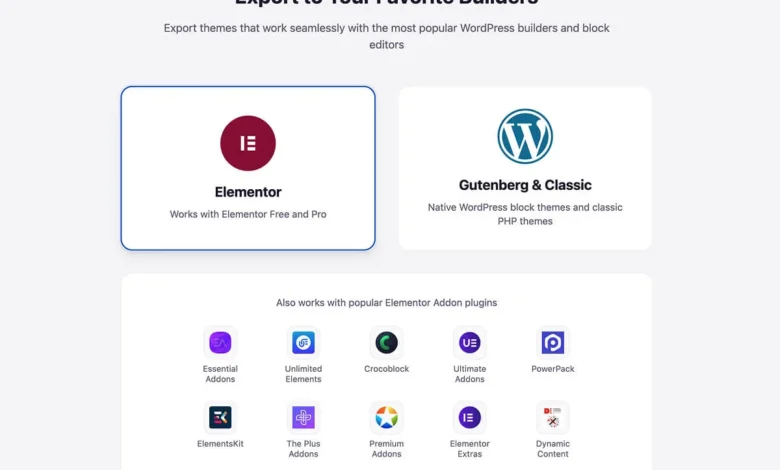
One of PressMeGPT’s key strengths is its ability to integrate seamlessly with existing WordPress development workflows rather than seeking to replace established tools. While it can be used for initial page or post generation, its primary function is to sit "upstream" of preferred page builders. It handles the crucial initial theme generation, then hands off the output to Elementor or the block editor (Gutenberg) for detailed customization. This approach ensures that teams and individuals already proficient with specific builders can continue leveraging their expertise.
The tool’s compatibility extends to popular page builder add-ons, including Essential Addons, Unlimited Elements, and Kadence Blocks, ensuring that the generated templates remain flexible and extensible. For teams standardized on Elementor, the ability to export directly as an Elementor template is a significant advantage, allowing the generated work to slot straight into a familiar and efficient workflow. Furthermore, these Elementor templates are designed to work with the free version of Elementor, eliminating the need for a Pro license to utilize the output. It is important to note, however, that Elementor export functionality is available from the Freelance plan upwards, with the entry-level Creator plan focusing on Gutenberg and classic theme exports.

Crucially, PressMeGPT champions the principle of ownership. Unlike many hosted AI builders or proprietary platforms, PressMeGPT delivers a genuine, downloadable WordPress theme or Elementor template. Users own the generated files outright, granting them complete freedom to install these themes on an unlimited number of sites, switch hosting providers at any time, and retain full control over their digital assets. This applies equally whether the project is for a personal site or a client’s extensive web presence, safeguarding against vendor lock-in and ensuring long-term flexibility and security.
A Deeper Dive into the Conversion Process: Modern Standards and Security
The practical workflow within PressMeGPT is structured around three logical steps designed for efficiency and clarity:
- Input: Users provide their source material – a URL, HTML/CSS/JS code, or a plain text prompt describing the desired site.
- AI Generation: PressMeGPT’s AI engine processes the input, creating three distinct design variations. This rapid prototyping phase allows for quick evaluation and selection.
- Refine & Download: Once a preferred variation is chosen, users can make further modifications within PressMeGPT (if desired) before downloading the output as a native WordPress theme or Elementor template.
A particularly noteworthy detail in PressMeGPT’s output is its commitment to generating proper block themes. These themes are designed to be fully compatible with WordPress’s native Full Site Editor (FSE), featuring real header and footer template parts that are entirely editable within the FSE interface. This is a critical distinction from many AI tools that merely generate isolated blocks or sections, leaving users to manually construct the overarching site structure. PressMeGPT’s approach ensures a cohesive and fully integrated theme experience from the outset.
The platform’s FAQ further reinforces its adherence to modern block theme standards, promising themes that run efficiently without requiring any additional plugins or ongoing subscriptions to function. This commitment has profound implications for site performance, security, and maintainability. Themes that operate independently of numerous third-party plugins inherently benefit from faster loading times, reduced potential for conflicts, and a cleaner security posture, given that third-party plugins are frequently identified as common vectors for security vulnerabilities. This focus on lean, standard-compliant output positions PressMeGPT themes as a more robust and future-proof solution for WordPress users.
Strategic Advantages for Key Stakeholders: Agencies, Freelancers, and Bloggers
PressMeGPT’s value proposition resonates strongly across various segments of the web development and content creation landscape.

For agencies, the potential for compounded time savings is immense. If the generated draft truly accounts for 80% of a typical website build, these saved hours can be multiplied across an agency’s entire client roster, significantly boosting efficiency and profitability. The ability to export Elementor templates means that even junior team members can handle the refinement phase, reducing the need for senior developers to engage in foundational layout work. This allows agencies to scale their operations more effectively, take on more projects, and deliver results faster, thereby enhancing client satisfaction and competitive advantage.
Freelancers stand to benefit for similar reasons. In a competitive market, time is a freelancer’s most precious commodity. Clients typically hire freelancers for their specialized skills in custom functionality, unique design elements, or strategic insights, not to meticulously recreate a header layout for the twentieth time. By automating the initial design and structural setup, PressMeGPT frees up freelancers to focus on the high-value, bespoke aspects of a project that truly differentiate their services and command higher fees. This tool aligns perfectly with the growing suite of AI tools for WordPress development that are already streamlining and enhancing the freelance workflow.
Even for bloggers and content creators, PressMeGPT offers a compelling advantage. The platform democratizes access to sophisticated web design by allowing non-technical users to describe their ideal site and receive a functional, editable WordPress theme without needing to learn complex theme development or incur the significant costs associated with custom builds. This empowers content creators to launch professional-looking websites quickly, focusing their energy on content generation rather than technical site setup, thereby accelerating their online presence and reach.
The 80% Problem: Acknowledging Limitations and Future Horizons
While PressMeGPT offers transformative efficiency, it is crucial to approach its claims with realistic expectations. The platform’s assertion of delivering approximately 80% of a finished design in minutes is a significant time-saver, but it inherently means that the remaining 20% remains the responsibility of the human user. This final 20% typically encompasses the critical elements of polish, fine-tuning, brand integration, accessibility considerations, and the unique details that imbue a website with its distinct identity and character. Users should set the expectation that while the heavy lifting of initial structure and basic design is automated, the artistic refinement and strategic customization will still require human input and expertise.
Currently, the platform does not feature a built-in review mechanism for critical aspects such as accessibility guidelines or Core Web Vitals performance. While a "Theme Checker" feature is reportedly on the roadmap for higher plans, until its release, users are advised to manually audit the first few generated themes for compliance with these essential standards before deploying them on a live production site. This ensures that the benefits of speed do not come at the expense of user experience or search engine performance.
A practical consideration highlighted in PressMeGPT’s knowledge base pertains to media handling. By default, exported themes reference images and videos via their remote source paths. Localizing this media directly into the WordPress media library is a separate step that consumes credits and is typically excluded from the free plan. While this is a manageable aspect of the workflow, it is an important detail for users to be aware of to avoid unexpected credit usage or additional steps during their first projects. The upcoming integrations with Canva and Figma, as well as the Theme Checker, signify a clear roadmap towards an even more comprehensive and user-friendly solution.

PressMeGPT Pricing, Credits, and Unwavering Theme Ownership
As is common with contemporary AI-powered tools, PressMeGPT operates on a credit-based system. Generating a new theme costs 3 credits and yields three distinct design variations. Each subsequent AI modification to a theme typically costs at least 1 credit, while converting an existing website via URL or code ranges from 2 to 3 credits, depending on complexity. PressMeGPT estimates that a fully customized theme, from initial generation through several rounds of modification, typically utilizes between 7 to 10 credits in total.
For those keen to explore the platform, a free plan is available, offering 5 credits per month. This allows users to generate a test theme and experience the core functionality. However, the free plan comes with certain limitations: themes generated are public, media migration is excluded, and exports are restricted to classic WordPress themes.
Paid plans offer more extensive features and credit allocations, billed annually with options for monthly and one-time billing, all backed by a 30-day money-back guarantee.
- Creator Plan: Starting at $69 per year, this plan provides 120 credits annually, sufficient for approximately one completed site per month.
- Freelance Plan: This tier introduces Elementor template export capabilities, catering to professional users.
- Agency Plan: At $399 per year, agencies receive a substantial 1,800 credits annually, enabling the development of around 15 sites per month, catering to high-volume client work.
A crucial aspect of PressMeGPT’s offering, and a significant differentiator, is its unwavering commitment to theme ownership. Once a theme or template is exported, it belongs entirely to the user. There are no ongoing per-site fees, no mandatory subscriptions to PressMeGPT for the theme to function, and no required plugins that tie the theme to the platform. This model ensures that the generated assets are truly future-proof, providing users with complete autonomy, flexibility, and control over their digital properties for the long term.
Market Impact and Future Outlook: A New Paradigm for Web Development
PressMeGPT stands poised to significantly impact the web development landscape, particularly for the WordPress ecosystem. By providing an efficient, clean pathway from diverse design sources – including the burgeoning realm of AI-generated aesthetics – to a robust and manageable CMS, it addresses a genuine and long-standing pain point. This innovation has the potential to democratize sophisticated web design, making it more accessible to a broader audience while simultaneously boosting the productivity of professional developers and agencies.

The tool’s ability to reduce the manual effort involved in initial site construction frees up valuable human resources to focus on higher-level strategic elements, custom functionalities, and the crucial human-centric aspects of design. This shift could lead to more innovative and highly customized websites, as developers are less bogged down by repetitive tasks. As AI continues to evolve, tools like PressMeGPT represent the next frontier, moving beyond mere content generation to sophisticated conversion and integration, thereby enhancing the utility of existing platforms.
For anyone grappling with the challenge of migrating a site from an AI builder or a proprietary platform to WordPress, or for agencies and freelancers seeking to optimize their workflow and increase client throughput, PressMeGPT warrants serious consideration. The availability of a free plan with monthly credits provides an ideal opportunity to test its capabilities on a real-world project. By experimenting with its conversion process and evaluating the output firsthand, the web development community can collectively assess its real-world performance and contribute to the ongoing evolution of AI-assisted design and development. The results of such trials will undoubtedly shape the future trajectory of this promising technology.