Bridging the Automation Gap: How Agentic AI and APIs Are Transforming WordPress Infrastructure Management


The integration of artificial intelligence into software engineering and web development has accelerated past the era of simple code generation and into the realm of autonomous execution. When software architects and developers task an AI agent with provisioning or managing a WordPress website, the success of that operation depends entirely on the underlying software interfaces provided by the hosting environment. While browser automation tools attempt to mimic human interaction through visual user interfaces, the structural backbone of reliable AI-driven infrastructure management relies on Application Programming Interfaces (APIs). As organizations increasingly adopt agentic workflows to streamline operations, the availability, design, and security of these APIs have become critical determinants of enterprise efficiency.
Industry data highlights the rapid shift toward AI-assisted development cycles. According to Postman’s State of the API report, nearly 90 percent of developers now incorporate generative artificial intelligence into their day-to-day workflows. However, the same research indicates that only a quarter of these developers intentionally design their APIs for agentic consumption. This structural mismatch highlights a growing friction point in modern web architecture: while artificial intelligence tools are ready to automate complex, repeatable tasks, the infrastructure they attempt to interact with is frequently tailored exclusively for human eyes.
Understanding the Limitations of Visual Dashboards in Autonomous Workflows
The internet has historically functioned as a visual medium designed for human cognition. Dashboards, control panels, and administrative interfaces rely on human visual perception, spatial reasoning, and intuitive clicks to navigate complex settings. AI agents, conversely, lack visual comprehension capabilities. They cannot naturally interpret a layout of buttons, drop-down menus, and forms on a screen.
To circumvent this limitation, developers have historically turned to browser automation frameworks such as Playwright and Puppeteer. These tools parse the Document Object Model (DOM) of a web page, allowing scripts to programmatically locate HTML elements like links, forms, and buttons to simulate human interaction. Nevertheless, this approach introduces significant fragility. Whenever a hosting provider updates its dashboard layout, modifies a CSS selector, or shifts an input field, the underlying script breaks.

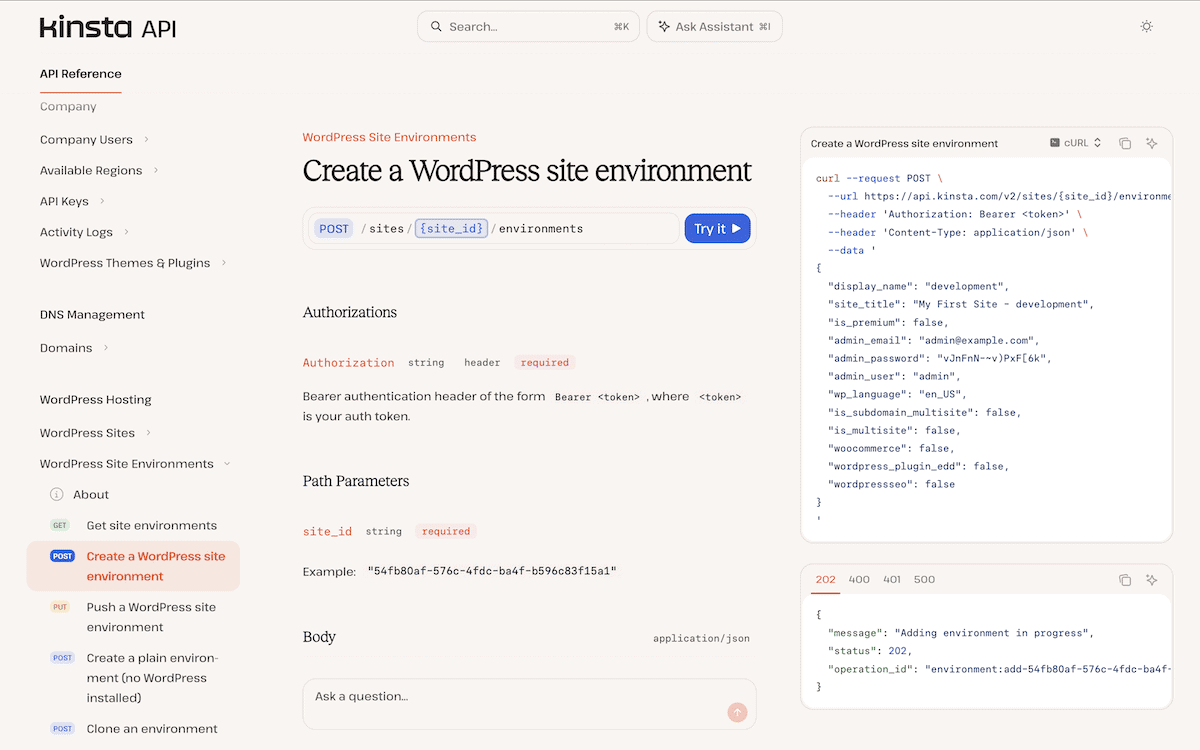
APIs bypass this vulnerability entirely. A standard HTTP request—such as a POST request to provision a new site or a GET request to fetch analytics—remains functionally identical regardless of any visual modifications made to a control panel. Consequently, programmable infrastructure removes the volatility associated with user interface changes, offering a stable foundation for autonomous agents.
The Evolution of API Interactions and Security Concerns
Integrating with a well-documented API presents fundamentally different challenges depending on whether the task is executed by a human engineer or an autonomous agent. Human developers possess the contextual intelligence to navigate ambiguous documentation, resolve missing parameters through trial and error, or troubleshoot unexpected runtime exceptions. AI agents, however, ingest machine-readable data literally. Undocumented schema changes, inconsistent endpoints, or ambiguous error messages can cause an agentic workflow to fail unpredictably.
This reliance on deterministic inputs elevates the importance of robust API security and reliability. As agentic systems gain the autonomy to execute sensitive administrative actions, unauthorized access becomes a prominent threat vector. The Open Worldwide Application Security Project (OWASP) emphasizes this risk in its GenAI LLM Top 10 report, classifying excessive agency as a primary security concern for large language models. Furthermore, enterprise security research from Salt Labs reveals that 95 percent of API attacks originate from authenticated sources, illustrating that modern API reliability encompasses stringent access controls, robust authentication protocols, and precise rate-limiting just as much as basic server uptime.
Programmable Infrastructure: The Kinsta API Architecture
To meet the demands of modern automated workflows, hosting providers are increasingly exposing their full infrastructure through programmatic interfaces. A prominent example in the WordPress ecosystem is the Kinsta API, which mirrors the platform’s core architecture. Rather than restricting administrative controls to the MyKinsta visual dashboard, the API exposes nearly every operational layer, including WordPress site creation, environment management, database access, backup generation, and caching controls. Similarly, Kinsta’s Sevalla platform provides comprehensive programmatic access for static site hosting.
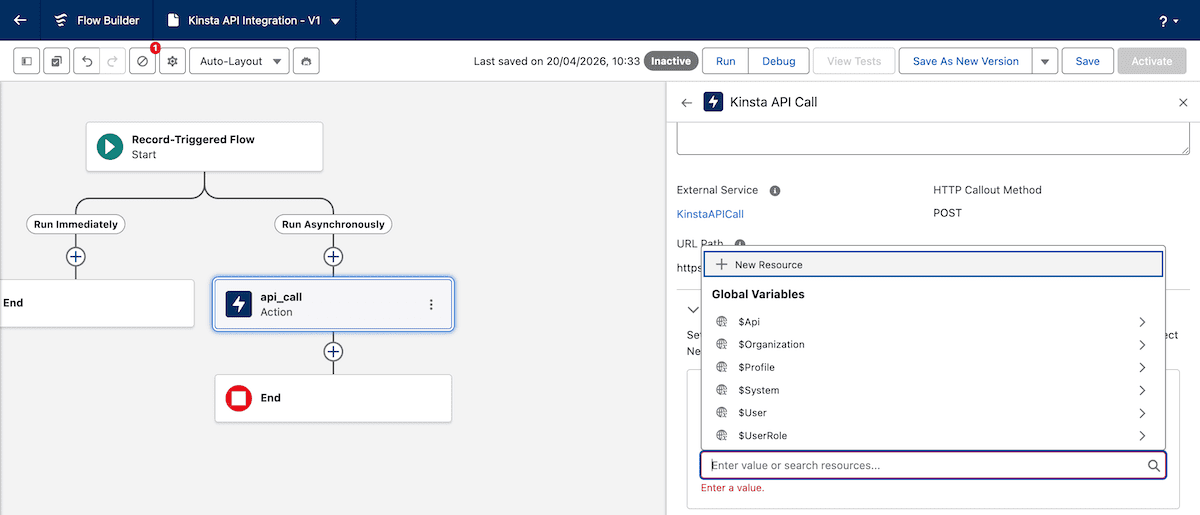
Enterprises and digital agencies are leveraging these endpoints to eliminate operational bottlenecks. For instance, digital agencies frequently integrate the Kinsta API with Customer Relationship Management (CRM) platforms like HubSpot or Salesforce. When a sales pipeline registers a signed client contract, a connected workflow can automatically trigger the provisioning of a fresh WordPress environment, configure staging parameters, and deploy initial assets without manual developer intervention.
Advanced monitoring and maintenance workflows similarly benefit from API connectivity. Rather than requiring system administrators to manually check performance dashboards, engineering teams can programmatically poll endpoints such as /wp-plugins to audit version numbers across hundreds of client accounts simultaneously. Additionally, querying the GET /sites/environments/env_id/analytics/response-codes endpoint allows automated scripts to track HTTP 500 errors over specific time windows. If error rates cross a predefined threshold, the system can autonomously open an internal support ticket or dispatch an alert to a designated Slack channel via webhooks before human intervention becomes necessary.
Standardization Through the Model Context Protocol (MCP)
As the developer ecosystem moves toward standardized AI interoperability, the Model Context Protocol (MCP) has emerged as the premier framework for connecting AI models to external data sources and tools. Major platforms have begun adopting this standard; for example, WordPress.com provides a native MCP server, while various community-driven implementations act as secure wrappers for infrastructure APIs.
Open-source contributions, such as Jacob Hartmann’s Kinsta MCP server, demonstrate how standardized protocols can abstract complex API calls into intuitive natural language commands for AI assistants. These integrations encompass dozens of tools handling authentication, site creation, PHP resource allocation, plugin management, and server-level caching. By leveraging MCP servers that interface directly with robust APIs, engineering teams can execute intricate multi-step administrative tasks through conversational AI interfaces while maintaining strict backend security.
Evaluating Infrastructure Providers for AI-Driven Workflows
As organizations transition toward agentic development and automated infrastructure management, selecting a hosting partner requires careful technical evaluation. Software architects must assess prospective providers against several core criteria to ensure compatibility with modern AI workflows:
- API Coverage: Does the API expose comprehensive site management capabilities, or is it limited to basic account administration?
- Documentation Quality: Are the API endpoints thoroughly documented with clear, machine-readable schemas suitable for AI ingestion?
- Security and Access Controls: Does the platform support granular token management, secure authentication, and robust rate-limiting to mitigate risks associated with autonomous agent execution?
- Supplementary Standards: Do the documentation resources include machine-friendly formats, such as
llms.txtfiles, to facilitate seamless context retrieval by large language models?
The Future of Programmable Web Operations
Dashboards will undoubtedly remain a cornerstone of software administration, as human judgment is indispensable for high-level decision-making, visual quality assurance, and client communication. However, routine, repeatable tasks are increasingly migrating toward autonomous execution through APIs.
As agentic technology matures, organizations that adopt a programmable infrastructure model—exposing comprehensive, secure, and well-documented APIs—will achieve unprecedented operational scalability. Platforms that integrate deep API access with modern security frameworks and standardized protocols like the Model Context Protocol are well-positioned to lead the next generation of web development and site management.
Related posts: